Shop
-
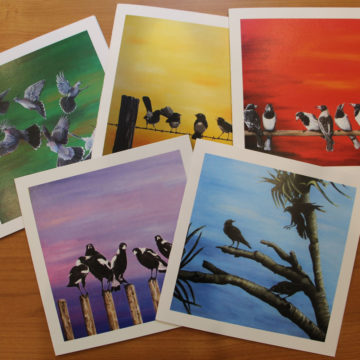
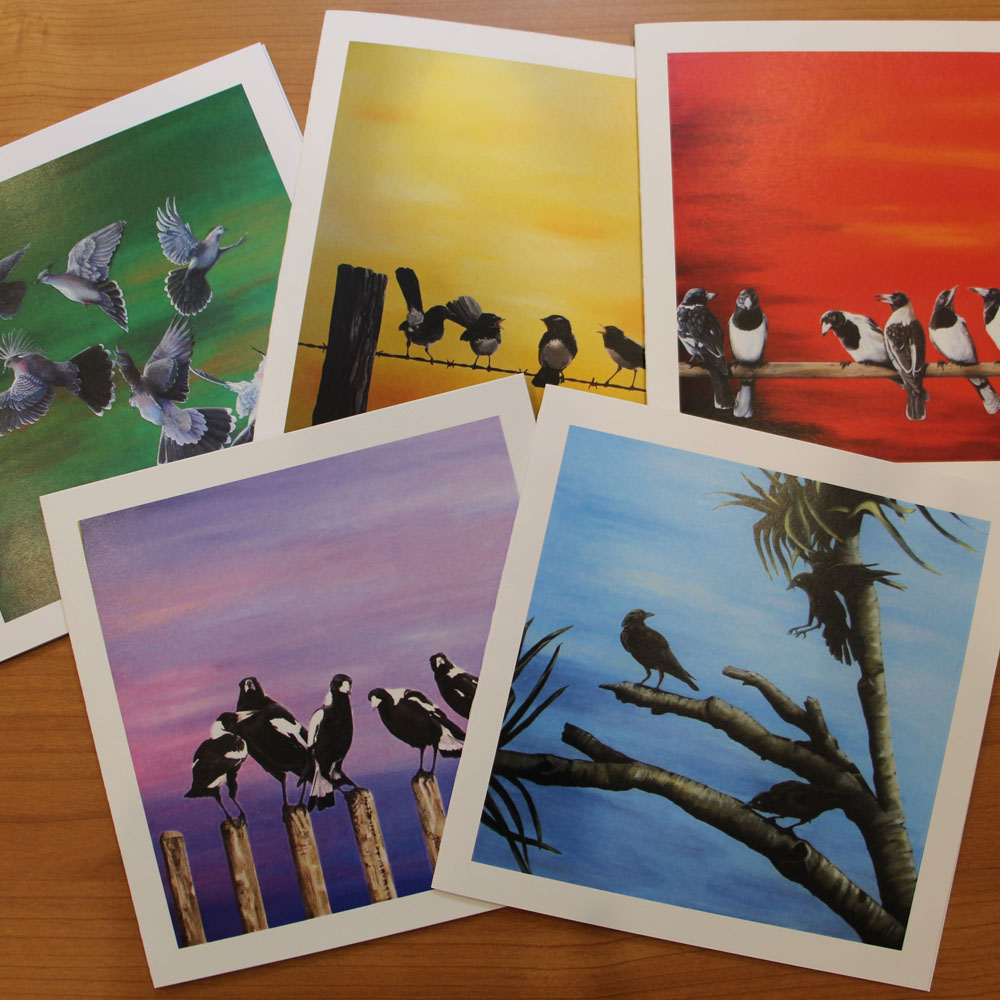
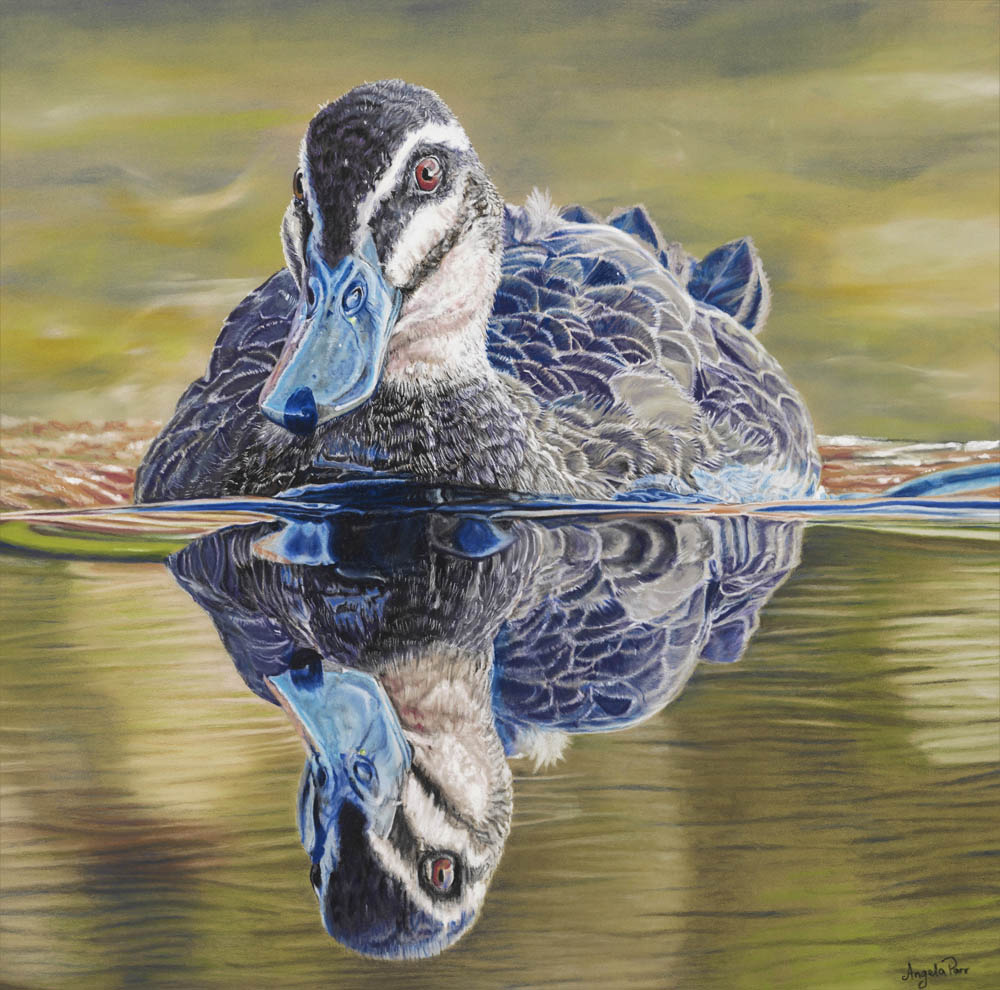
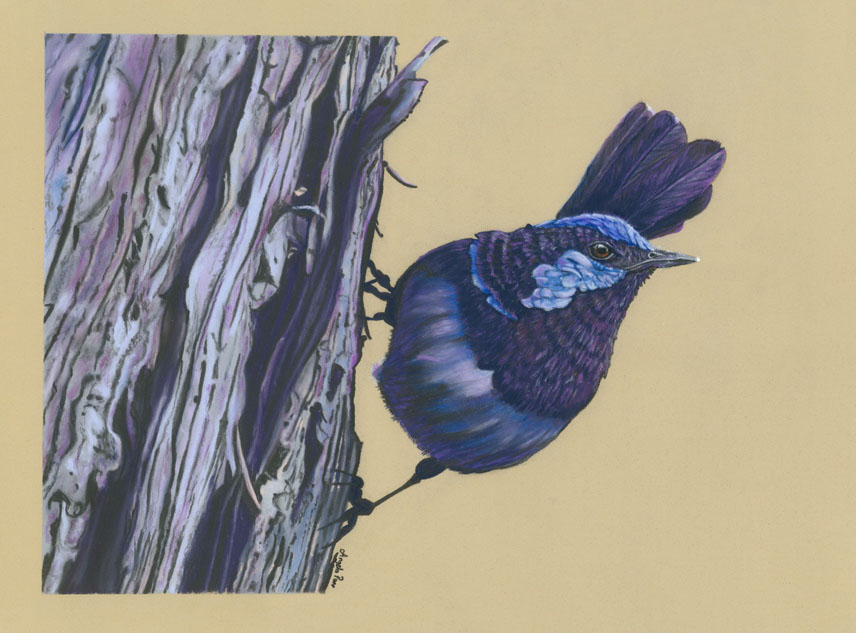
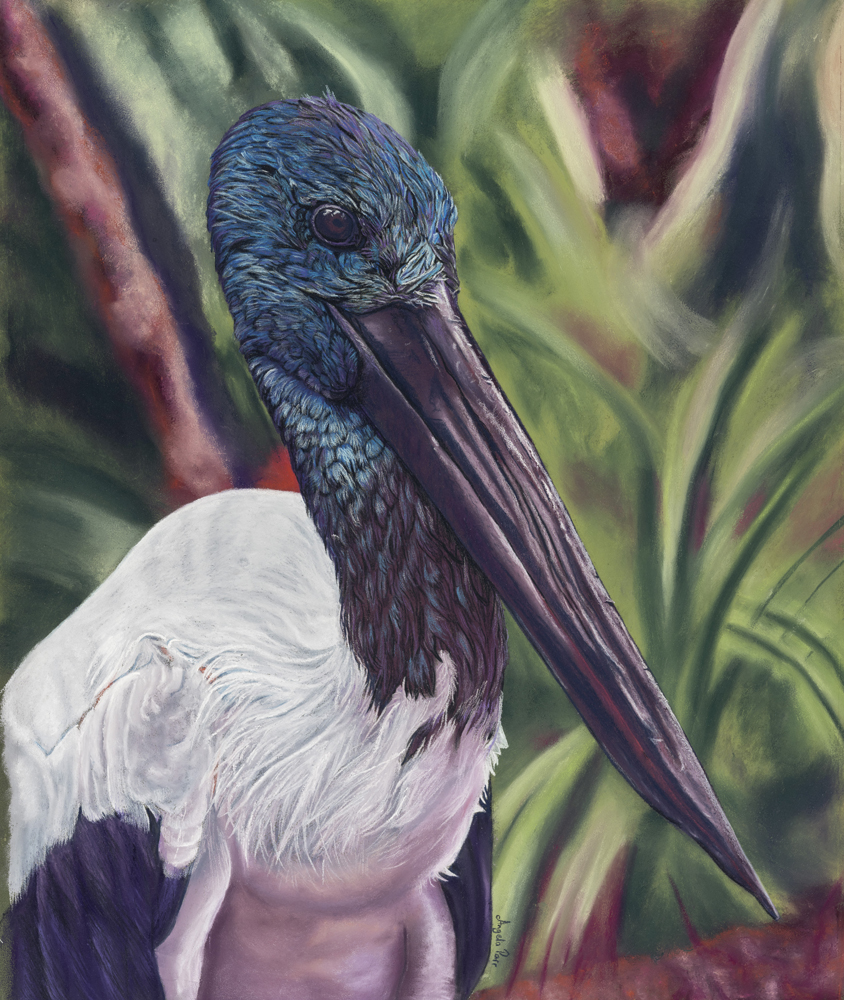
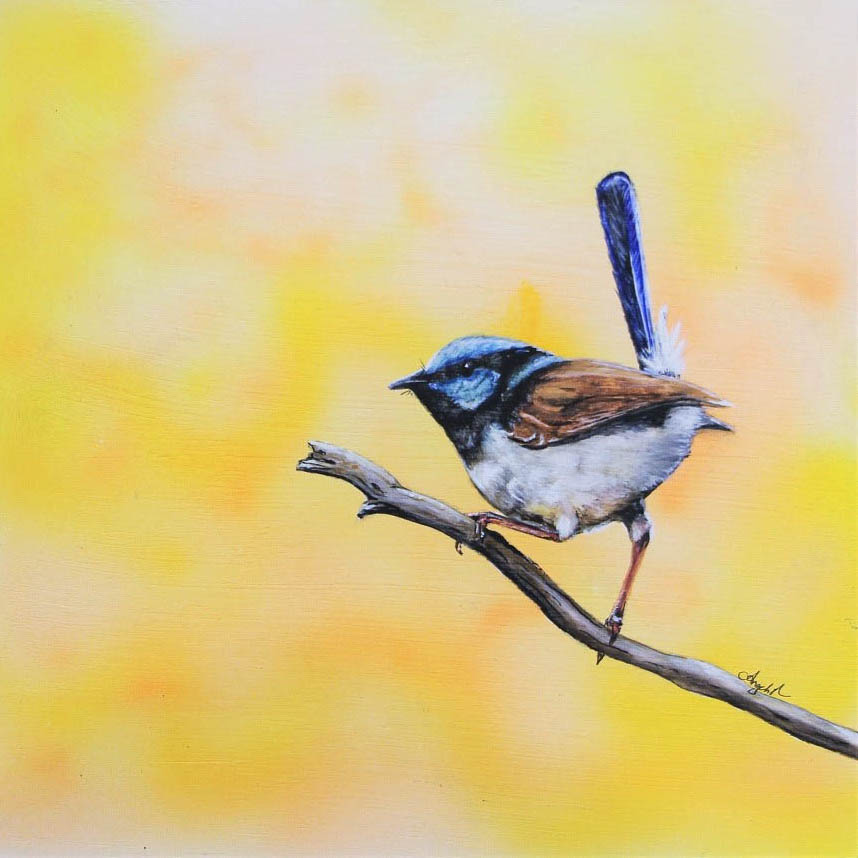
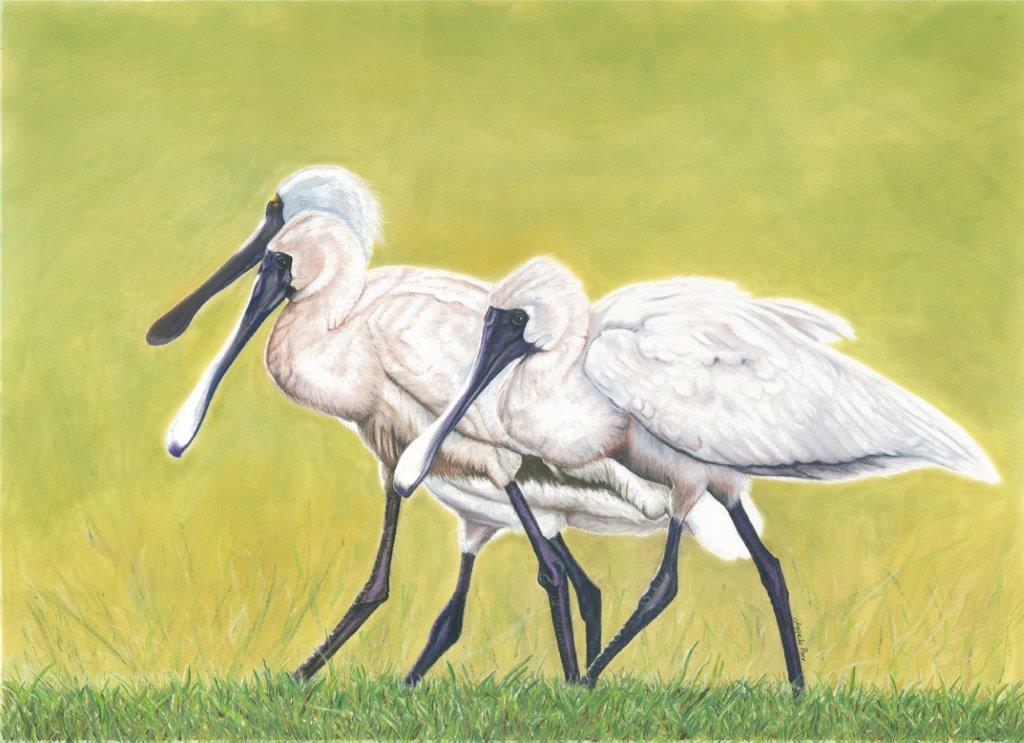
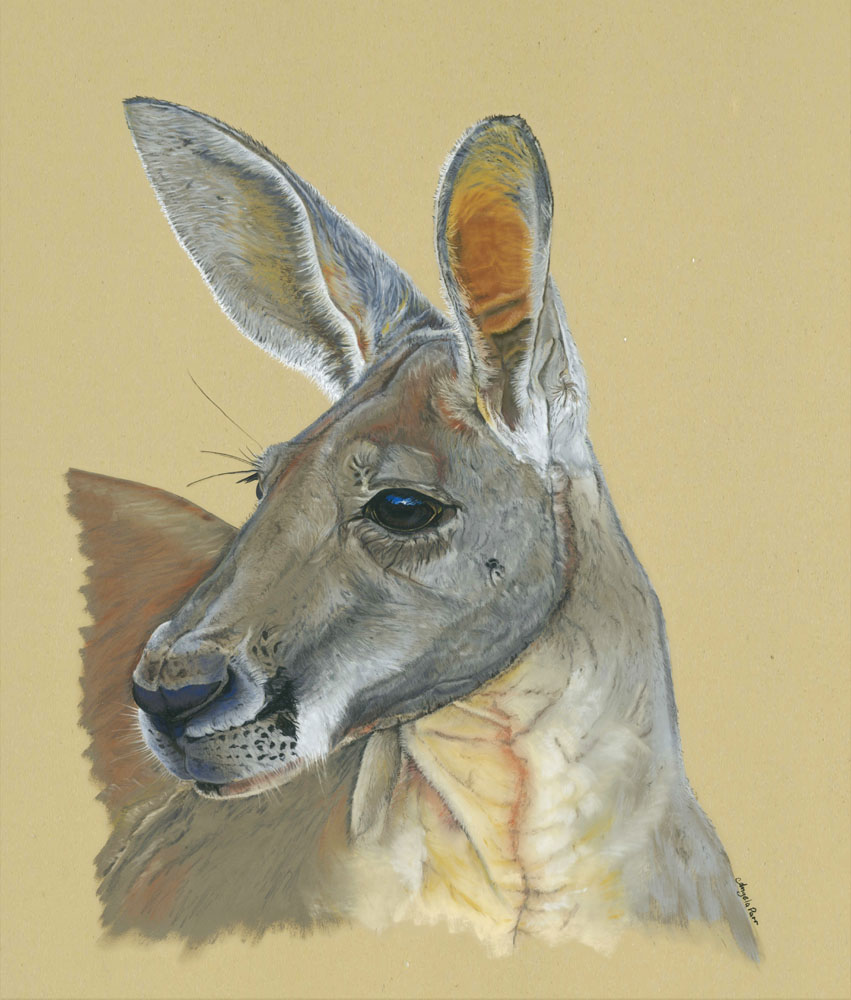
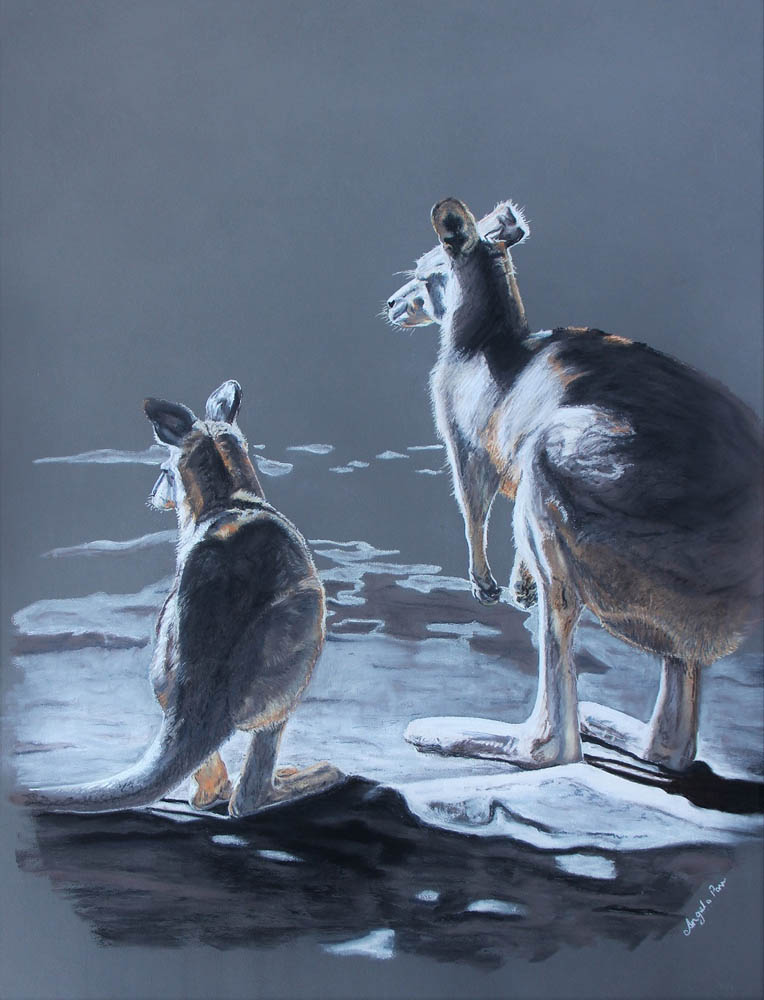
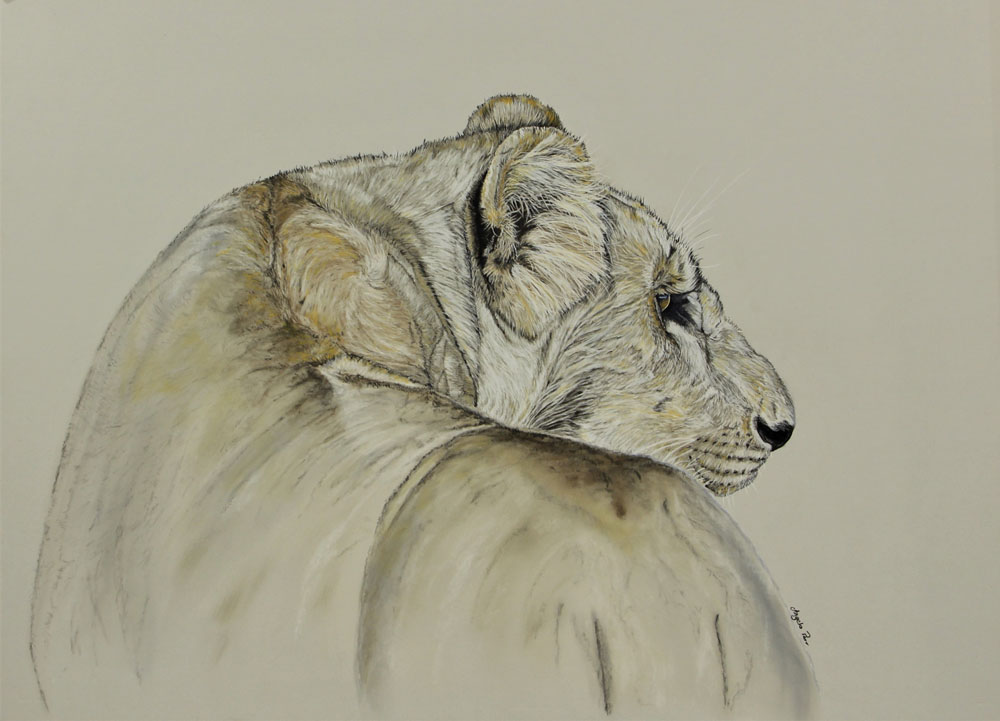
Australian Bird 5 Square Art Cards
$25.0014.5 cm x 14.5 cm
5 cards, 5 designs
*All come with envelopes and a plastic sleeve coverAdd to cart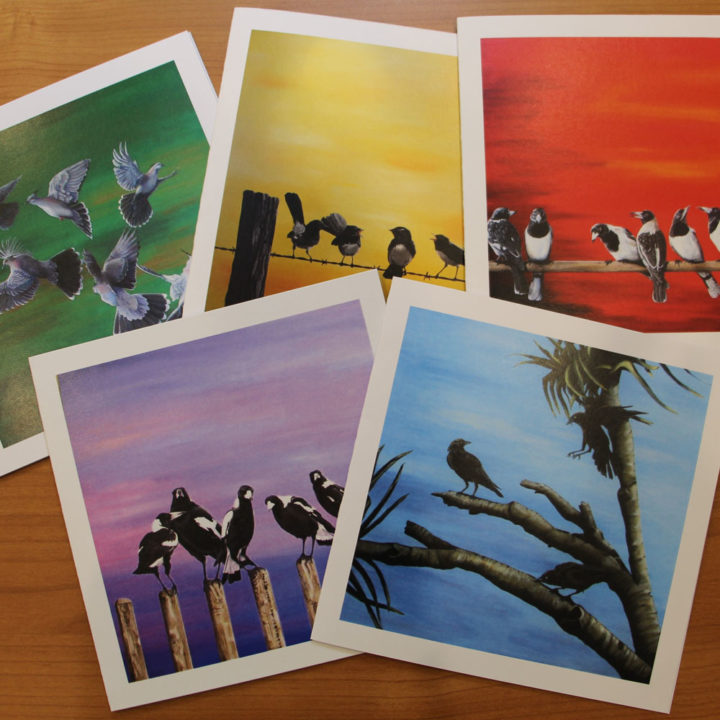
Australian Bird 5 Square Art Cards
$25.0014.5 cm x 14.5 cm
5 cards, 5 designs
*All come with envelopes and a plastic sleeve coverQuick View -
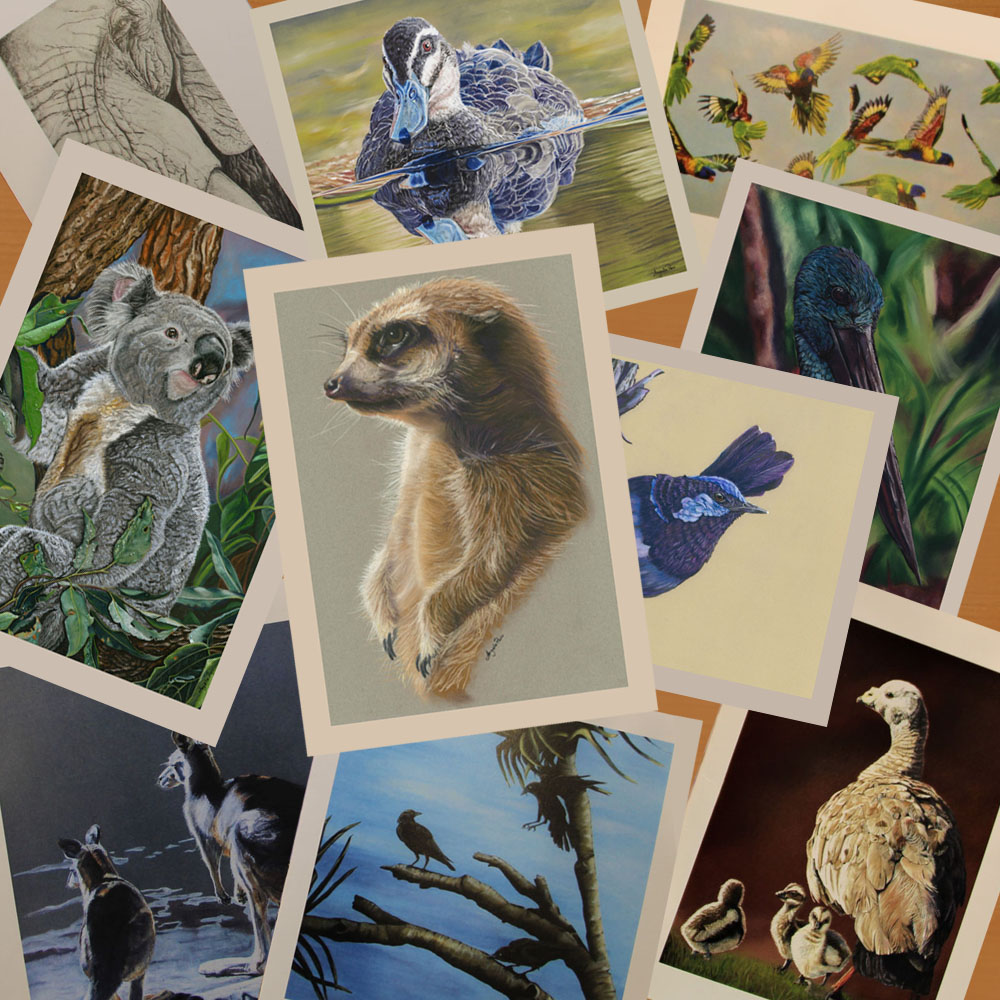
Random Mix 10 Cards
$50.0010 cards, 10 designs
*All come with envelopes and a plastic sleeve cover
Add to cart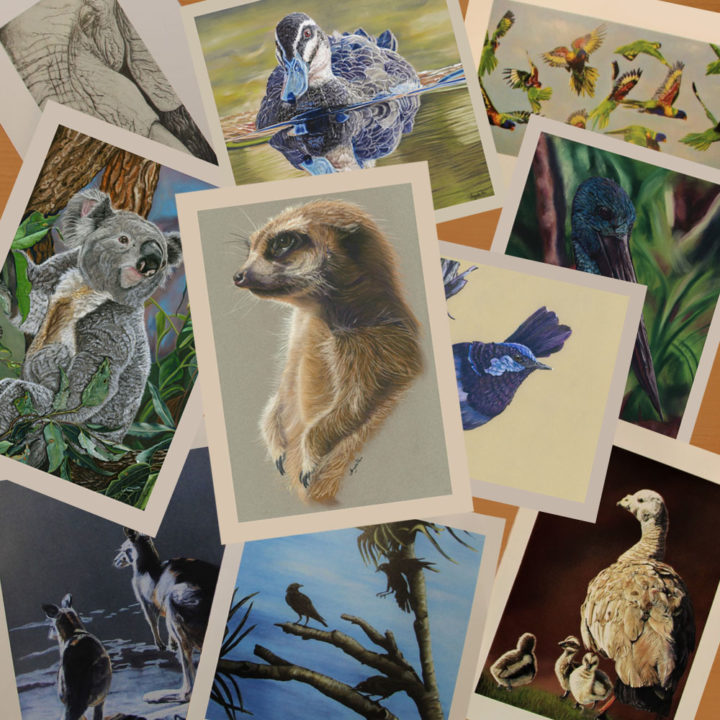
Random Mix 10 Cards
$50.0010 cards, 10 designs
*All come with envelopes and a plastic sleeve cover
Quick View -
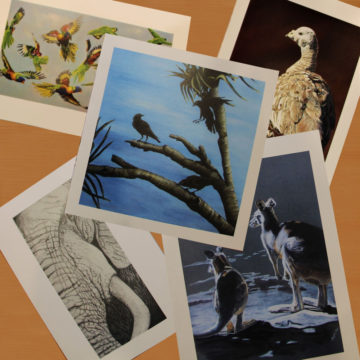
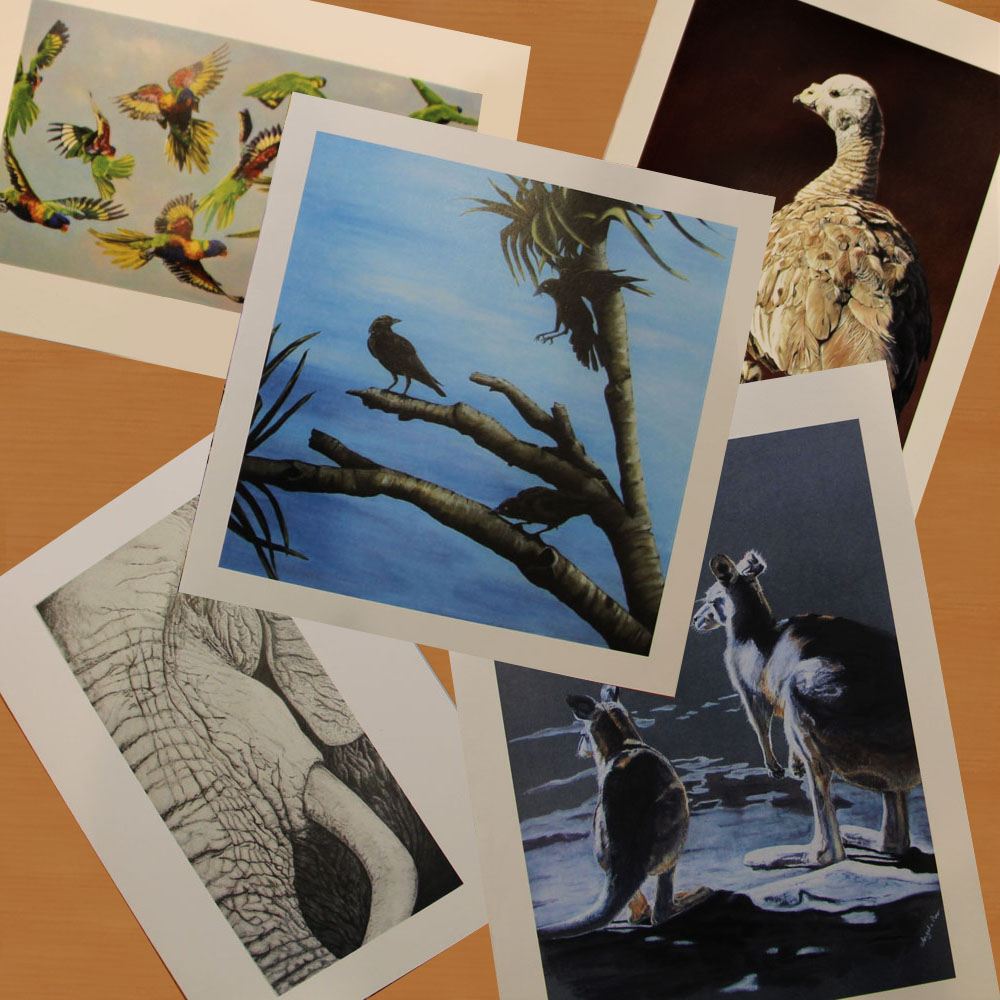
Random Mix 5 Cards
$25.005 cards, 5 designs
*All come with envelopes and a plastic sleeve cover
Add to cart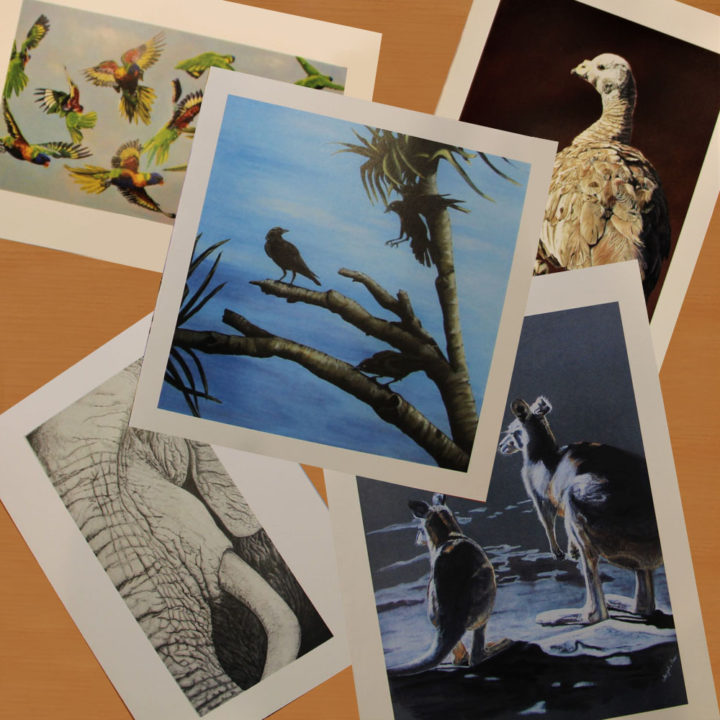
Random Mix 5 Cards
$25.005 cards, 5 designs
*All come with envelopes and a plastic sleeve cover
Quick View -
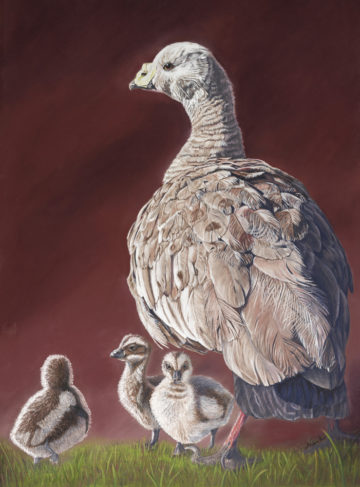
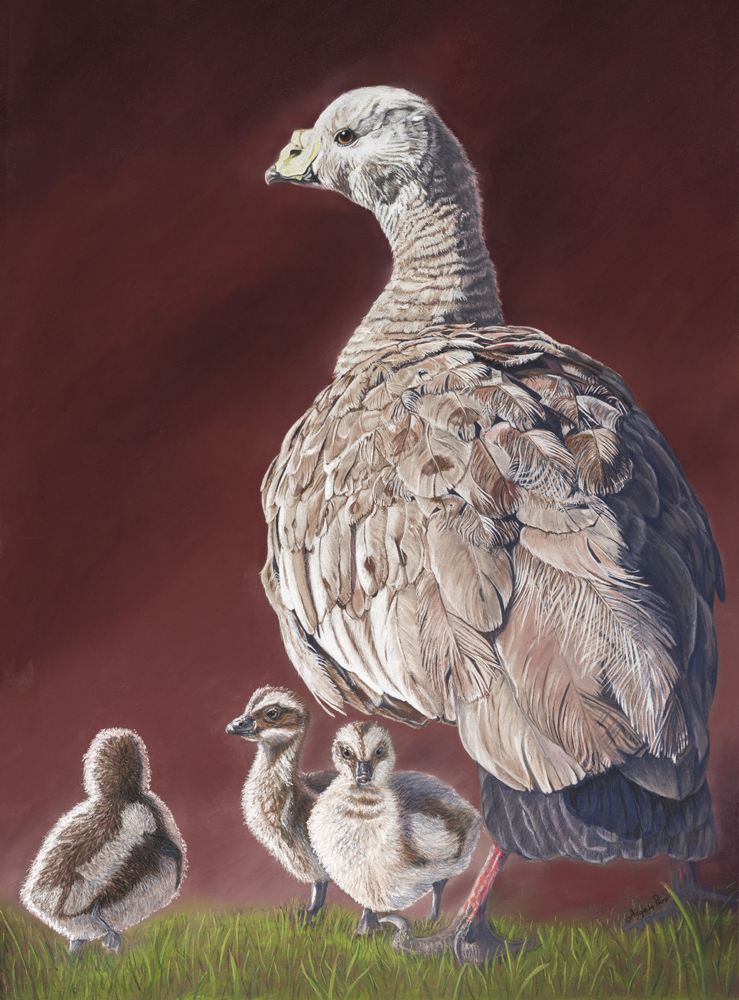
Protecting Her Young
Pastel on Pastelmat (Sold)
51 cm W x 71 cm H
An early morning drive on Kangaroo Island revealed Cape Barron Geese (Cereopsis novaehollandiae) grazing in the grassy clearing. A month later half of the island was burning, and I was concerned for this little flock. Cape Barron Geese were almost hunted to extinction in the 1900’s but numbers eventually restored to 20,000 on Australia’s southern islands. They are monogamous, bonding for life, and aggressively defend their clutches of 4-5 eggs. They are one of the world’s rarest geese. In my artwork I highlight their beautiful plumage, the adult’s defensive position over the vulnerable chicks, and hint at the imminent danger of fire.Read more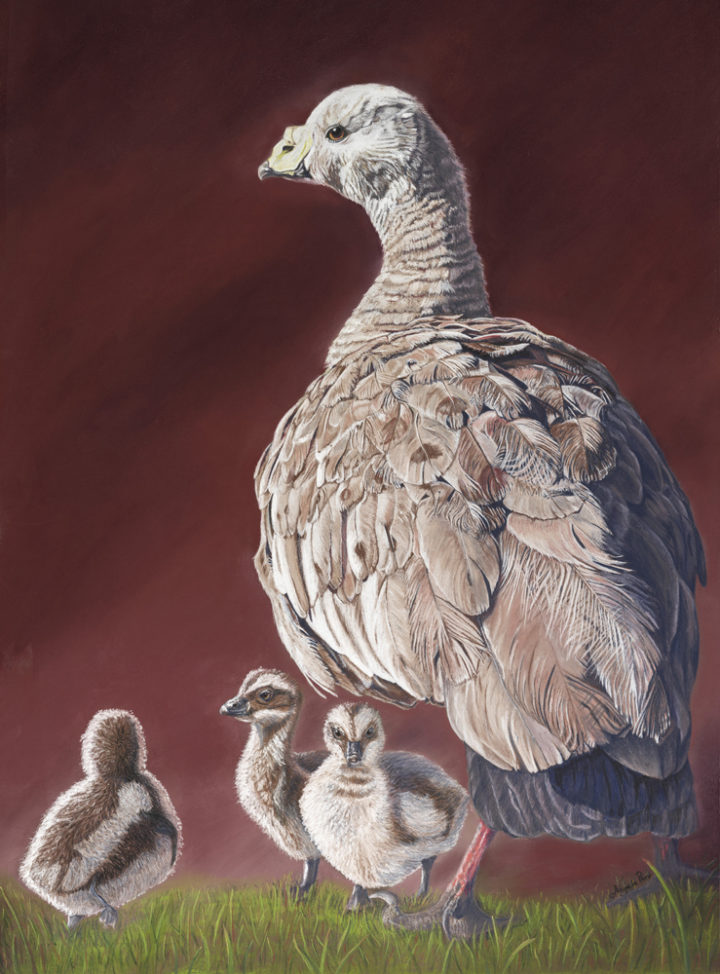
Protecting Her Young
Pastel on Pastelmat (Sold)
51 cm W x 71 cm H
An early morning drive on Kangaroo Island revealed Cape Barron Geese (Cereopsis novaehollandiae) grazing in the grassy clearing. A month later half of the island was burning, and I was concerned for this little flock. Cape Barron Geese were almost hunted to extinction in the 1900’s but numbers eventually restored to 20,000 on Australia’s southern islands. They are monogamous, bonding for life, and aggressively defend their clutches of 4-5 eggs. They are one of the world’s rarest geese. In my artwork I highlight their beautiful plumage, the adult’s defensive position over the vulnerable chicks, and hint at the imminent danger of fire.Quick View -
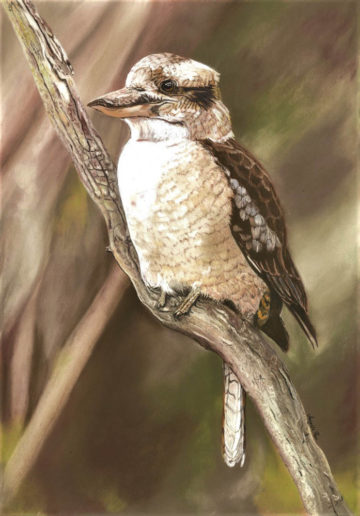
A Keen Eye
Pastel on Pastelmat (Sold)
51 cm W x 67 cm H
The Laughing Kookaburra (Dacelo novaeguineae) is arguably the best-known and most loved bird of Australia with its highly distinctive raucous “laugh”. The loud ‘koo-koo-koo-koo-koo-kaa-kaa-kaa’ is however not really the kookaburra laughing but actually a territorial call to warn other birds to stay away. Laughing Kookaburras feed mostly on insects, worms and crustaceans, although small snakes, mammals, frogs and birds may also be eaten. Prey is espied and then seized by pouncing from a suitable perch, as shown in my artwork. Small prey is eaten whole, but larger prey is killed by bashing it against the ground or tree branch.Read more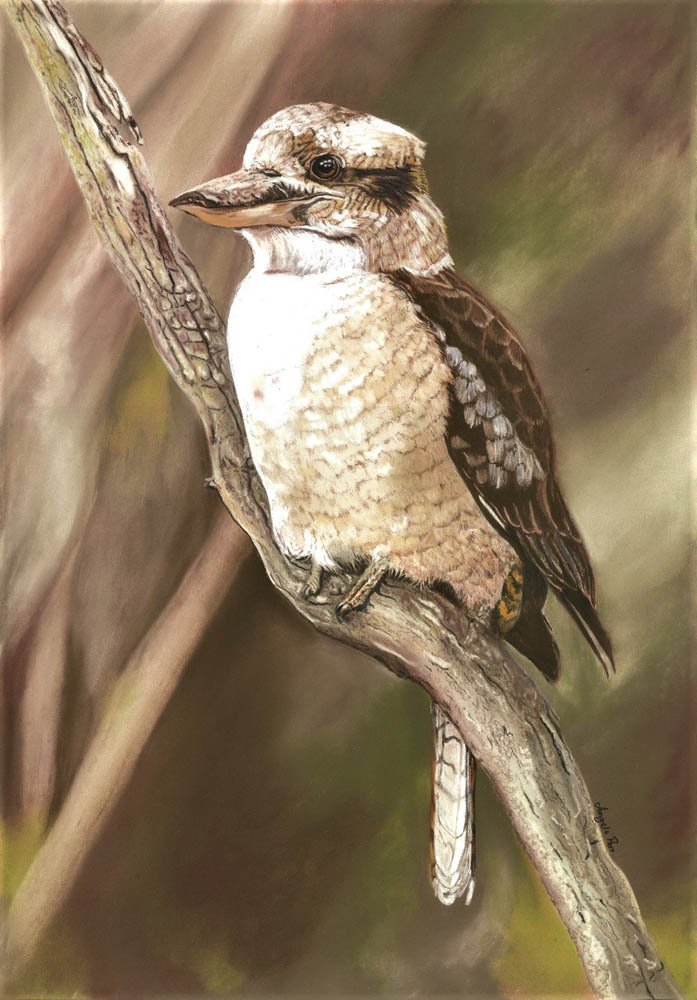
A Keen Eye
Pastel on Pastelmat (Sold)
51 cm W x 67 cm H
The Laughing Kookaburra (Dacelo novaeguineae) is arguably the best-known and most loved bird of Australia with its highly distinctive raucous “laugh”. The loud ‘koo-koo-koo-koo-koo-kaa-kaa-kaa’ is however not really the kookaburra laughing but actually a territorial call to warn other birds to stay away. Laughing Kookaburras feed mostly on insects, worms and crustaceans, although small snakes, mammals, frogs and birds may also be eaten. Prey is espied and then seized by pouncing from a suitable perch, as shown in my artwork. Small prey is eaten whole, but larger prey is killed by bashing it against the ground or tree branch.Quick View -
The Bow Wave
Pastel on Pastelmat (Sold)
45 cm W x 45 cm H
Sunset on Lake Ainsworth at Lennox Head, and this Pacific Black Duck (Anas superciliosa) was hunting a final meal for the day. Their diet is mainly vegetarian, supplemented by small molluscs, crustaceans, and insects, not bread, which well-meaning but misinformed people often feed them. Due to their “commonness” ducks are often overlooked as subjects to paint, although they have obvious beauty. They are at risk from habitat loss and despite the strong evidence of the extreme suffering involved, four Australian states still allow recreational duck hunting. My artwork aims to draw attention to these ducks, becoming a conversation starter for their protection.Read more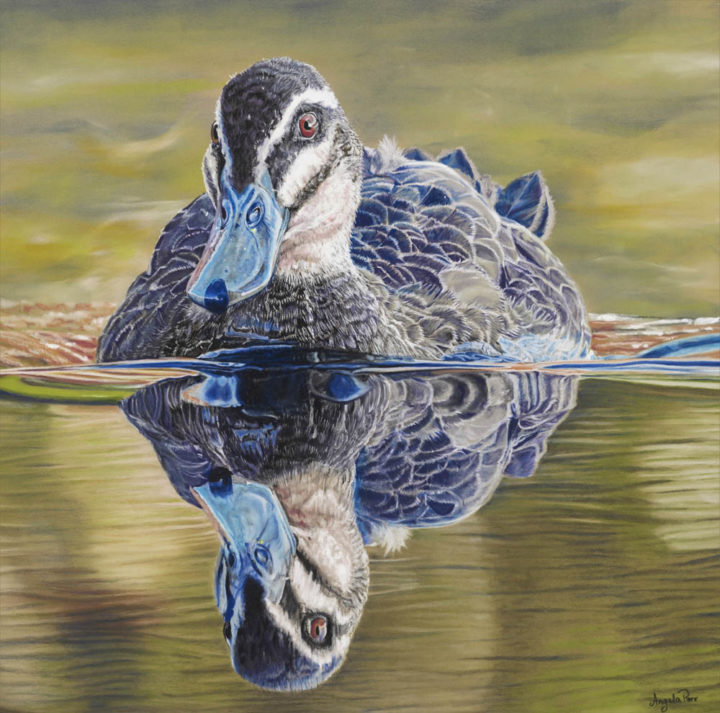
The Bow Wave
Pastel on Pastelmat (Sold)
45 cm W x 45 cm H
Sunset on Lake Ainsworth at Lennox Head, and this Pacific Black Duck (Anas superciliosa) was hunting a final meal for the day. Their diet is mainly vegetarian, supplemented by small molluscs, crustaceans, and insects, not bread, which well-meaning but misinformed people often feed them. Due to their “commonness” ducks are often overlooked as subjects to paint, although they have obvious beauty. They are at risk from habitat loss and despite the strong evidence of the extreme suffering involved, four Australian states still allow recreational duck hunting. My artwork aims to draw attention to these ducks, becoming a conversation starter for their protection.Quick View -
A Split Second
Pastel on Pastelmat Board (Sold)
48 cm W x 38 cm H
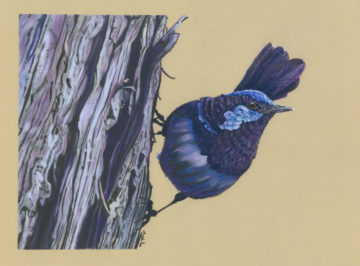
Adult male Superb Fairy-wrens (Malurus cyaneus) are among the most brightly coloured of the species, especially during the breeding season. These ‘coloured’ males are often accompanied by a band of brown ‘jenny wrens’, assumed to be a harem of females, but often include immature males which have not yet attained their breeding plumage. Seen in most habitat types where suitable dense cover and low shrubs occur, including urban parks and gardens, they can be seen in small social groups. These groups normally consist of one male and several females and young birds. They feed on insects and other small arthropods, which are caught mostly on the ground, but may also be taken from low bushes. This artwork depicts a male in the waning evening light about to launch on unsuspecting prey.Read more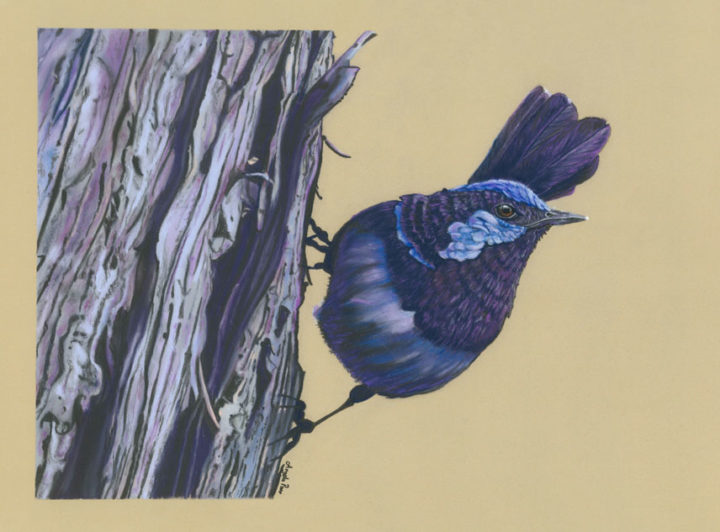
A Split Second
Pastel on Pastelmat Board (Sold)
48 cm W x 38 cm H
Adult male Superb Fairy-wrens (Malurus cyaneus) are among the most brightly coloured of the species, especially during the breeding season. These ‘coloured’ males are often accompanied by a band of brown ‘jenny wrens’, assumed to be a harem of females, but often include immature males which have not yet attained their breeding plumage. Seen in most habitat types where suitable dense cover and low shrubs occur, including urban parks and gardens, they can be seen in small social groups. These groups normally consist of one male and several females and young birds. They feed on insects and other small arthropods, which are caught mostly on the ground, but may also be taken from low bushes. This artwork depicts a male in the waning evening light about to launch on unsuspecting prey.Quick View -
Jabiru Dreaming
Pastel on Mi Tientes Tex ($POA)
41 cm W x 51 cm H
The Black-necked Stork (formerly referred to as the Jabiru) (Ephippiorhynchus asiaticusis) is Australia’s only native stork, with numbers at approximately 10,000 birds. They are threatened by habitat destruction, the draining of shallow wetlands, disturbance at nests, overfishing, pollution, collision with electricity wires and hunting. Several breeding pairs have recently been spotted as far south as the northern river areas of NSW, the Bundjalung area where I live. My father-in-law loves these birds and asked me to paint him one. Their black-neck name is misleading, as although their bodies are black and white, their necks shine a radiant glossy dark green and purple in the sunlight. They have a massive black bill and striking long coral-red legs. The males have black eyes whilst the female’s eye is yellow. This fellow is obviously a male and was hunting in the shallow waters of Chickiba Lake in Ballina, NSW.Read more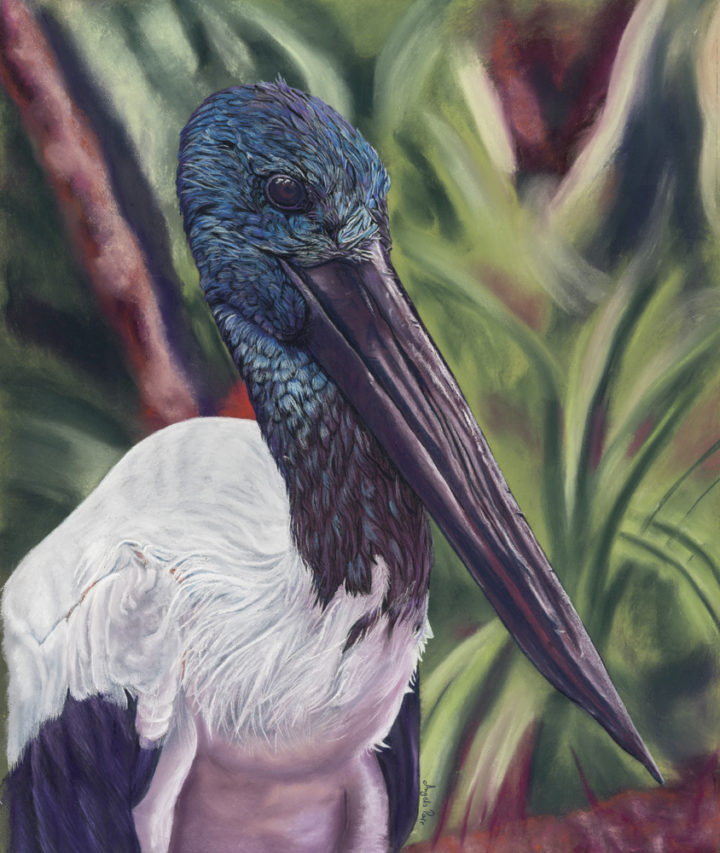
Jabiru Dreaming
Pastel on Mi Tientes Tex ($POA)
41 cm W x 51 cm H
The Black-necked Stork (formerly referred to as the Jabiru) (Ephippiorhynchus asiaticusis) is Australia’s only native stork, with numbers at approximately 10,000 birds. They are threatened by habitat destruction, the draining of shallow wetlands, disturbance at nests, overfishing, pollution, collision with electricity wires and hunting. Several breeding pairs have recently been spotted as far south as the northern river areas of NSW, the Bundjalung area where I live. My father-in-law loves these birds and asked me to paint him one. Their black-neck name is misleading, as although their bodies are black and white, their necks shine a radiant glossy dark green and purple in the sunlight. They have a massive black bill and striking long coral-red legs. The males have black eyes whilst the female’s eye is yellow. This fellow is obviously a male and was hunting in the shallow waters of Chickiba Lake in Ballina, NSW.Quick View -
Little Boy Blue
Watercolour on board (Sold)
35 cm W x 30 cm H
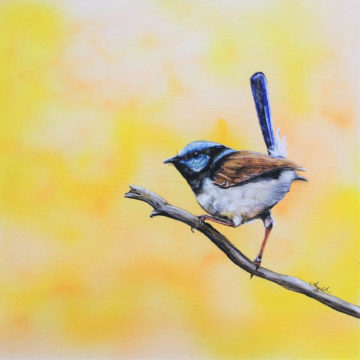
Another Superb Fairy-Wren (Malurus cyaneus) this time outside of breeding season. It’s their sky blue-coloured caps, which become iridescent during breeding season. Much loved among Australians, the fairy-wren can be found all across south-east Australia and enjoys a shrubby understorey where they move about in small groups. New research has revealed that male fairy-wrens sing to their eggs and their chicks come out recognising their parent’s unique song. This small study made good use of a vibrant yellow background to really highlight the wren’s colouration.Read more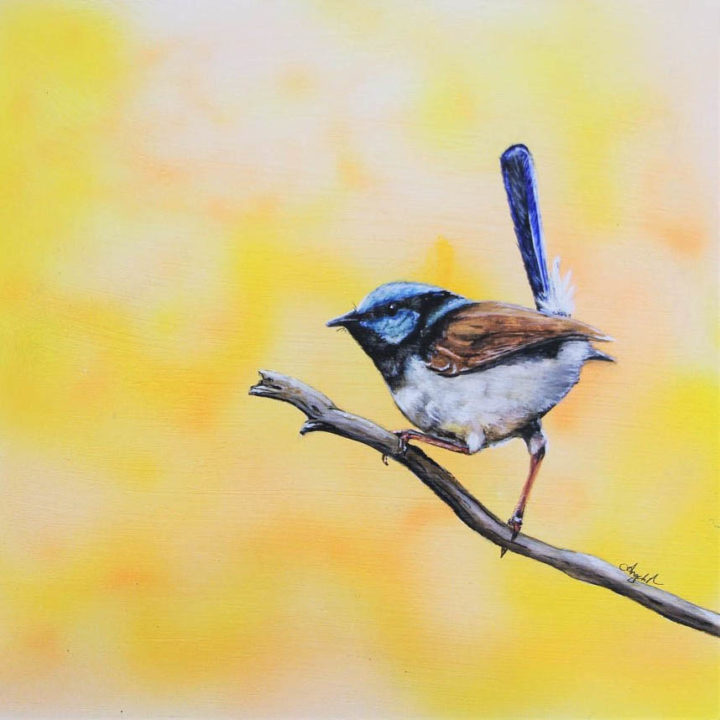
Little Boy Blue
Watercolour on board (Sold)
35 cm W x 30 cm H
Another Superb Fairy-Wren (Malurus cyaneus) this time outside of breeding season. It’s their sky blue-coloured caps, which become iridescent during breeding season. Much loved among Australians, the fairy-wren can be found all across south-east Australia and enjoys a shrubby understorey where they move about in small groups. New research has revealed that male fairy-wrens sing to their eggs and their chicks come out recognising their parent’s unique song. This small study made good use of a vibrant yellow background to really highlight the wren’s colouration.Quick View -
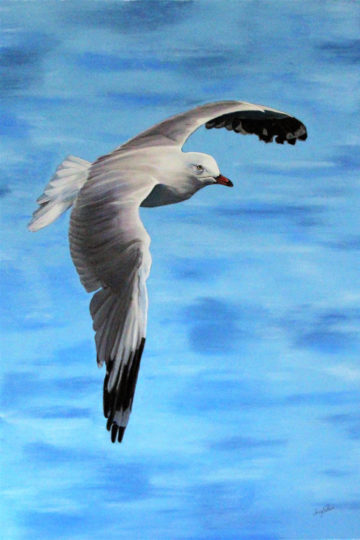
Jonathan Soaring
Pastel on Mi Tientes Tex ($POA)
68 cm W x 88 cm H
I was obsessed with the book Jonathan Livingston Seagull during my youth and even named our son Fletcher after one of the characters in Richard Bach’s fable novella. The common Silver Gull (Chroicocephalus novaehollandiae) is easily the most recognisable of all seagulls, although sadly it is also widely castigated as a voracious and persistent scavenger. The saying “Like a seagull on a hot chip” speaks of this characteristic. Their kleptoparasitic behaviour, and explosion in numbers since the 1950’s is due to the large quantities of food waste that Australians now produce. Their “natural diet” includes worms, fish, insects, and crustaceans. They are a clean and attractive bird and to see them soaring on the coastal breezes, like this one is doing, reminds us of how stunning they really are.Read more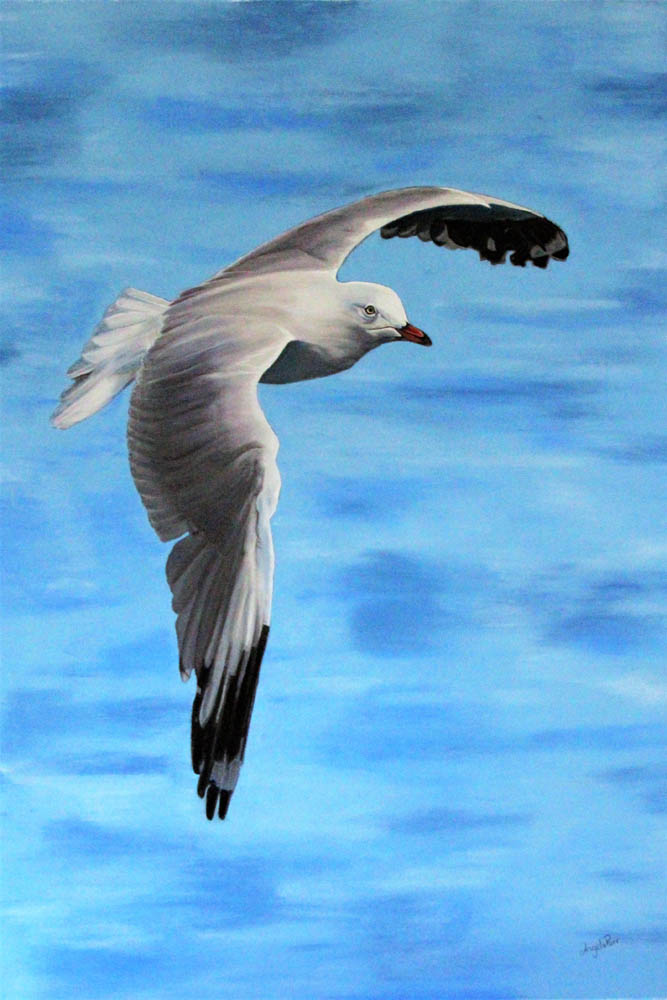
Jonathan Soaring
Pastel on Mi Tientes Tex ($POA)
68 cm W x 88 cm H
I was obsessed with the book Jonathan Livingston Seagull during my youth and even named our son Fletcher after one of the characters in Richard Bach’s fable novella. The common Silver Gull (Chroicocephalus novaehollandiae) is easily the most recognisable of all seagulls, although sadly it is also widely castigated as a voracious and persistent scavenger. The saying “Like a seagull on a hot chip” speaks of this characteristic. Their kleptoparasitic behaviour, and explosion in numbers since the 1950’s is due to the large quantities of food waste that Australians now produce. Their “natural diet” includes worms, fish, insects, and crustaceans. They are a clean and attractive bird and to see them soaring on the coastal breezes, like this one is doing, reminds us of how stunning they really are.Quick View -
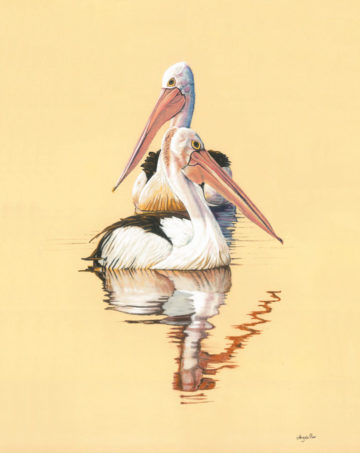
Ponderings
Pastel on Pastelmat (Sold)
63 cm W x 83 cm H
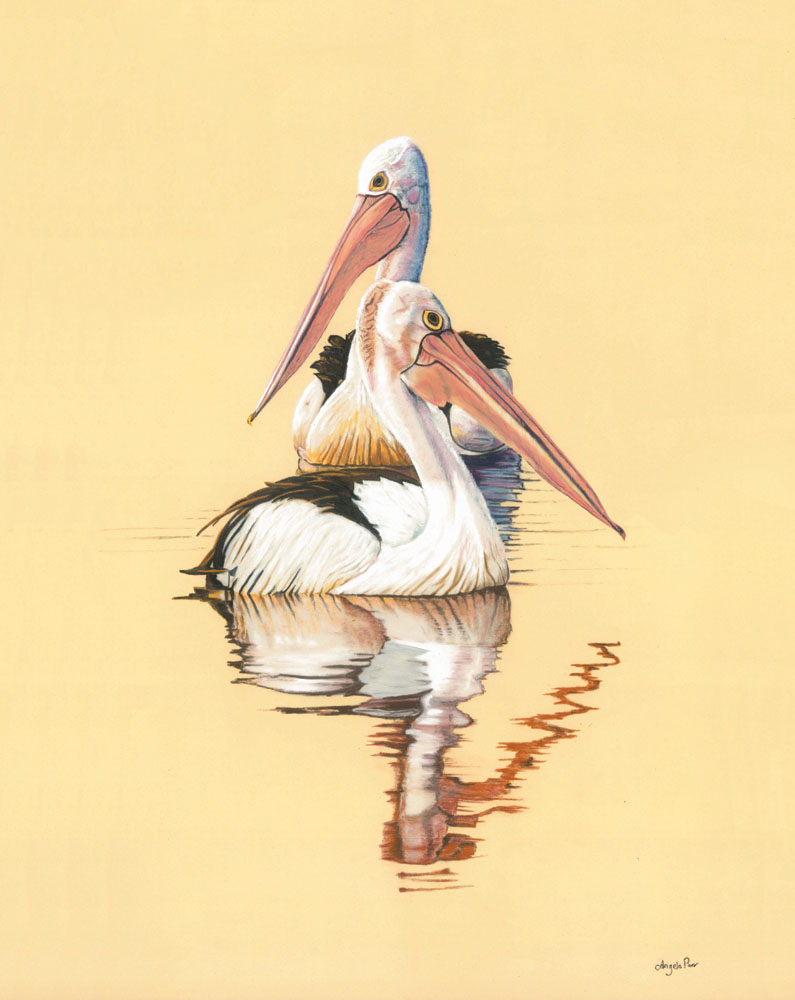
My hometown has an abundance of Australian pelicans (Pelecanus conspicillatus), and in fact the Australia Seabird Rescue was founded and based here through the conservation work of a wonderful man Lance Ferris, whom locals affectionately knew as “The Pelican Man”. Lance’s work started in 1992 after he noticed many pelicans injured by fishing line and hooks. Pelicans were rescued, rehabilitated, and released. His work soon extended from pelicans to other coastal birds as well as marine turtles. As I was involved in Bird Rehabilitation myself at the time, I often crossed paths with Lance. He was passionate about educating the community, especially school children and fisher-folk, to preserve and protect the coastal environment and all marine wildlife. Australian Seabird Rescue (one of my chosen charities) now works around Australia to protect and rescue seabirds and shorebirds. Seeing pelicans serenely gliding along our waterways, still gives me great delight.Read more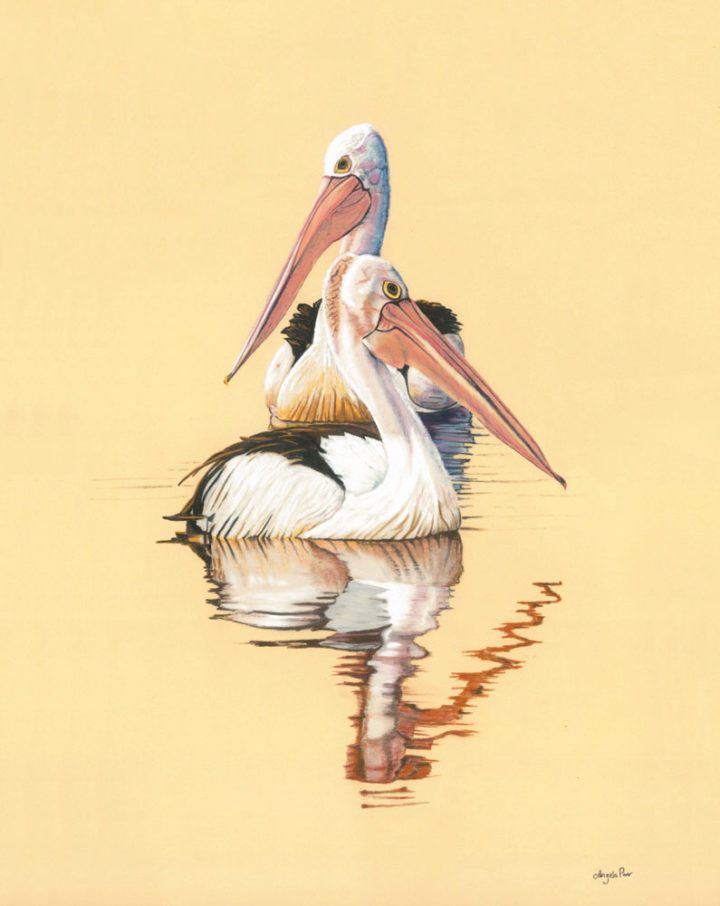
Ponderings
Pastel on Pastelmat (Sold)
63 cm W x 83 cm H
My hometown has an abundance of Australian pelicans (Pelecanus conspicillatus), and in fact the Australia Seabird Rescue was founded and based here through the conservation work of a wonderful man Lance Ferris, whom locals affectionately knew as “The Pelican Man”. Lance’s work started in 1992 after he noticed many pelicans injured by fishing line and hooks. Pelicans were rescued, rehabilitated, and released. His work soon extended from pelicans to other coastal birds as well as marine turtles. As I was involved in Bird Rehabilitation myself at the time, I often crossed paths with Lance. He was passionate about educating the community, especially school children and fisher-folk, to preserve and protect the coastal environment and all marine wildlife. Australian Seabird Rescue (one of my chosen charities) now works around Australia to protect and rescue seabirds and shorebirds. Seeing pelicans serenely gliding along our waterways, still gives me great delight.Quick View -
Rainbows Take Flight
Pastel on Pastelmat board ($POA)
94 cm W x 54 cm H
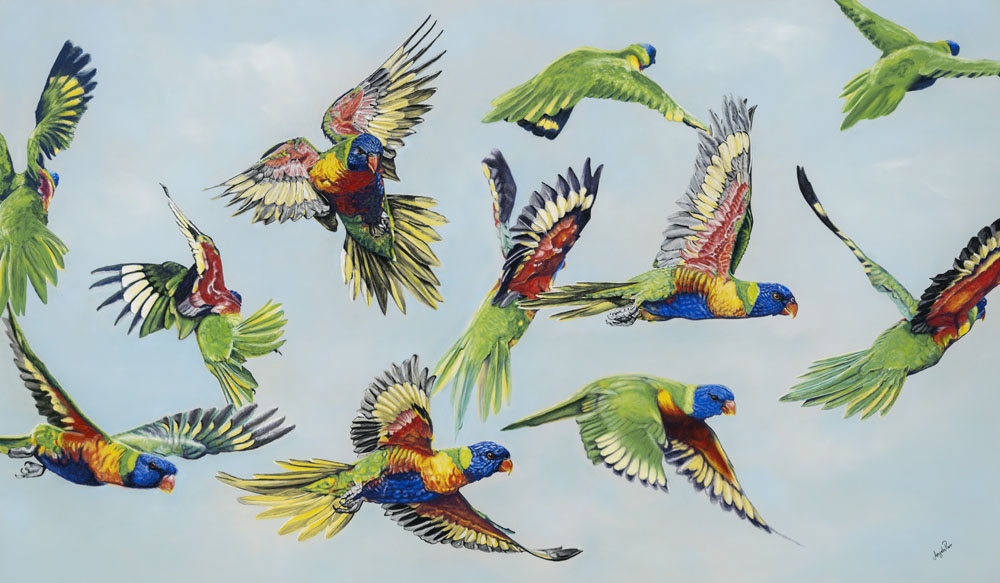
Loud, belligerent colonies of rainbow lorikeets (Trichoglossus moluccanus) are the soundtrack of urban Australia. They are often seen in fast-moving screeching flocks or gathering in huge, noisy numbers inhabiting large blossoming trees in local parks or backyards. The noise can be deafening. In many places, including campsites and suburban gardens, wild lorikeets are so used to humans that they can be hand-fed, although many people, ignorant of their dietary requirements, feed them bread or bread coated with honey. This is an inadequate source of the nutrients, vitamins and minerals that the rainbow lorikeet requires and can lead to health and feather formation issues in young lorikeets. Sadly, this is just another example of how human interaction can negatively affect our precious wildlife. I have created this artwork from a compilation of images, intending to show the rainbow lorikeets’ unmistakable patchwork of colours in a variety of flight positions and focus.Read more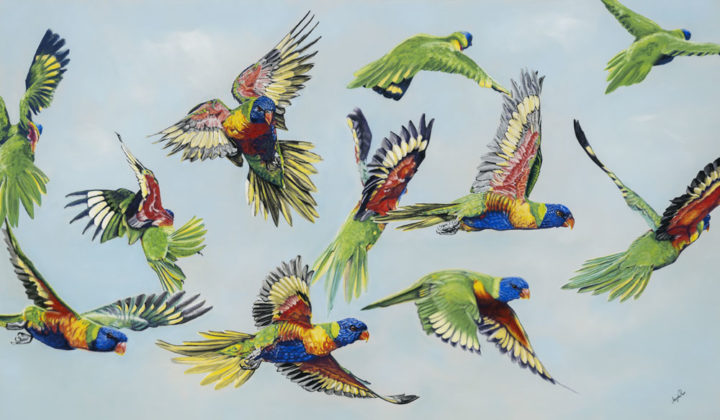
Rainbows Take Flight
Pastel on Pastelmat board ($POA)
94 cm W x 54 cm H
Loud, belligerent colonies of rainbow lorikeets (Trichoglossus moluccanus) are the soundtrack of urban Australia. They are often seen in fast-moving screeching flocks or gathering in huge, noisy numbers inhabiting large blossoming trees in local parks or backyards. The noise can be deafening. In many places, including campsites and suburban gardens, wild lorikeets are so used to humans that they can be hand-fed, although many people, ignorant of their dietary requirements, feed them bread or bread coated with honey. This is an inadequate source of the nutrients, vitamins and minerals that the rainbow lorikeet requires and can lead to health and feather formation issues in young lorikeets. Sadly, this is just another example of how human interaction can negatively affect our precious wildlife. I have created this artwork from a compilation of images, intending to show the rainbow lorikeets’ unmistakable patchwork of colours in a variety of flight positions and focus.Quick View -
Is This My Best Side?
Pastel on Pastelmat board ($POA)
55 cm W x 46 cm H
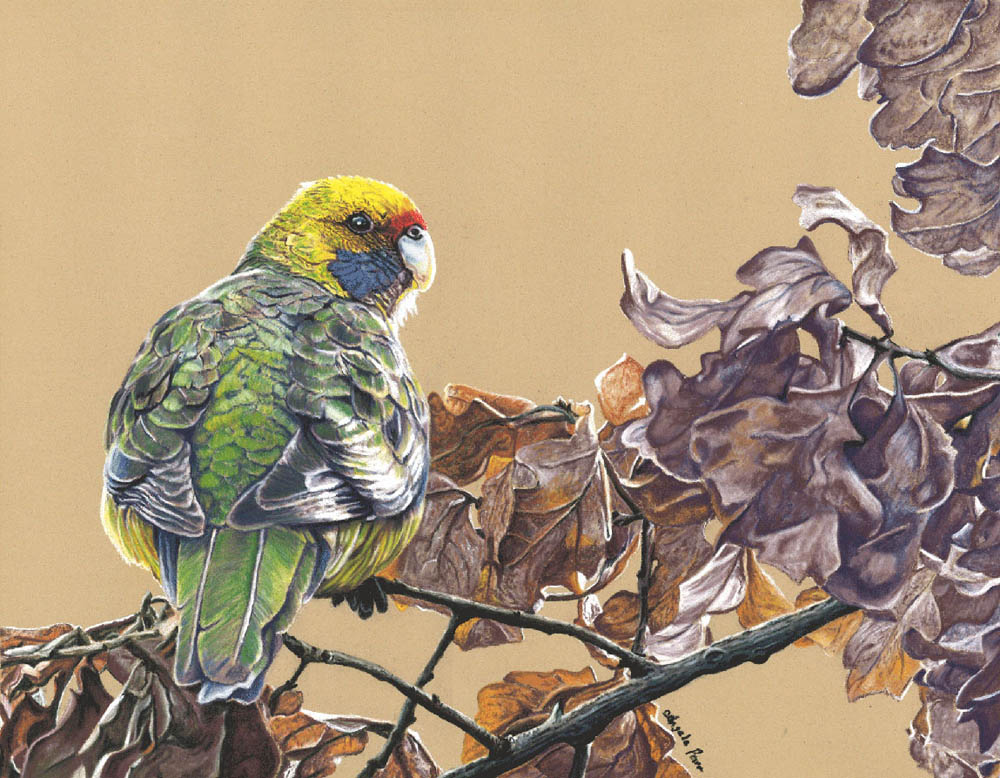
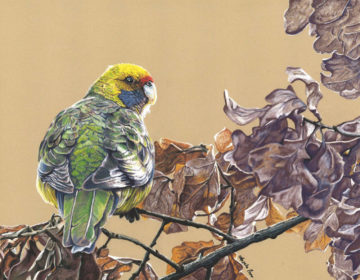
The green rosella or Tasmanian rosella (Platycercus caledonicus) is a species of parrot native to Tasmania and Bass Strait islands. Found in a wide range of habitats with some form of tree cover, the green rosella is predominantly herbivorous, consuming seeds, berries, nuts and fruit, as well as flowers, but may also eat insect larvae and insects such as psyllids. Their nesting site is usually a hollow over 1 m deep in a tree trunk anywhere up to 30 m above the ground. Chimneys, holes in walls and even the vertical pipes of tennis court fences have been used. Green rosellas nested in a wall cavity at Port Arthur convict prison site in 1958 and 2009, which is where this bird was spotted.Read more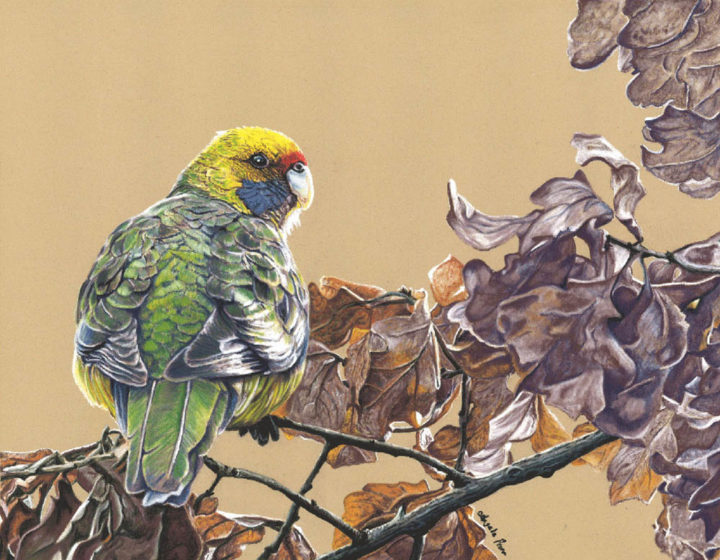
Is This My Best Side?
Pastel on Pastelmat board ($POA)
55 cm W x 46 cm H
The green rosella or Tasmanian rosella (Platycercus caledonicus) is a species of parrot native to Tasmania and Bass Strait islands. Found in a wide range of habitats with some form of tree cover, the green rosella is predominantly herbivorous, consuming seeds, berries, nuts and fruit, as well as flowers, but may also eat insect larvae and insects such as psyllids. Their nesting site is usually a hollow over 1 m deep in a tree trunk anywhere up to 30 m above the ground. Chimneys, holes in walls and even the vertical pipes of tennis court fences have been used. Green rosellas nested in a wall cavity at Port Arthur convict prison site in 1958 and 2009, which is where this bird was spotted.Quick View -
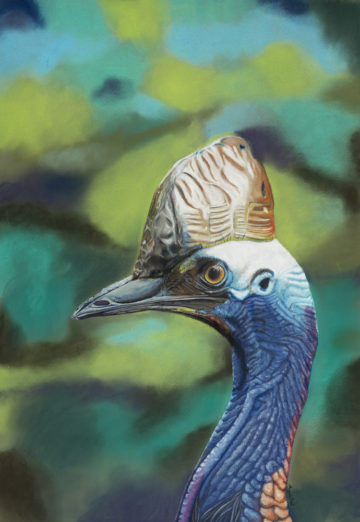
Wrinkles
Pastel on Canson paper (Sold)
47 cm W x 66 cm H
“Wrinkles” lives in the Daintree in far north Queensland, along with other Southern Cassowaries, (Casuarius casuarius). They are an icon of tourism in this area, but sadly are now endangered due to habitat loss, and threats from motor vehicles, dog packs, feral pigs and disease. Cassowaries are integral for the health of our Tropical rainforests due to seed dispersal of between 70 to 100 plant species. It is vital that this bird’s unique future is secured. Cassowaries have striking colours and “helmets” known as casques and I hoped to give homage to this in my pastel rendition.Read more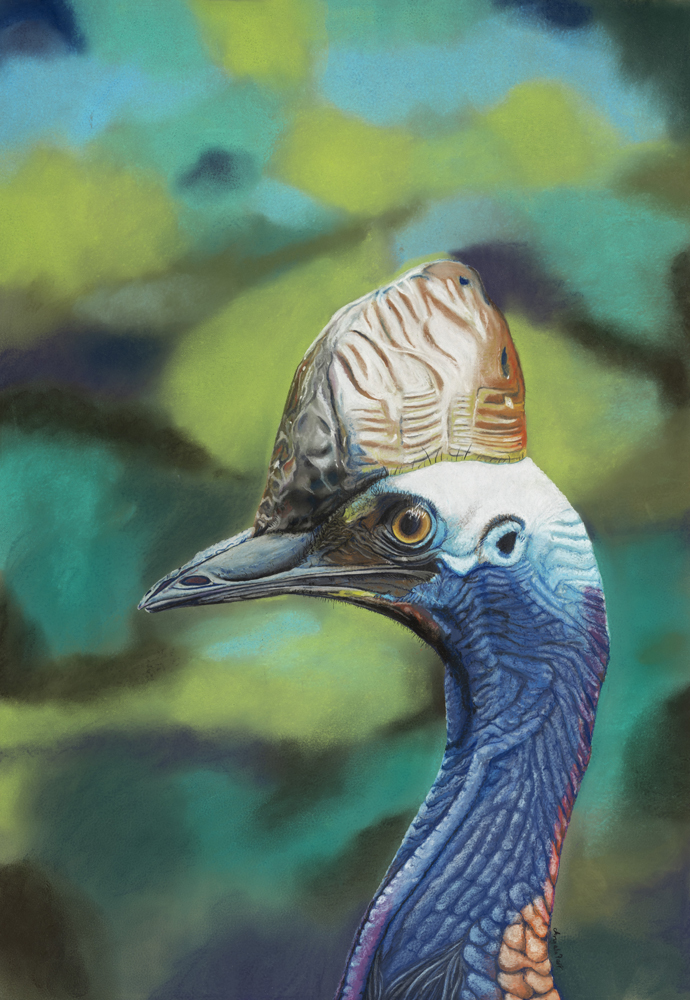
Wrinkles
Pastel on Canson paper (Sold)
47 cm W x 66 cm H
“Wrinkles” lives in the Daintree in far north Queensland, along with other Southern Cassowaries, (Casuarius casuarius). They are an icon of tourism in this area, but sadly are now endangered due to habitat loss, and threats from motor vehicles, dog packs, feral pigs and disease. Cassowaries are integral for the health of our Tropical rainforests due to seed dispersal of between 70 to 100 plant species. It is vital that this bird’s unique future is secured. Cassowaries have striking colours and “helmets” known as casques and I hoped to give homage to this in my pastel rendition.Quick View -
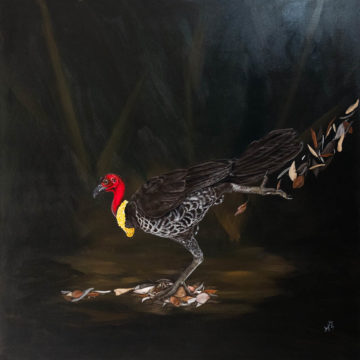
A Brush with Death
Acrylic on canvas (Sold)
122 cm W x 122 cm H
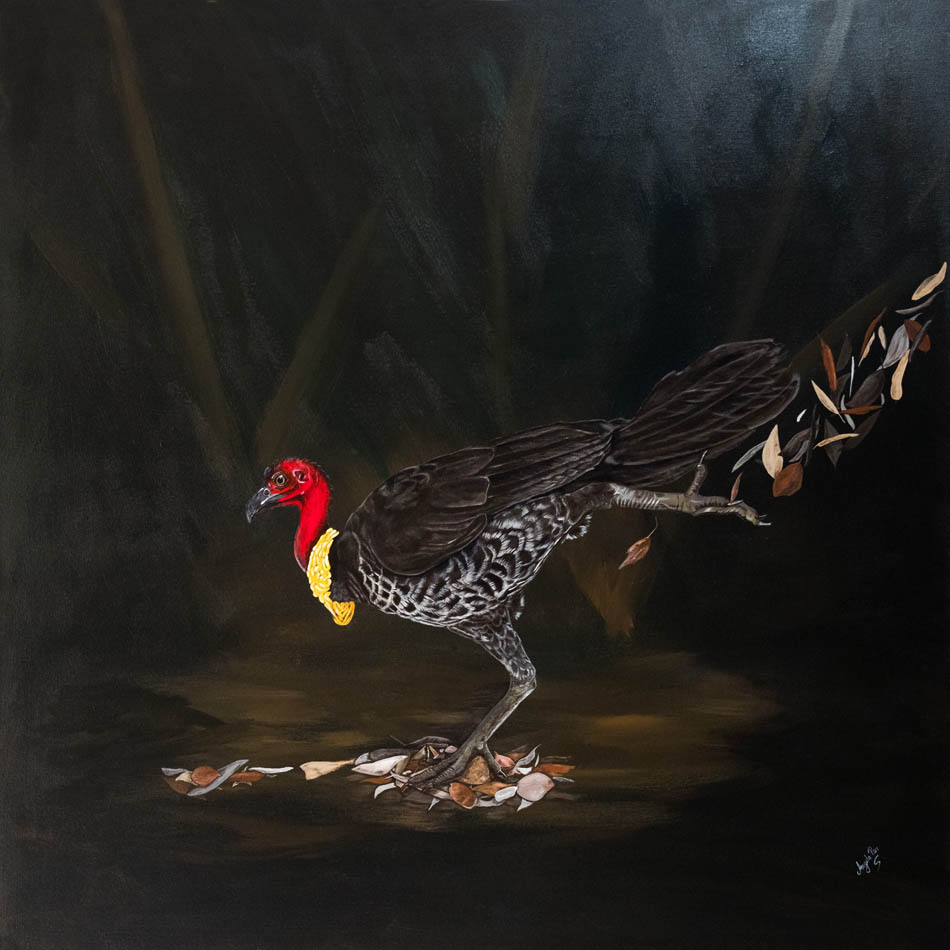
Never has a bird so divided the opinions of visitors coming to my gallery as this Brush Turkey. The Australian Brush Turkey (Alectura lathami), also known as the bush or scrub turkey, has a bad reputation. They are blamed for damaging gardens (making an awful mess as it digs up leaf litter, twigs and dirt to build its egg mound) and darting across roads. Found in eastern Australia from Far North Queensland to the Illawarra in New South Wales, they’ve managed to adapt to life in cities and have also been introduced to Kangaroo Island in South Australia. Brush turkey nests or ‘mounds’ are the size of a car and are made up of soil and plant material. Built by the males to attract a mate, they’re essentially large compost heaps, that take the hard-working male about a month to create.
These mounds generate a huge amount of heat and that’s what incubates the eggs — which is lucky because once the eggs are laid the mother is off, and the father only sticks around to defend the mound. When the chicks have left the nest, the leftover mound is a perfect bit of compost for humans to spread out over the garden.Read more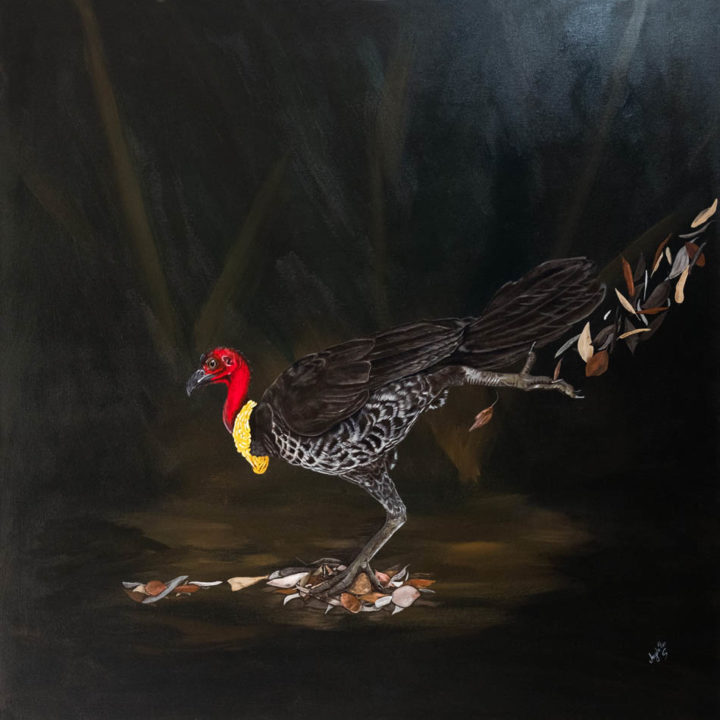
A Brush with Death
Acrylic on canvas (Sold)
122 cm W x 122 cm H
Never has a bird so divided the opinions of visitors coming to my gallery as this Brush Turkey. The Australian Brush Turkey (Alectura lathami), also known as the bush or scrub turkey, has a bad reputation. They are blamed for damaging gardens (making an awful mess as it digs up leaf litter, twigs and dirt to build its egg mound) and darting across roads. Found in eastern Australia from Far North Queensland to the Illawarra in New South Wales, they’ve managed to adapt to life in cities and have also been introduced to Kangaroo Island in South Australia. Brush turkey nests or ‘mounds’ are the size of a car and are made up of soil and plant material. Built by the males to attract a mate, they’re essentially large compost heaps, that take the hard-working male about a month to create.
These mounds generate a huge amount of heat and that’s what incubates the eggs — which is lucky because once the eggs are laid the mother is off, and the father only sticks around to defend the mound. When the chicks have left the nest, the leftover mound is a perfect bit of compost for humans to spread out over the garden.Quick View -
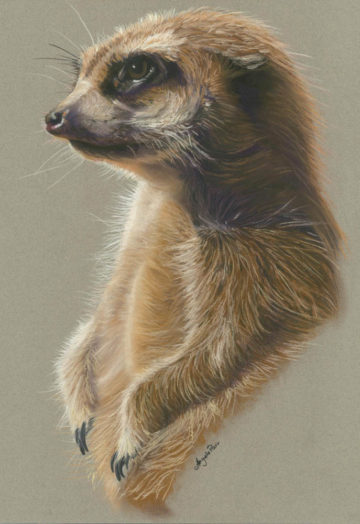
Suricate Sentinel
Pastel on Canson pastel paper (Sold)
32cm W x 45cm H
The Meerkat (Suricata suricatta) is a highly intelligent omnivore (standing only about 25 – 30cm from head to rump) found in southern Africa. The dark patches around their eyes help cut down on the sun’s glare, and their thin fur and dark skin on their stomachs assists them to control body temperature. Their diet consists of insects, lizards, birds, and fruit. When hunting small game, they work together and communicate with purring sounds. As they forage for insects and other prey, they bury their heads in the sand, so they need a reliable and trusted sentry to be on the alert for predatory snakes, hawks, eagles and jackals. This curious upright stance keeps the rest of the gang safe.Read more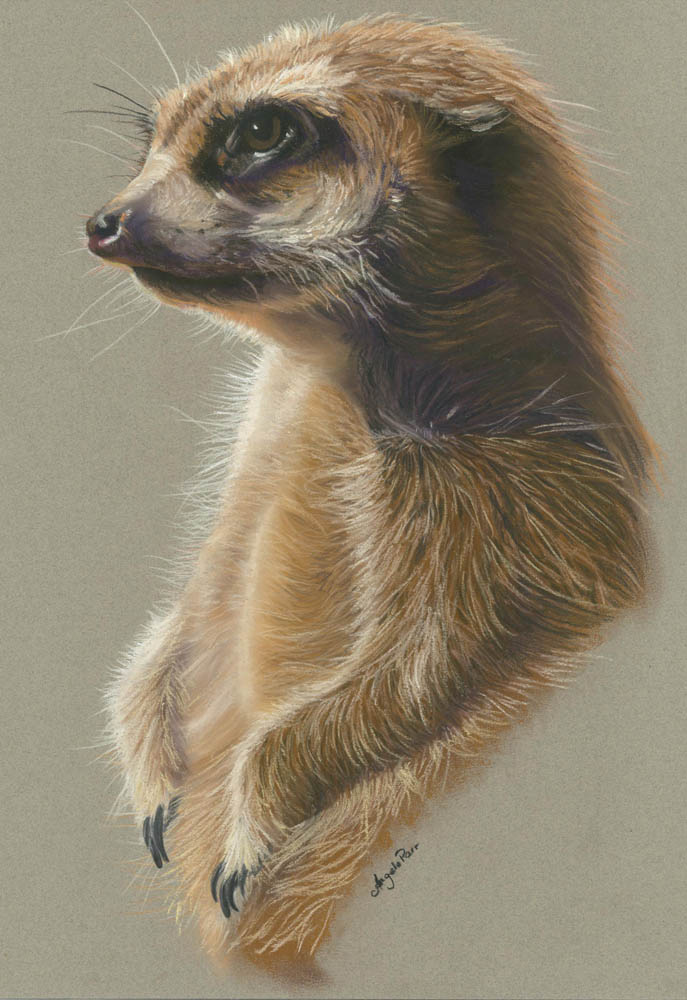
Suricate Sentinel
Pastel on Canson pastel paper (Sold)
32cm W x 45cm H
The Meerkat (Suricata suricatta) is a highly intelligent omnivore (standing only about 25 – 30cm from head to rump) found in southern Africa. The dark patches around their eyes help cut down on the sun’s glare, and their thin fur and dark skin on their stomachs assists them to control body temperature. Their diet consists of insects, lizards, birds, and fruit. When hunting small game, they work together and communicate with purring sounds. As they forage for insects and other prey, they bury their heads in the sand, so they need a reliable and trusted sentry to be on the alert for predatory snakes, hawks, eagles and jackals. This curious upright stance keeps the rest of the gang safe.Quick View -
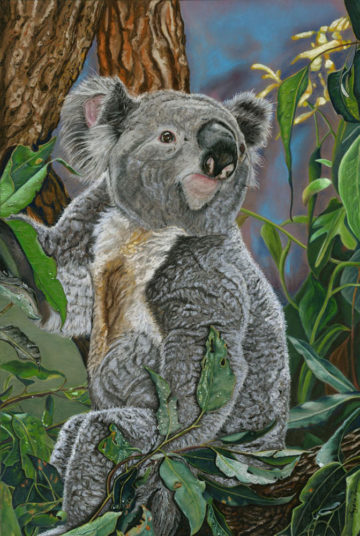
A Comfortable Seat
Pastel on Colour Fix Art Spectrum paper ($POA)
39 cm W x 58 cm H
The Koala (Phascolarctos cinereus) is an arboreal herbivorous marsupial, and an integral part of the Australian bush. They usually sleep for 20 hours a day, perched high up in eucalyptus trees. Their diet consists exclusively of these leaves, considered poisonous to most other animals. The word ‘Koala’ is thought to mean ‘no drink’ in the Australian Aboriginal language, however koalas do drink especially during heatwaves and in times of drought. Koalas are in serious danger of becoming extinct by 2050 due to deforestation, drought and bushfires.
This little guy is “Arni”, a northern koala (their fur is shorter and more silvery-grey than their southern cousins). He is a lovely gentle male, almost in his prime, who happily resides at the Byron Bay Wildlife Sanctuary, in northern NSW.Read more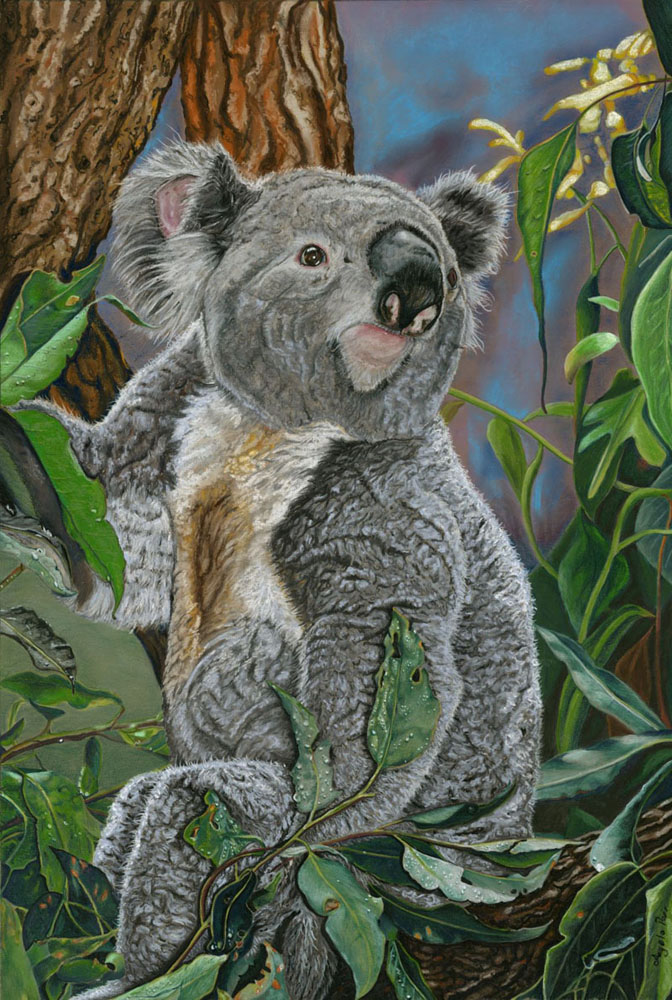
A Comfortable Seat
Pastel on Colour Fix Art Spectrum paper ($POA)
39 cm W x 58 cm H
The Koala (Phascolarctos cinereus) is an arboreal herbivorous marsupial, and an integral part of the Australian bush. They usually sleep for 20 hours a day, perched high up in eucalyptus trees. Their diet consists exclusively of these leaves, considered poisonous to most other animals. The word ‘Koala’ is thought to mean ‘no drink’ in the Australian Aboriginal language, however koalas do drink especially during heatwaves and in times of drought. Koalas are in serious danger of becoming extinct by 2050 due to deforestation, drought and bushfires.
This little guy is “Arni”, a northern koala (their fur is shorter and more silvery-grey than their southern cousins). He is a lovely gentle male, almost in his prime, who happily resides at the Byron Bay Wildlife Sanctuary, in northern NSW.Quick View -
A Nest of Spoons
Pastel on Mi Tientes Tex. Unframed ($POA)
87 cm W x 67 cm H
A juvenile Royal Spoonbill (Platalea regia) arrived on our property, lost and starving. We fed little “Teaspoon” the Christmas Prawn scraps before finding a suitable wetland nearby for relocation.
“Teaspoon’s” visit made me curious about Spoonbills. They are found throughout eastern and northern Australia, residing in wetlands, mudflats and grasslands. Their black spatulate bill contains papillae (vibration detectors) which help them “feel” for prey in murky water, day or night.
In breeding season the birds are very white, with a distinctive ‘nuchal’ crest on the head/neck. A yellow patch is above the eye, absent in juveniles, who are often ‘dirty’ in appearance.Read more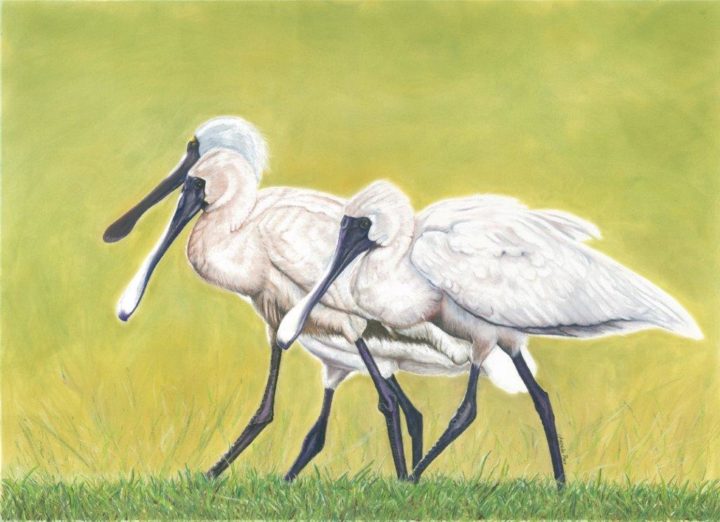
A Nest of Spoons
Pastel on Mi Tientes Tex. Unframed ($POA)
87 cm W x 67 cm H
A juvenile Royal Spoonbill (Platalea regia) arrived on our property, lost and starving. We fed little “Teaspoon” the Christmas Prawn scraps before finding a suitable wetland nearby for relocation.
“Teaspoon’s” visit made me curious about Spoonbills. They are found throughout eastern and northern Australia, residing in wetlands, mudflats and grasslands. Their black spatulate bill contains papillae (vibration detectors) which help them “feel” for prey in murky water, day or night.
In breeding season the birds are very white, with a distinctive ‘nuchal’ crest on the head/neck. A yellow patch is above the eye, absent in juveniles, who are often ‘dirty’ in appearance.Quick View -
Andrew
Pastel on Pastelmat paper (Sold)
67 cm W x 88 cm H
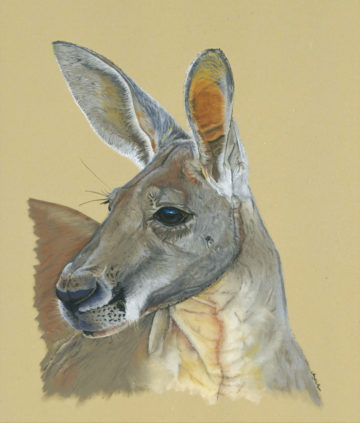
Andrew is a big Red Kangaroo, (Macropus rufus) one of the many offspring of the famous alpha-male Red Kangaroo “Roger”, raised in the Kangaroo Sanctuary in Alice Springs. The Red Kangaroo is the largest of all kangaroos, which are terrestrial marsupials native to Australia, and they are found over most of the arid parts of the country, preferring flat open plains. Big Reds may weigh as much as 90kg and reach 1.8 meters in height when standing. When male kangaroos fight over potential mates, they appear to be boxing. They balance on their strong tails, grab their rival with their forearms and kick with their powerful hind legs. They attempt to push their opponent off balance. Kangaroos can also bite and wield sharp claws, which they may do in battle with an enemy like a dingo.Read more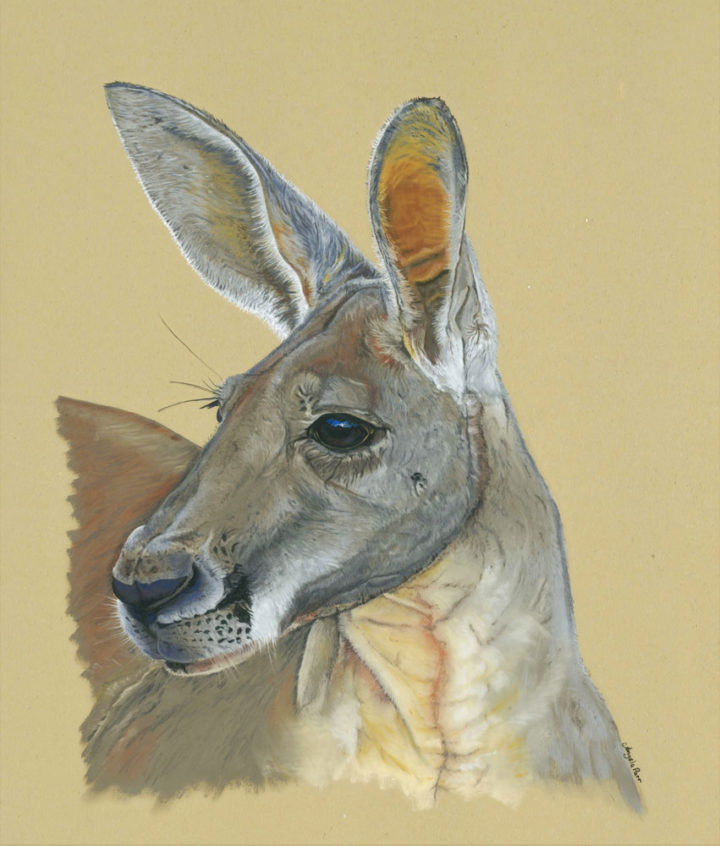
Andrew
Pastel on Pastelmat paper (Sold)
67 cm W x 88 cm H
Andrew is a big Red Kangaroo, (Macropus rufus) one of the many offspring of the famous alpha-male Red Kangaroo “Roger”, raised in the Kangaroo Sanctuary in Alice Springs. The Red Kangaroo is the largest of all kangaroos, which are terrestrial marsupials native to Australia, and they are found over most of the arid parts of the country, preferring flat open plains. Big Reds may weigh as much as 90kg and reach 1.8 meters in height when standing. When male kangaroos fight over potential mates, they appear to be boxing. They balance on their strong tails, grab their rival with their forearms and kick with their powerful hind legs. They attempt to push their opponent off balance. Kangaroos can also bite and wield sharp claws, which they may do in battle with an enemy like a dingo.Quick View -
Morning Light
Pastel on Canson paper ($POA)
71 cm W x 91 cm H
The Eastern Grey Kangaroo, (Macropus giganteus), is one of 73 species of macropods. (The Greek words makros meaning large and poús or pod meaning foot) The key distinguishing features of all macropods are their triangular body shapes, large hind legs and feet, and disproportionately small front limbs. All have forward-facing pouches, and most use hopping as their primary mode of locomotion. The Eastern Grey is found in the eastern third of Australia, with a population of several million. They live in groups called Mobs and are highly sociable. Joeys usually stay in the pouch for 11 months and then continue to feed from their mother for an additional 9 months. This doe and joey were basking in the morning sunlight at Currumbin Wildlife Sanctuary.Read more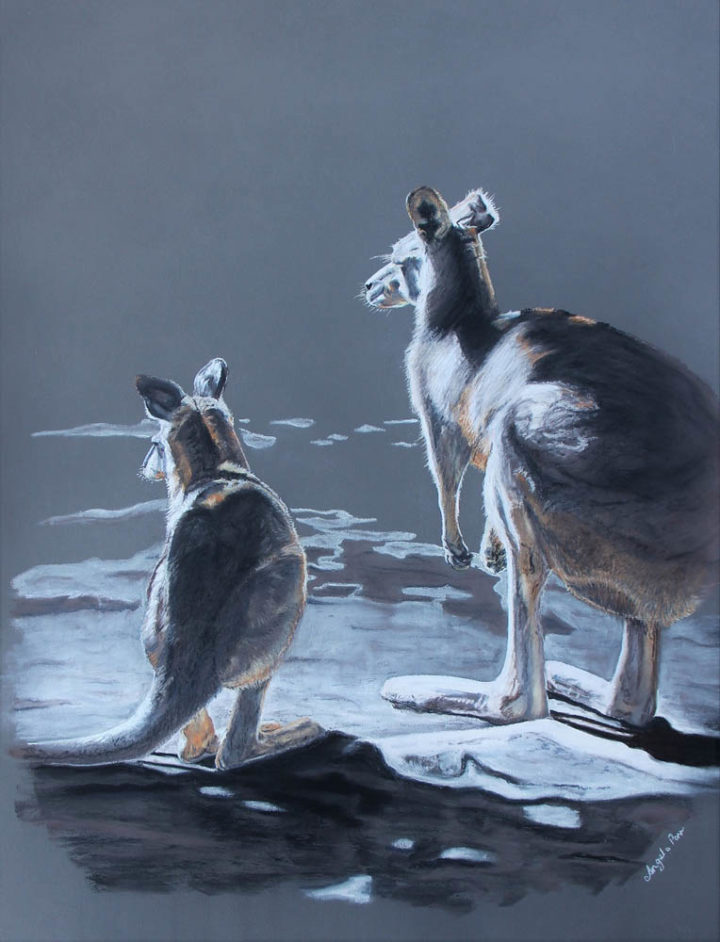
Morning Light
Pastel on Canson paper ($POA)
71 cm W x 91 cm H
The Eastern Grey Kangaroo, (Macropus giganteus), is one of 73 species of macropods. (The Greek words makros meaning large and poús or pod meaning foot) The key distinguishing features of all macropods are their triangular body shapes, large hind legs and feet, and disproportionately small front limbs. All have forward-facing pouches, and most use hopping as their primary mode of locomotion. The Eastern Grey is found in the eastern third of Australia, with a population of several million. They live in groups called Mobs and are highly sociable. Joeys usually stay in the pouch for 11 months and then continue to feed from their mother for an additional 9 months. This doe and joey were basking in the morning sunlight at Currumbin Wildlife Sanctuary.Quick View -
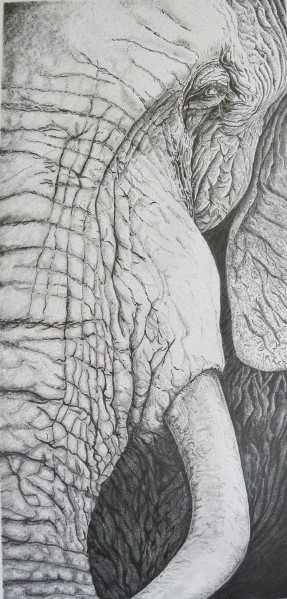
I am Elephant
Graphite on Arches paper ($POA)
42 cm W x 63 cm H
The African Bush Elephant (Loxodonta africana) is considered endangered, threatened by habitat loss and fragmentation, and poaching for the illegal ivory trade. African elephants have grey folded skin up to 30 mm thick that is covered with sparse, bristled dark brown to black hair. The trunk is a prehensile elongation of its upper lip and nose, manipulated by about 40,000–60,000 muscles and so strong that elephants can use it for lifting about 3% of their own body weight. They use it for smelling, touching, feeding, drinking, dusting, producing sounds, loading, defending and attacking. This artwork focuses on the skin, trunk and tusk of a large bull and attempts to convey the immense size and strength of these magnificent creatures.Read moreI am Elephant
Graphite on Arches paper ($POA)
42 cm W x 63 cm H
The African Bush Elephant (Loxodonta africana) is considered endangered, threatened by habitat loss and fragmentation, and poaching for the illegal ivory trade. African elephants have grey folded skin up to 30 mm thick that is covered with sparse, bristled dark brown to black hair. The trunk is a prehensile elongation of its upper lip and nose, manipulated by about 40,000–60,000 muscles and so strong that elephants can use it for lifting about 3% of their own body weight. They use it for smelling, touching, feeding, drinking, dusting, producing sounds, loading, defending and attacking. This artwork focuses on the skin, trunk and tusk of a large bull and attempts to convey the immense size and strength of these magnificent creatures.Quick View -
Just a Big Pussycat
Pastel on Colour Fix Art Spectrum paper ($POA)
44 cm W x 58 cm H
The Indian Tiger (Panthera tigris) is surely the most stunning of the big cats, with its distinctive dark vertical stripes on orange fur with a white underside. It is an apex predator, primarily preying on ungulates such as deer and wild boar. It is territorial and generally solitary. It is listed as endangered on the IUCN Red List. As of 2024, the global wild tiger population was estimated to number of 5,574 mature individuals, with most living in small, isolated pockets. Major reasons for population decline are habitat destruction, habitat fragmentation, human-wildlife conflict and poaching.
source World Animal Foundation
worldanimalfoundation.orgRead more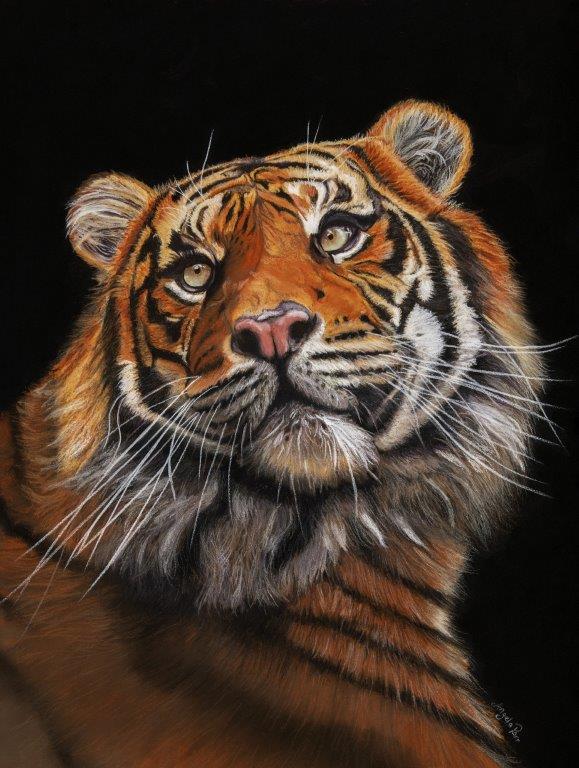
Just a Big Pussycat
Pastel on Colour Fix Art Spectrum paper ($POA)
44 cm W x 58 cm H
The Indian Tiger (Panthera tigris) is surely the most stunning of the big cats, with its distinctive dark vertical stripes on orange fur with a white underside. It is an apex predator, primarily preying on ungulates such as deer and wild boar. It is territorial and generally solitary. It is listed as endangered on the IUCN Red List. As of 2024, the global wild tiger population was estimated to number of 5,574 mature individuals, with most living in small, isolated pockets. Major reasons for population decline are habitat destruction, habitat fragmentation, human-wildlife conflict and poaching.
source World Animal Foundation
worldanimalfoundation.orgQuick View -
The Huntress
Pastel on Pastelmat Board ($POA)
(size to come)
Lions (Panthera leo) are unique among cats in that they live in a pride, often consisting of about 15 individuals. Lionesses are the chief hunters. They prey on animals of all sizes, including hippopotamuses, but prefer wildebeests, antelopes, and zebras. Lionesses are much faster than their male counterparts because of their sleeker and lighter bodies. A Lion runs at 35 mph however a Lioness can reach up to a speed of 45 mph.
This beautiful female in Tanzania was testing the breeze for possible prey in the vicinity.Read more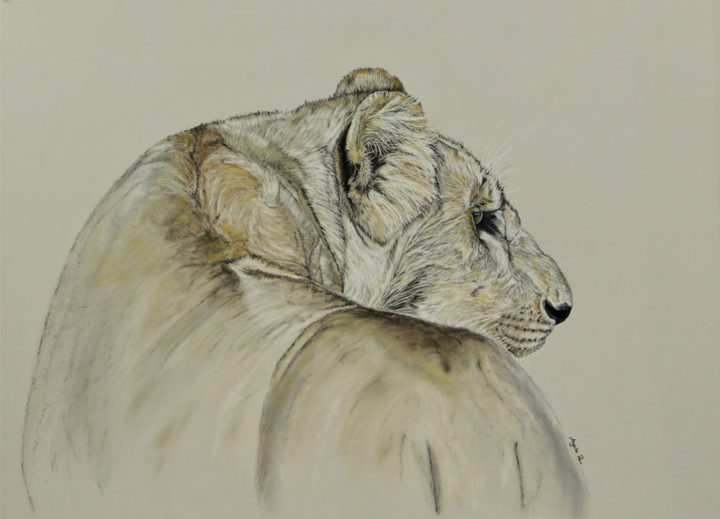
The Huntress
Pastel on Pastelmat Board ($POA)
(size to come)
Lions (Panthera leo) are unique among cats in that they live in a pride, often consisting of about 15 individuals. Lionesses are the chief hunters. They prey on animals of all sizes, including hippopotamuses, but prefer wildebeests, antelopes, and zebras. Lionesses are much faster than their male counterparts because of their sleeker and lighter bodies. A Lion runs at 35 mph however a Lioness can reach up to a speed of 45 mph.
This beautiful female in Tanzania was testing the breeze for possible prey in the vicinity.Quick View -
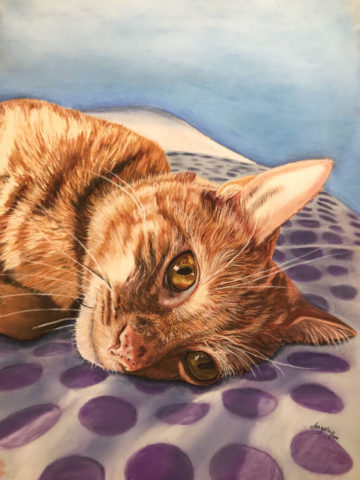
Leo
Pastel on Pastelmat Board (Sold)
25 cm W x 35 cm H
Leo was a much-loved pet of my sister-in-law, and I drew him as a gift for her birthday. In an ironic twist of fate, Leo was killed days after the portrait arrived. She was forever grateful to have this reminder of him.Read more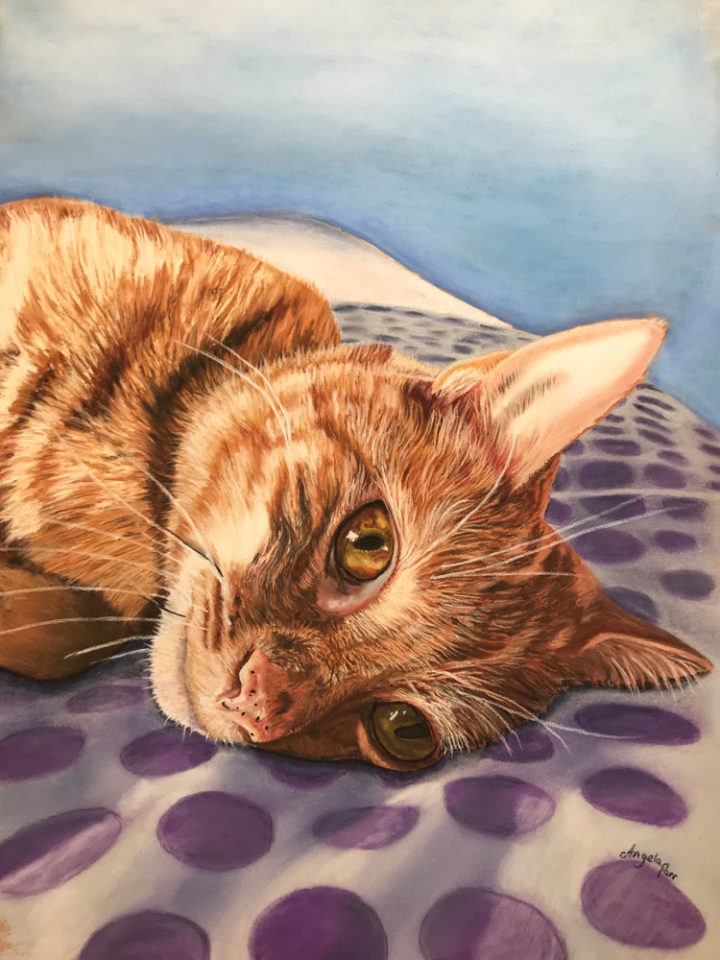
Leo
Pastel on Pastelmat Board (Sold)
25 cm W x 35 cm H
Leo was a much-loved pet of my sister-in-law, and I drew him as a gift for her birthday. In an ironic twist of fate, Leo was killed days after the portrait arrived. She was forever grateful to have this reminder of him.Quick View -
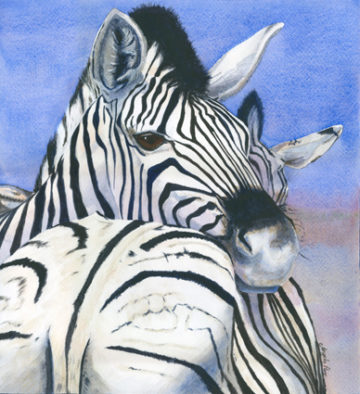
The Rear Guard
Watercolour on Arches paper ($POA)
30 cm W x 33 cm H
Being the favourite prey of lions, zebras must always be alert, and often stand head to tail to keep an eye on the terrain all around them. Naturally when they stand this way, they can also give each other a good scratch on the rump, and with their tails constantly swishing, help chase flies away from each other’s faces.Read more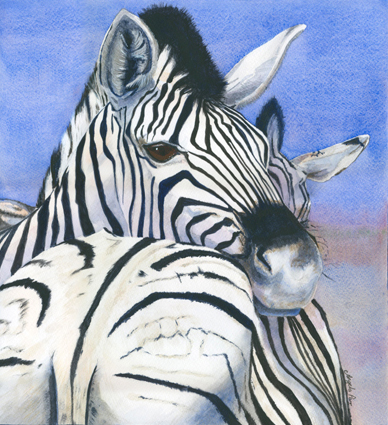
The Rear Guard
Watercolour on Arches paper ($POA)
30 cm W x 33 cm H
Being the favourite prey of lions, zebras must always be alert, and often stand head to tail to keep an eye on the terrain all around them. Naturally when they stand this way, they can also give each other a good scratch on the rump, and with their tails constantly swishing, help chase flies away from each other’s faces.Quick View -
The Observer
Pastel on Pastelmat (Sold)
46 cm W x 66 cm H
The Eastern Osprey (Pandion cristatus) is a familiar sight on the Ballina/Byron coastline, so I was surprised to learn its status is “vulnerable” in NSW. Osprey often return to the same nest, so habitat destruction and disturbance often disrupts nesting. Discarded fishing tackle, contaminated fish, polluted waterways and electrocution from nesting on powerline poles also pose serious threats. Fortunately, our council has erected several Osprey Breeding Platforms and I am accustomed to see them circling the skies, hear them whistle to each other, and in breeding season, see little fluff balls peek over the nest’s edge. They are a majestic bird.Read more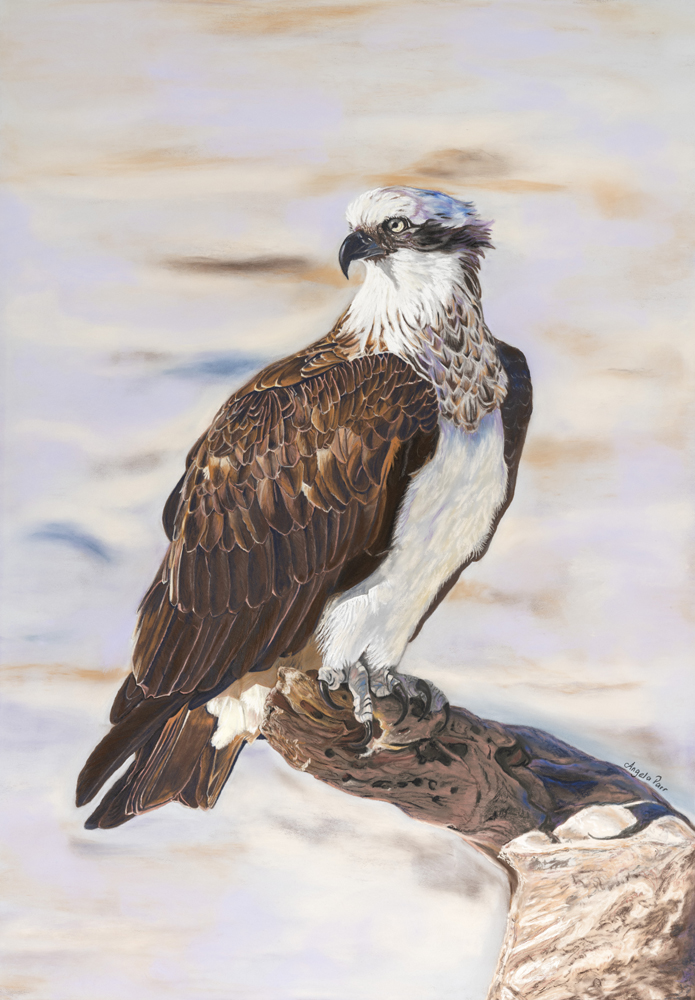
The Observer
Pastel on Pastelmat (Sold)
46 cm W x 66 cm H
The Eastern Osprey (Pandion cristatus) is a familiar sight on the Ballina/Byron coastline, so I was surprised to learn its status is “vulnerable” in NSW. Osprey often return to the same nest, so habitat destruction and disturbance often disrupts nesting. Discarded fishing tackle, contaminated fish, polluted waterways and electrocution from nesting on powerline poles also pose serious threats. Fortunately, our council has erected several Osprey Breeding Platforms and I am accustomed to see them circling the skies, hear them whistle to each other, and in breeding season, see little fluff balls peek over the nest’s edge. They are a majestic bird.Quick View -
Watching and Waiting 1
Graphite on Arches paper (Sold)
45 cm W x 33 cm H
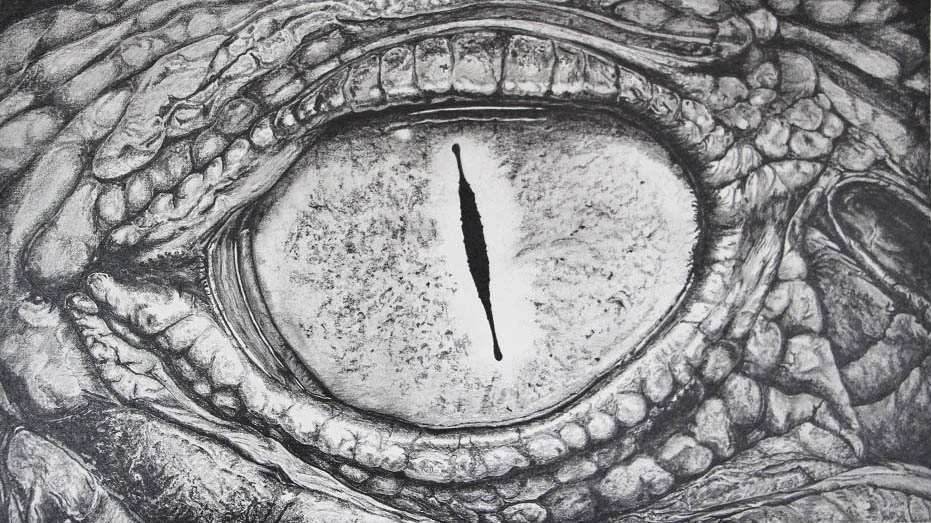
Earth’s largest living crocodilian—and, some say, the animal most likely to eat a human—is the saltwater or estuarine crocodile, (Crocodylus porosus). The typical male Saltwater Crocodile has an overall length of 4.25-7 m, with females at lengths of 2.30-3.35 m. An average male Saltwater Crocodile weighs between 400-1000 kg and has a typical lifespan of 70-100 years in the wild.
I have equal parts fascination and fear of these ancient reptiles but managed to convince myself to swim for 15 minutes in the famous “Cage of Death”, at Crocosaurus Cove in Darwin and eyeball a 5-metre monster through the acrylic-strengthened “glass” cage.Read more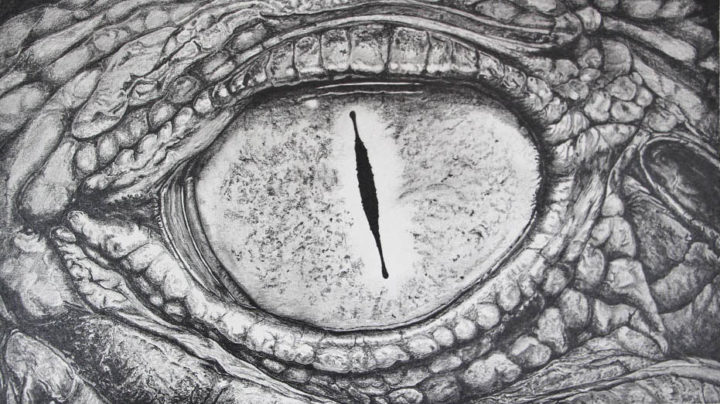
Watching and Waiting 1
Graphite on Arches paper (Sold)
45 cm W x 33 cm H
Earth’s largest living crocodilian—and, some say, the animal most likely to eat a human—is the saltwater or estuarine crocodile, (Crocodylus porosus). The typical male Saltwater Crocodile has an overall length of 4.25-7 m, with females at lengths of 2.30-3.35 m. An average male Saltwater Crocodile weighs between 400-1000 kg and has a typical lifespan of 70-100 years in the wild.
I have equal parts fascination and fear of these ancient reptiles but managed to convince myself to swim for 15 minutes in the famous “Cage of Death”, at Crocosaurus Cove in Darwin and eyeball a 5-metre monster through the acrylic-strengthened “glass” cage.Quick View -
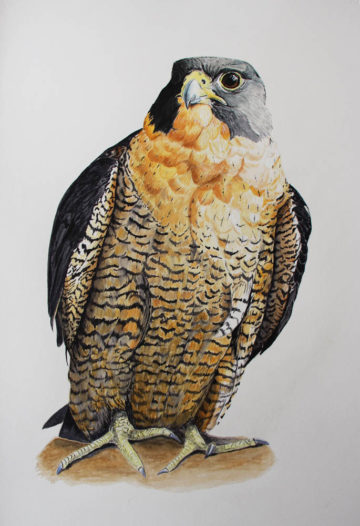
Peregrine Falcon
Watercolour on Arches paper ($POA)
49 cm W x 68 cm H
The peregrine falcon (Falco peregrinus) is the world’s most widespread raptor found nearly everywhere on Earth, except extreme polar regions, very high mountains, and most tropical rainforests. The peregrine is renowned for its speed, reaching over 320 km/h during its characteristic hunting stoop (high-speed dive), making it the fastest bird in the world, and the fastest member of the animal kingdom. Although its diet consists almost exclusively of medium-sized birds, the peregrine will sometimes hunt small mammals, small reptiles, or even insects. Reaching sexual maturity at one year, it mates for life and nests in a scrape, normally on cliff edges or, in recent times, on tall human-made structures. Since 1991, a pair of Peregrine Falcons has been observed in a nest on the rooftop of 367 Collins Street. As home to the only known peregrine falcon nesting site within Melbourne’s CBD, the building plays a surprisingly important role to the ongoing breeding success of these rare and fiercely territorial birds. The magnificent specimen in my artwork was recovering from injury in a raptor sanctuary before being released back into the wild.Read more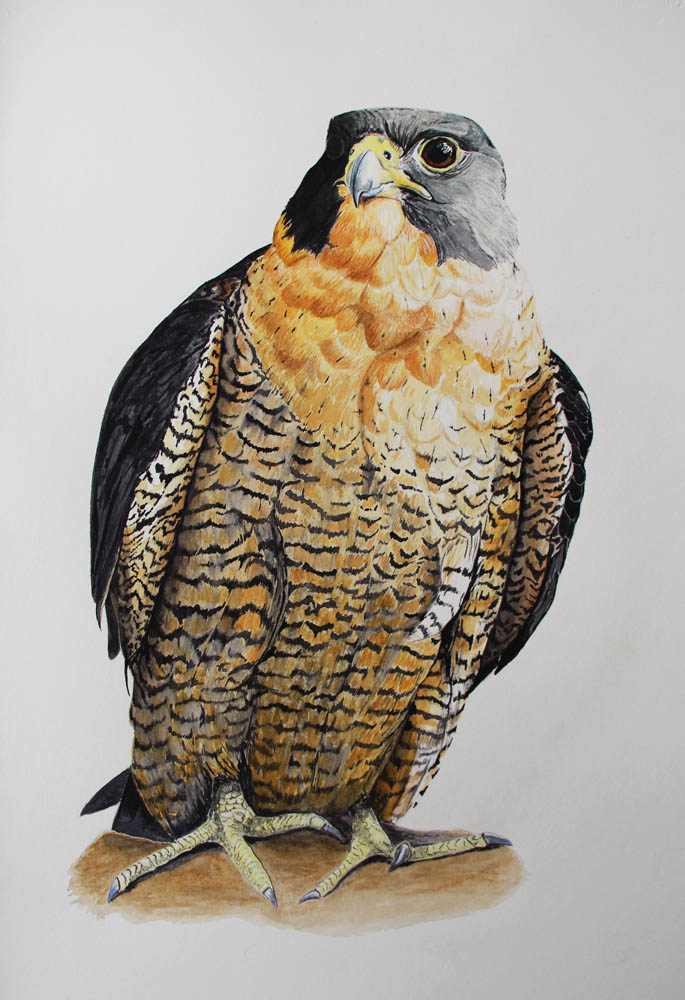
Peregrine Falcon
Watercolour on Arches paper ($POA)
49 cm W x 68 cm H
The peregrine falcon (Falco peregrinus) is the world’s most widespread raptor found nearly everywhere on Earth, except extreme polar regions, very high mountains, and most tropical rainforests. The peregrine is renowned for its speed, reaching over 320 km/h during its characteristic hunting stoop (high-speed dive), making it the fastest bird in the world, and the fastest member of the animal kingdom. Although its diet consists almost exclusively of medium-sized birds, the peregrine will sometimes hunt small mammals, small reptiles, or even insects. Reaching sexual maturity at one year, it mates for life and nests in a scrape, normally on cliff edges or, in recent times, on tall human-made structures. Since 1991, a pair of Peregrine Falcons has been observed in a nest on the rooftop of 367 Collins Street. As home to the only known peregrine falcon nesting site within Melbourne’s CBD, the building plays a surprisingly important role to the ongoing breeding success of these rare and fiercely territorial birds. The magnificent specimen in my artwork was recovering from injury in a raptor sanctuary before being released back into the wild.Quick View -
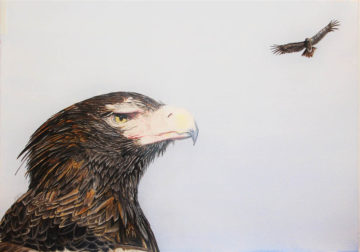
Aquila Audax
Watercolour and coloured pencil on Arches paper ($POA)
76 cm W x 60 cm H
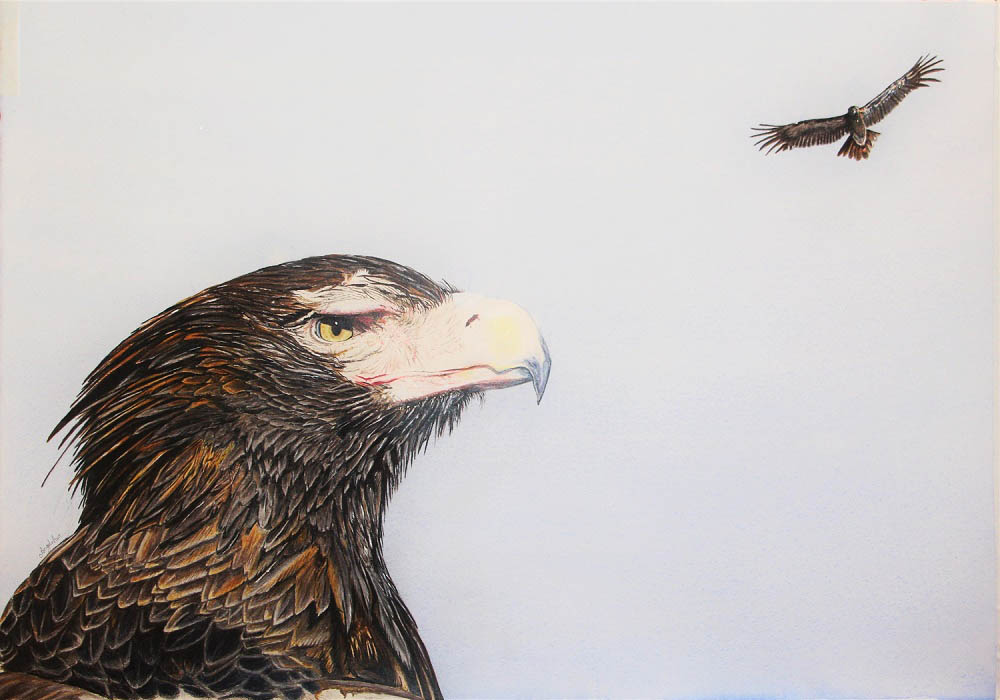
The wedge-tailed eagle (Aquila audax) is the largest bird of prey in Australia, with an impressive wing span of up to 2.84 m and a body length up to 1.06 m. Females weigh between 3-6kg , whilst males are slightly lighter at 2-4kg. Wedge-tailed eagles are highly aerial, soaring for hours on end without wingbeat and seemingly without effort, regularly reaching 1,800 m. Most prey is captured on the ground in gliding attacks. Choice of prey include the introduced rabbit and brown hare, (their diet of choice) foxes and feral cats, native wallabies, small kangaroos, possums, wombats, koalas, and bandicoots. In some areas, birds and reptiles may also be taken. “Wedgies” have also been known to team up to hunt large red kangaroos, to cause goats to fall off steep hillsides and injure themselves, or to drive flocks of sheep or kangaroos to isolate a weaker animal.Read more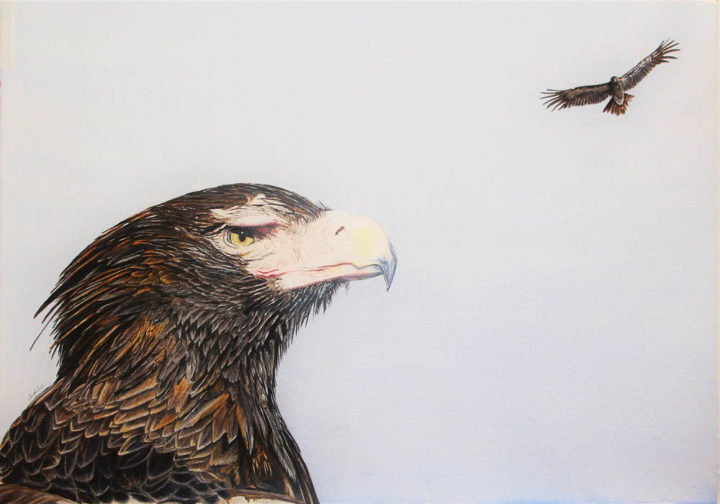
Aquila Audax
Watercolour and coloured pencil on Arches paper ($POA)
76 cm W x 60 cm H
The wedge-tailed eagle (Aquila audax) is the largest bird of prey in Australia, with an impressive wing span of up to 2.84 m and a body length up to 1.06 m. Females weigh between 3-6kg , whilst males are slightly lighter at 2-4kg. Wedge-tailed eagles are highly aerial, soaring for hours on end without wingbeat and seemingly without effort, regularly reaching 1,800 m. Most prey is captured on the ground in gliding attacks. Choice of prey include the introduced rabbit and brown hare, (their diet of choice) foxes and feral cats, native wallabies, small kangaroos, possums, wombats, koalas, and bandicoots. In some areas, birds and reptiles may also be taken. “Wedgies” have also been known to team up to hunt large red kangaroos, to cause goats to fall off steep hillsides and injure themselves, or to drive flocks of sheep or kangaroos to isolate a weaker animal.Quick View -
Scamper and Scurry
Pastel on Mi Tientes Tex (Sold)
53 cm W x 43 cm H
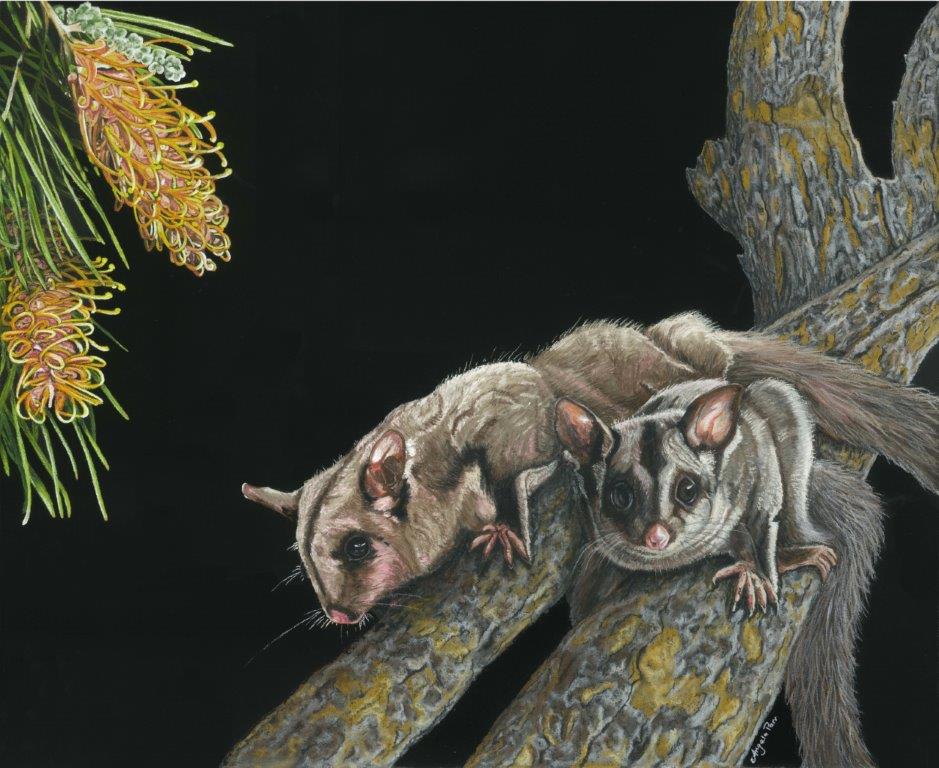
The models for this artwork are Samson and Sebastian, four-year-old brothers and the resident Sugar gliders of Byron Bay Wildlife Sanctuary (formerly Macadamia Castle). The sugar glider (Petaurus breviceps) is a small, omnivorous, arboreal, and nocturnal gliding possum belonging to the marsupial infraclass. The common name refers to its predilection for sugary foods such as sap and nectar (hence the inclusion of the grevillea in the artwork) and its ability to glide through the air, much like a flying squirrel. Its pair of gliding membranes, known as patagia, extend from its forelegs to its hindlegs enabling it to glide 50 metres or more. Gliding serves as an efficient means of reaching food and evading predators.Read more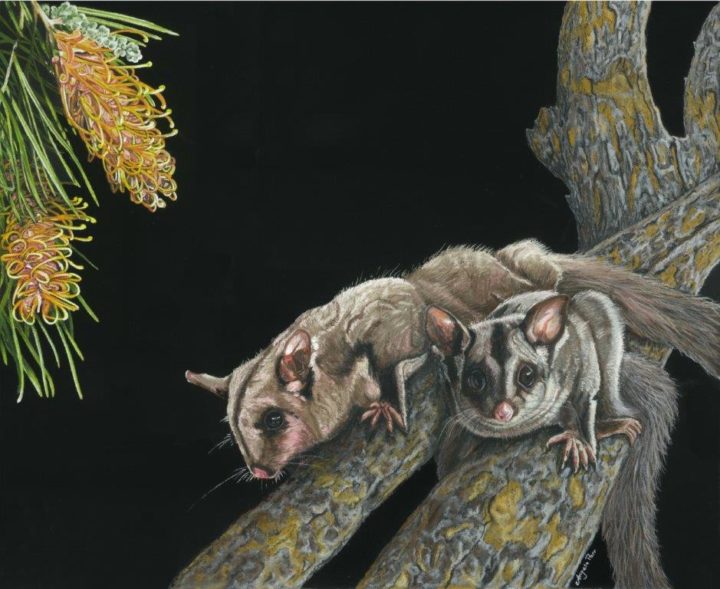
Scamper and Scurry
Pastel on Mi Tientes Tex (Sold)
53 cm W x 43 cm H
The models for this artwork are Samson and Sebastian, four-year-old brothers and the resident Sugar gliders of Byron Bay Wildlife Sanctuary (formerly Macadamia Castle). The sugar glider (Petaurus breviceps) is a small, omnivorous, arboreal, and nocturnal gliding possum belonging to the marsupial infraclass. The common name refers to its predilection for sugary foods such as sap and nectar (hence the inclusion of the grevillea in the artwork) and its ability to glide through the air, much like a flying squirrel. Its pair of gliding membranes, known as patagia, extend from its forelegs to its hindlegs enabling it to glide 50 metres or more. Gliding serves as an efficient means of reaching food and evading predators.Quick View -
Little Bentwing Bats Roosting
Pastel on Canson paper (Sold)
63 cm W x 48 cm H
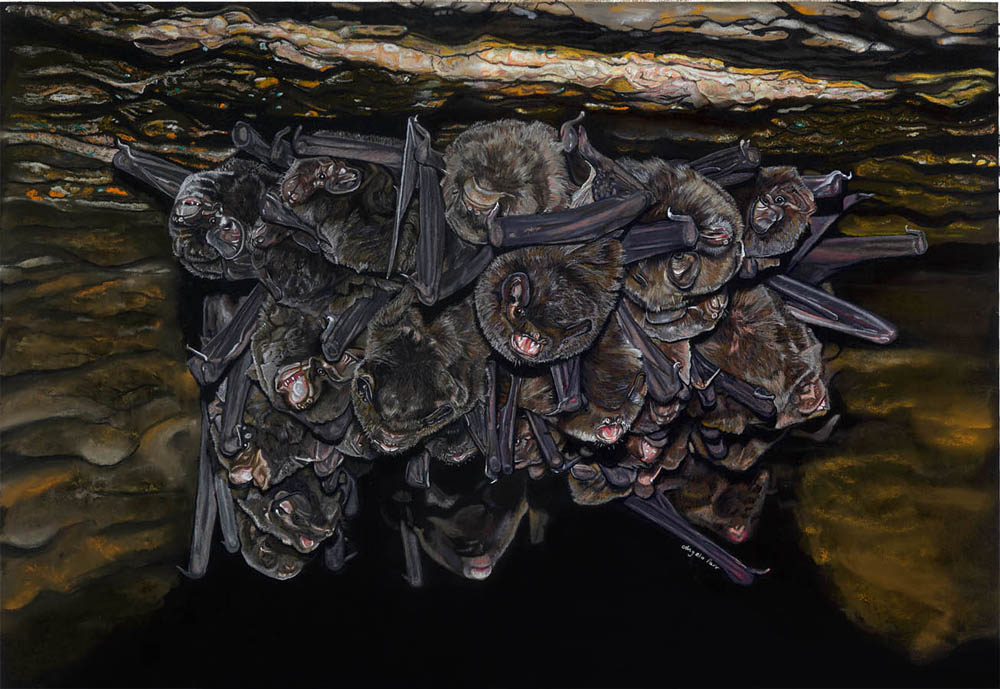
Little Bent-wing Bats (Miniopterus australis) roost in caves, mine tunnels and tree hollows, often in colonies numbering in the hundreds. Common Bent-wing Bats are often found roosting alongside them. Like all microbats, Little Bent-wing Bats also feed on small insects that fly beneath the canopy of thick forests. They are agile fliers, having to manoeuvre through the trees to catch their prey. Female Little Bent-wing Bats have a single baby in summer. They leave their babies in nursery caves at night to go and hunt, returning in the morning. These bats are also vulnerable to disturbance from human visitors to cave roosts, destruction of caves by limestone mining, and loss of feeding habitat by forestry operations, clearing and land degradation from agriculture.
I enjoyed creating this artwork although I found it challenging controlling the pastel dust fallout on the black paper and counting all those heads, making sure everything aligned correctly.Read more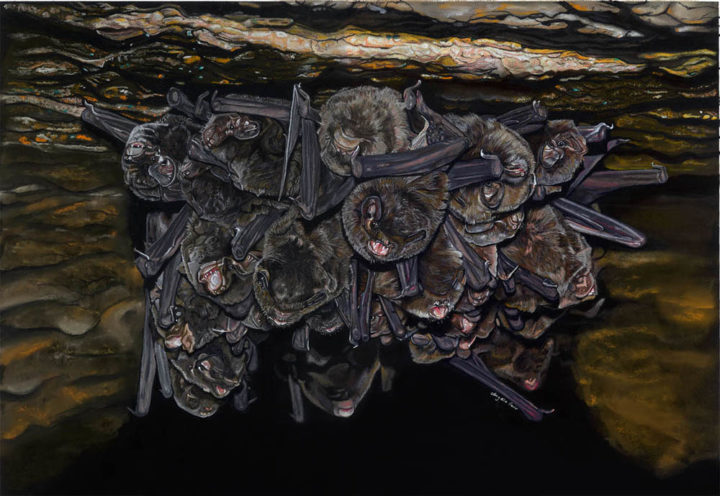
Little Bentwing Bats Roosting
Pastel on Canson paper (Sold)
63 cm W x 48 cm H
Little Bent-wing Bats (Miniopterus australis) roost in caves, mine tunnels and tree hollows, often in colonies numbering in the hundreds. Common Bent-wing Bats are often found roosting alongside them. Like all microbats, Little Bent-wing Bats also feed on small insects that fly beneath the canopy of thick forests. They are agile fliers, having to manoeuvre through the trees to catch their prey. Female Little Bent-wing Bats have a single baby in summer. They leave their babies in nursery caves at night to go and hunt, returning in the morning. These bats are also vulnerable to disturbance from human visitors to cave roosts, destruction of caves by limestone mining, and loss of feeding habitat by forestry operations, clearing and land degradation from agriculture.
I enjoyed creating this artwork although I found it challenging controlling the pastel dust fallout on the black paper and counting all those heads, making sure everything aligned correctly.Quick View -
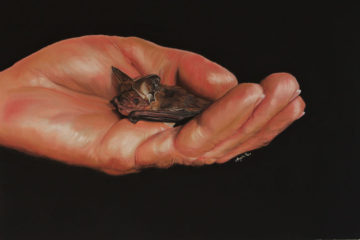
Long Eared Bat Being Held
Pastel on Canson paper ($POA)
63 cm W x 48 cm H
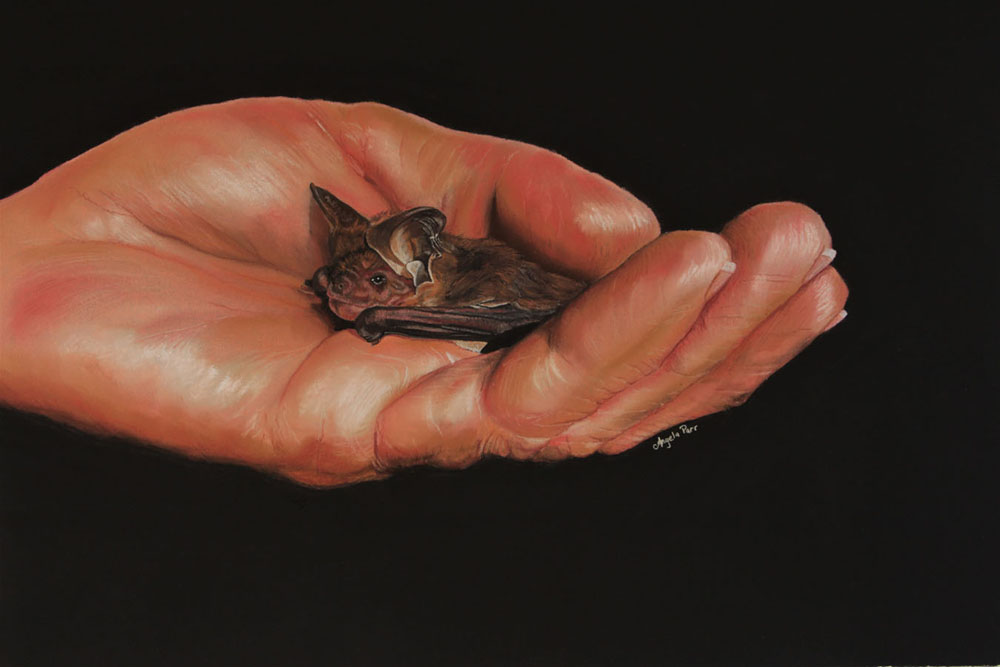
This was the final artwork of the “bat” series, (there were 8 in total), and this is probably my favourite as it clearly shows the diminutive size of microbats. Lesser Long-eared Bats (Nyctophilus geoffroyi) occur in towns and suburbs, roosting in hollows and fissures in old trees, under bark, in old fairy marten (bird) nests and occasionally in caves. They also often roost in ceilings, hollow walls, unused roller doors and canvas awnings in suburban and inner-city areas. Lesser Long-eared Bats hunt near the ground, and swoop around street lights at night catching insects. They are at risk from pesticides and cats. Luckily they prefer hollows of big old eucalypts for nursery colonies.Read more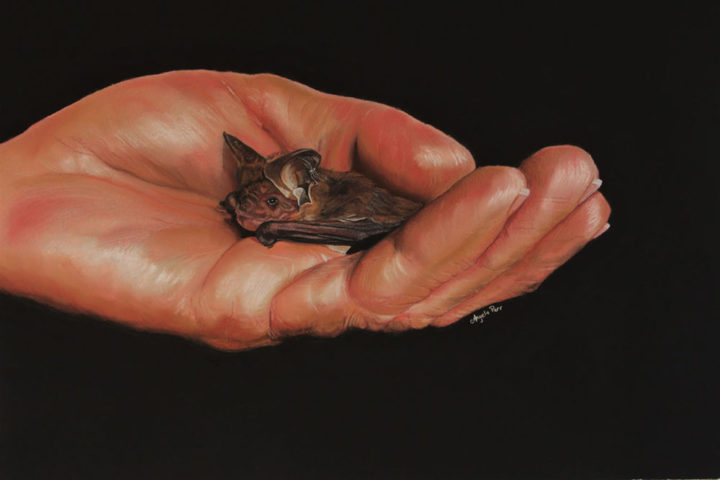
Long Eared Bat Being Held
Pastel on Canson paper ($POA)
63 cm W x 48 cm H
This was the final artwork of the “bat” series, (there were 8 in total), and this is probably my favourite as it clearly shows the diminutive size of microbats. Lesser Long-eared Bats (Nyctophilus geoffroyi) occur in towns and suburbs, roosting in hollows and fissures in old trees, under bark, in old fairy marten (bird) nests and occasionally in caves. They also often roost in ceilings, hollow walls, unused roller doors and canvas awnings in suburban and inner-city areas. Lesser Long-eared Bats hunt near the ground, and swoop around street lights at night catching insects. They are at risk from pesticides and cats. Luckily they prefer hollows of big old eucalypts for nursery colonies.Quick View -
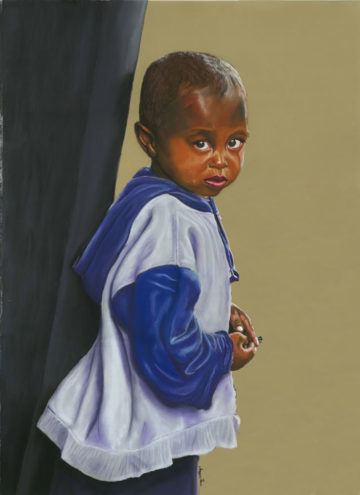
The Nail
Pastel on Mi Tientes Tex ($POA)
50 cm W x 70 cm H
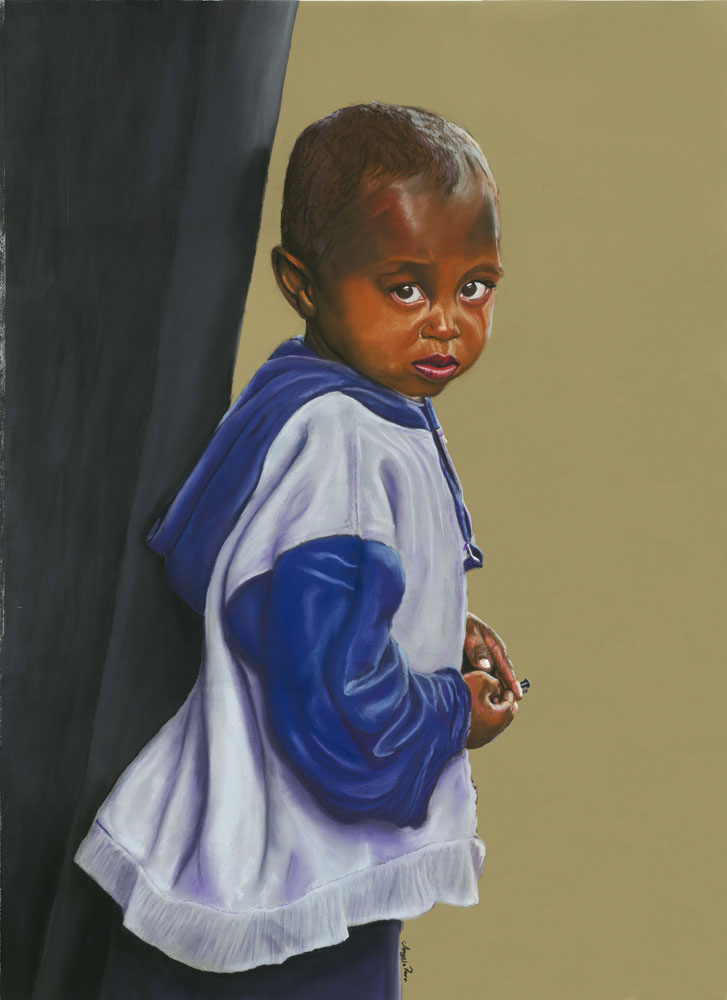
I had spent a few weeks in Madagascar when I walked past this little boy standing outside his mother’s small, basic house in the outskirts of Antananarivo (the capital). He had the remnants of tears on his face, and I wonder what had upset him. It was only after I took the photo that I realised he held a nail in his hand as a “plaything”.Read more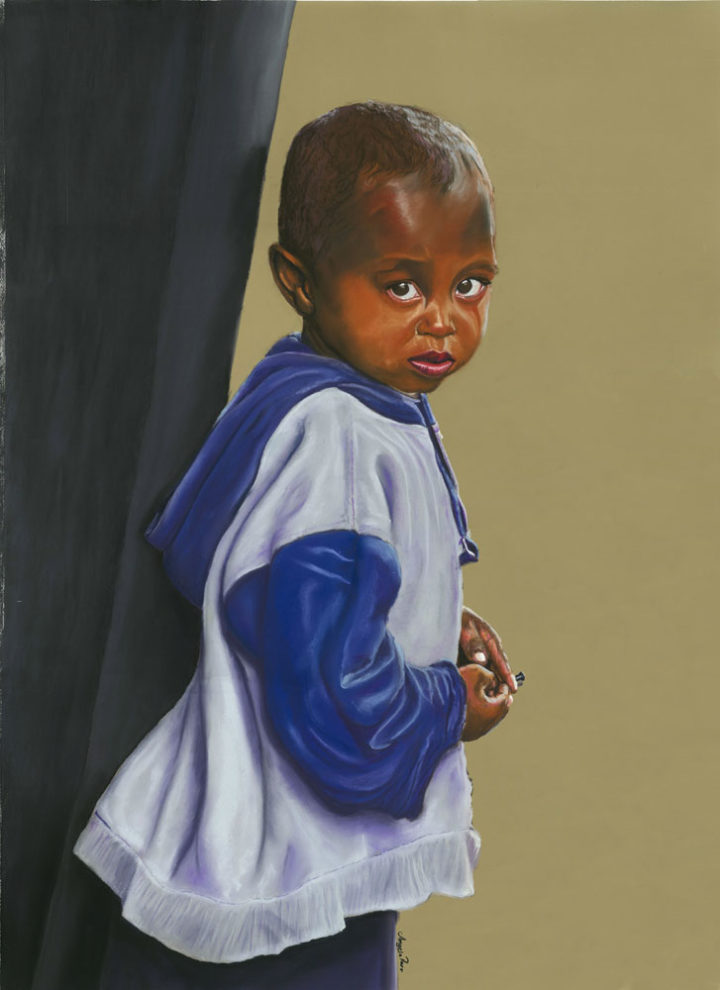
The Nail
Pastel on Mi Tientes Tex ($POA)
50 cm W x 70 cm H
I had spent a few weeks in Madagascar when I walked past this little boy standing outside his mother’s small, basic house in the outskirts of Antananarivo (the capital). He had the remnants of tears on his face, and I wonder what had upset him. It was only after I took the photo that I realised he held a nail in his hand as a “plaything”.Quick View -
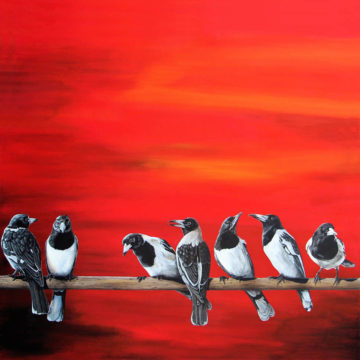
Butchers
Acrylic on canvas (Sold)
122 cm W x 122 cm H
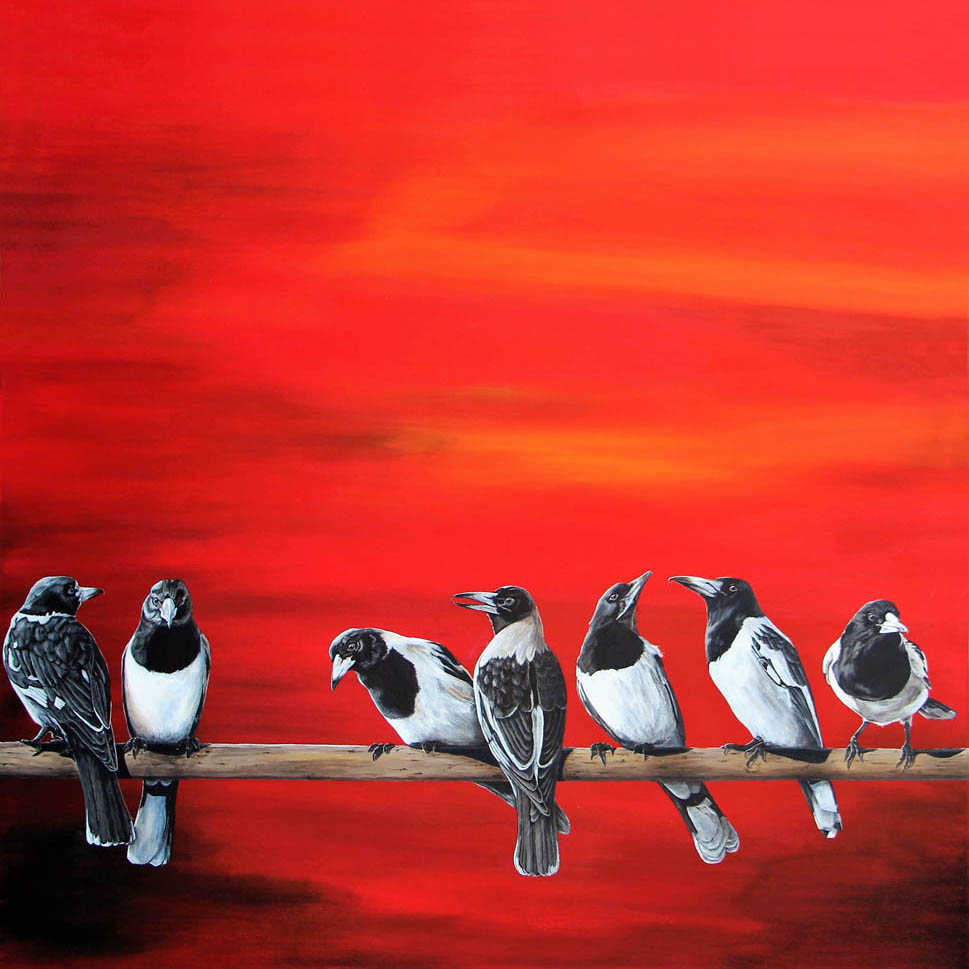
The striking red background in this “Avian Criminal” piece hints strongly at the blood thirsty nature of the pied butcherbird (Cracticus nigrogularis) due to its habit of sometimes storing food items by impaling them on a stick or on barbed wire or shoving them in a nook or crevice. In ironic contrast the pied butcherbird has been considered the most accomplished songbird in Australia, its song described as a “magic flute”. Song melodies vary across the continent and no single song is sung by the whole population. There is no clear demarcation between simple calls and elaborate songs: duets, and even larger choirs, are common. The species improvises extensively in creating new and complex melodies. One of its calls has been likened to the opening bars of Beethoven’s Fifth Symphony. Singing often takes place at dawn, rarely late in the day, but sometimes on moonlit nights.Read more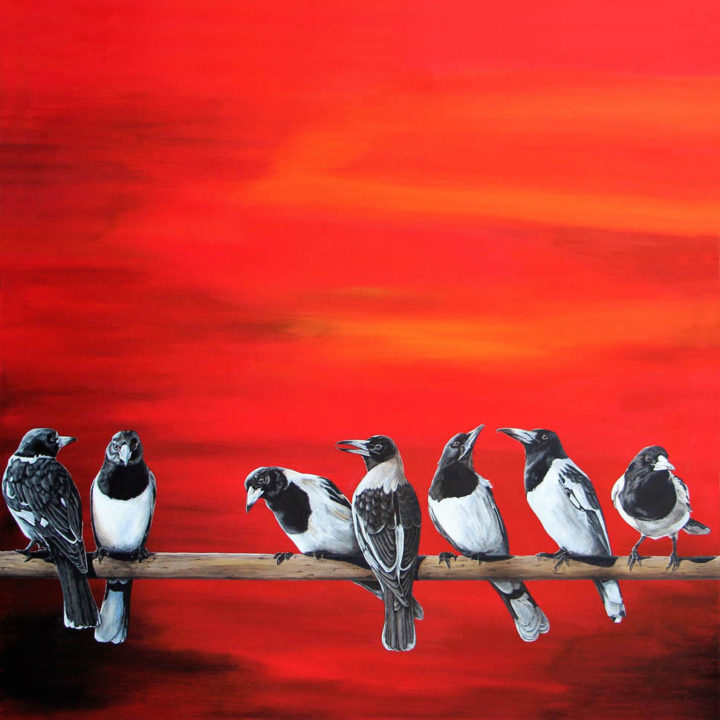
Butchers
Acrylic on canvas (Sold)
122 cm W x 122 cm H
The striking red background in this “Avian Criminal” piece hints strongly at the blood thirsty nature of the pied butcherbird (Cracticus nigrogularis) due to its habit of sometimes storing food items by impaling them on a stick or on barbed wire or shoving them in a nook or crevice. In ironic contrast the pied butcherbird has been considered the most accomplished songbird in Australia, its song described as a “magic flute”. Song melodies vary across the continent and no single song is sung by the whole population. There is no clear demarcation between simple calls and elaborate songs: duets, and even larger choirs, are common. The species improvises extensively in creating new and complex melodies. One of its calls has been likened to the opening bars of Beethoven’s Fifth Symphony. Singing often takes place at dawn, rarely late in the day, but sometimes on moonlit nights.Quick View -
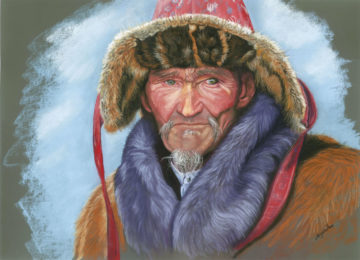
Mongolian Eagle Hunter
Pastel on Mi Tientes Tex paper ($POA)
89 cm W x 70 cm H
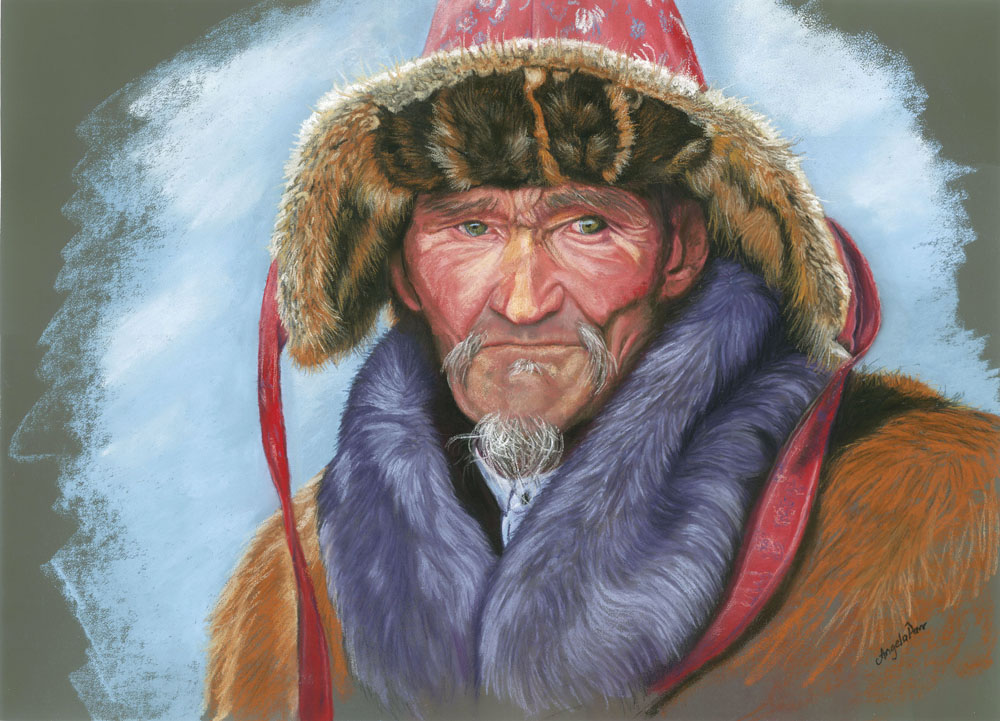
Several years ago, my husband and I had a great good fortune to be able to travel to Western Mongolia and attend the famed Golden Eagle Festival. What magnificent days we spent there, learning about, and being immersed in ancient Mongolian culture. This interesting face was one of the “judges” and his garb was typical of what all the other participants were wearing, thick fur hats and coats to keep out the cold.Read more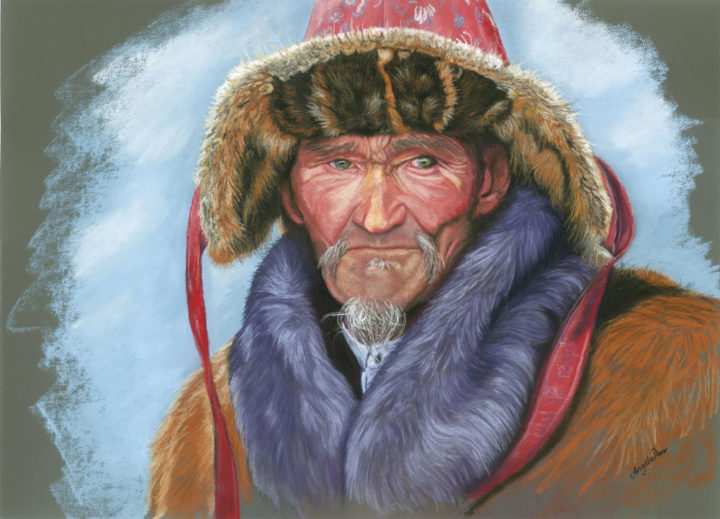
Mongolian Eagle Hunter
Pastel on Mi Tientes Tex paper ($POA)
89 cm W x 70 cm H
Several years ago, my husband and I had a great good fortune to be able to travel to Western Mongolia and attend the famed Golden Eagle Festival. What magnificent days we spent there, learning about, and being immersed in ancient Mongolian culture. This interesting face was one of the “judges” and his garb was typical of what all the other participants were wearing, thick fur hats and coats to keep out the cold.Quick View -
Casey
Pastel on Canson paper (Sold)
30 cm W x 30 cm H
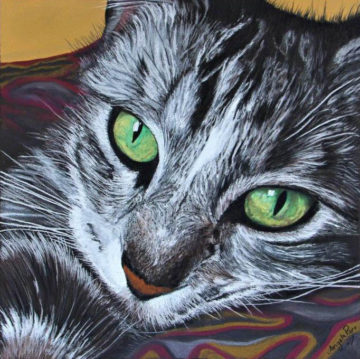
The devastating flood of 2017 saw almost 20,000 people evacuated from the northern rivers area of NSW. The flood peaked at 11.59 metres in Lismore on March 31, overtopping the levee and inundating the CBD. It affected 68 per cent of businesses resulting in an estimated damage bill of just under $40 million. Afterwards when the water receded almost every home and business on the floodplain had a large muddy pile of possessions stacked on the roadside awaiting council pick-up. In some areas possessions had floated away and were now scattered across open areas. Pets were also lost with one family losing some sixty guinea pigs. As an artist I offered to “memorialise” some of these lost pets. Casey was one of these much-loved pets, and her owner was grateful to receive my tribute to her.Read more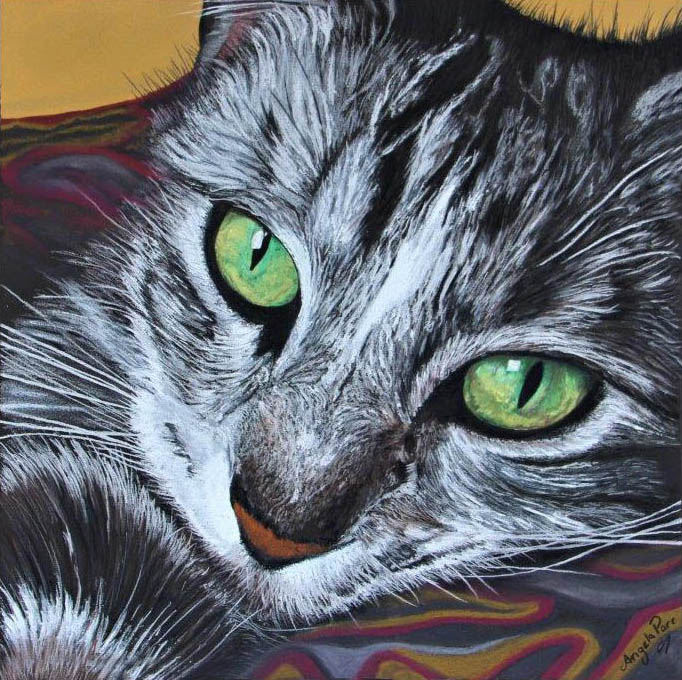
Casey
Pastel on Canson paper (Sold)
30 cm W x 30 cm H
The devastating flood of 2017 saw almost 20,000 people evacuated from the northern rivers area of NSW. The flood peaked at 11.59 metres in Lismore on March 31, overtopping the levee and inundating the CBD. It affected 68 per cent of businesses resulting in an estimated damage bill of just under $40 million. Afterwards when the water receded almost every home and business on the floodplain had a large muddy pile of possessions stacked on the roadside awaiting council pick-up. In some areas possessions had floated away and were now scattered across open areas. Pets were also lost with one family losing some sixty guinea pigs. As an artist I offered to “memorialise” some of these lost pets. Casey was one of these much-loved pets, and her owner was grateful to receive my tribute to her.Quick View -
Himba Queen
Watercolour base and pastels on Mi Tientes Tex ($POA)
54 cm W x 73 cm H
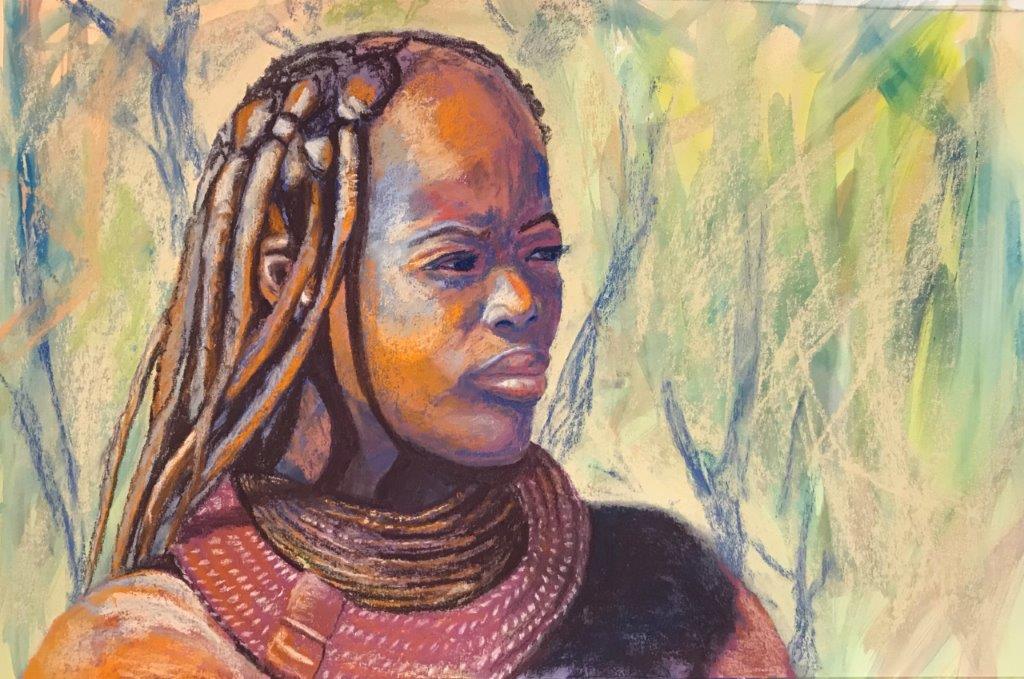
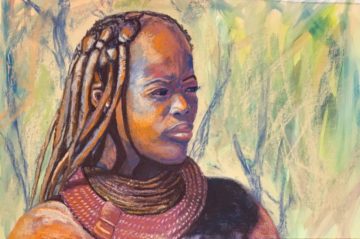
Another wonderful trip overseas saw us in Namibia, Africa where we met and spent time with the Himba tribe. Himba people, especially women, are famous for covering themselves with otjize paste, a cosmetic mixture of butterfat and ochre pigment. Otjize cleanses the skin over long periods due to water scarcity and protects from the hot and dry climate of the Kaokoland, as well as from insect bites. It gives Himba people’s skin and hair plaits a distinctive texture, style, and orange or red tinge, and is often perfumed with the aromatic resin of the omuzumba shrub. Otjize is considered foremost a highly desirable aesthetic beauty cosmetic, symbolizing earth’s rich red color and blood, the essence of life, and is consistent with the OvaHimba ideal of beauty. Women who have been married for about a year or have had a child wear an ornate headpiece called the Erembe, sculptured from sheepskin, with many streams of braided hair coloured and put in shape with otjize pasteRead more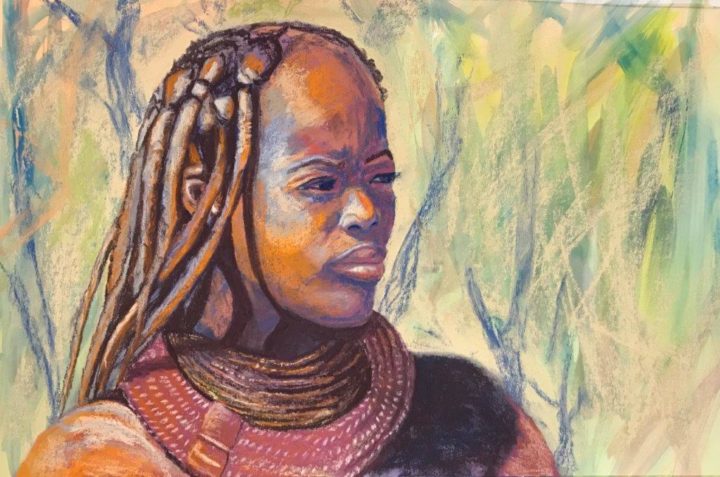
Himba Queen
Watercolour base and pastels on Mi Tientes Tex ($POA)
54 cm W x 73 cm H
Another wonderful trip overseas saw us in Namibia, Africa where we met and spent time with the Himba tribe. Himba people, especially women, are famous for covering themselves with otjize paste, a cosmetic mixture of butterfat and ochre pigment. Otjize cleanses the skin over long periods due to water scarcity and protects from the hot and dry climate of the Kaokoland, as well as from insect bites. It gives Himba people’s skin and hair plaits a distinctive texture, style, and orange or red tinge, and is often perfumed with the aromatic resin of the omuzumba shrub. Otjize is considered foremost a highly desirable aesthetic beauty cosmetic, symbolizing earth’s rich red color and blood, the essence of life, and is consistent with the OvaHimba ideal of beauty. Women who have been married for about a year or have had a child wear an ornate headpiece called the Erembe, sculptured from sheepskin, with many streams of braided hair coloured and put in shape with otjize pasteQuick View -
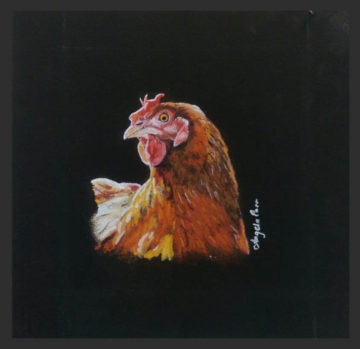
Chicken (Miniature)
Pastel on Canson paper (Sold)
15 cm W x 15 cm H
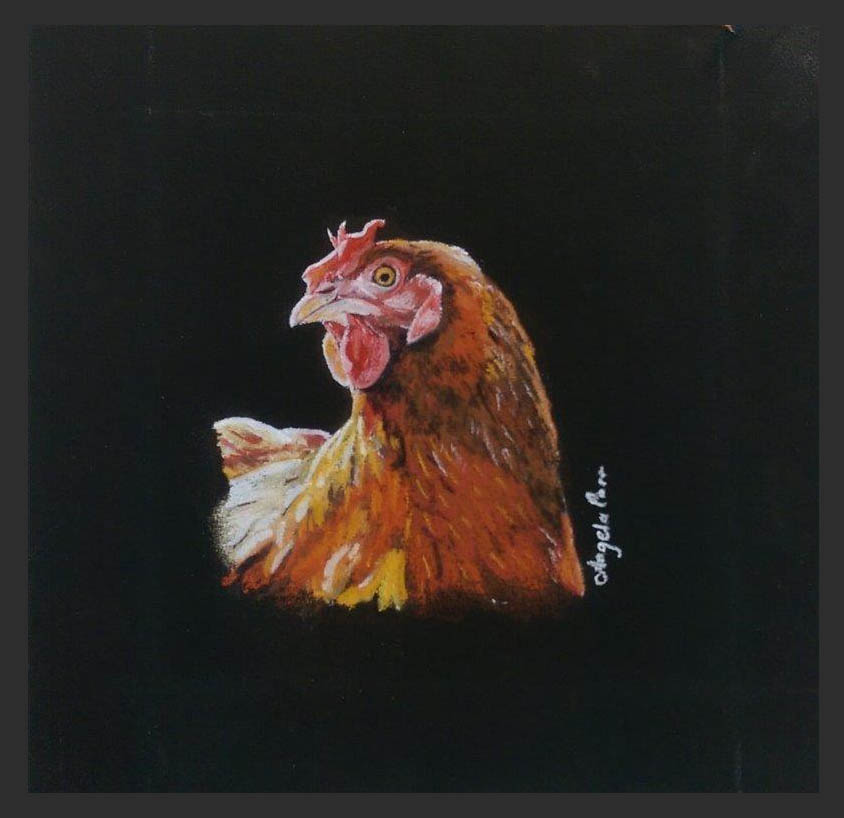
This small fun piece was done as a donation for a Cancer Council fundraiser.Read more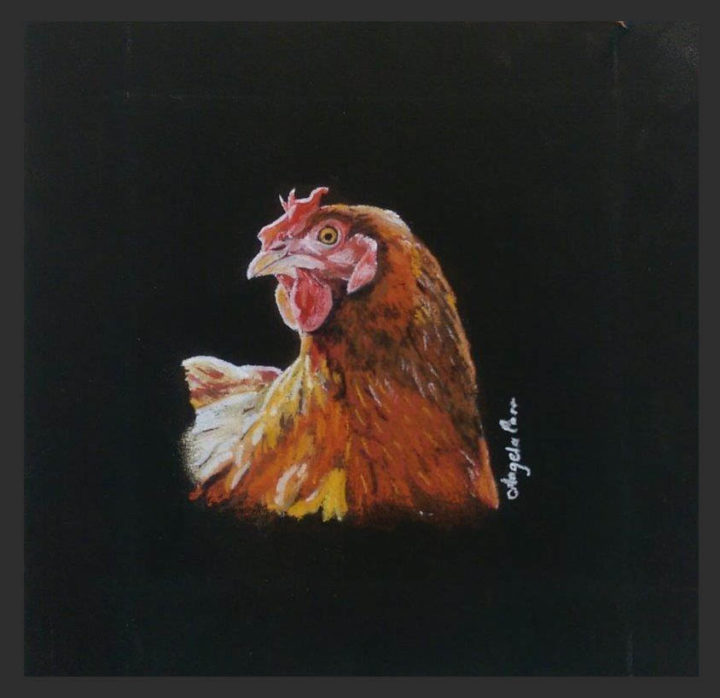
Chicken (Miniature)
Pastel on Canson paper (Sold)
15 cm W x 15 cm H
This small fun piece was done as a donation for a Cancer Council fundraiser.Quick View -
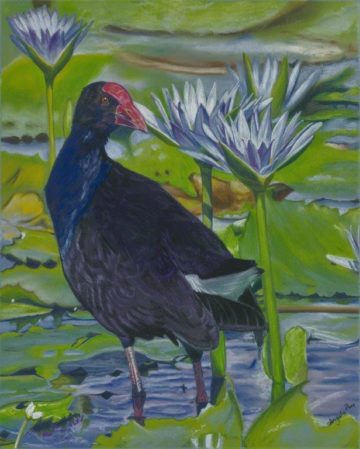
Pukeko
Pastel on Canson paper ($POA)
30 cm W x 36 cm H
Our dog was a very well behaved cattle dog who as a rule didn’t chase wildlife or birds, but there was something about the “pukeko” which drove her crazy. The Australasian swamphen (Porphyrio melanotus) is a species of swamphen occurring in eastern Indonesia, Papua New Guinea, Australia and New Zealand where it is known as the pukeko. They are a handsome bird of the wetlands, Conspicuous blue and black in colour with a gigantic red bill and forehead shield. They have large feet and white under tail feathers which they flick up and down when walking. They are very vocal, often making loud crowing calls and a range of other shorter squawks, including a single note squawk at night.Read more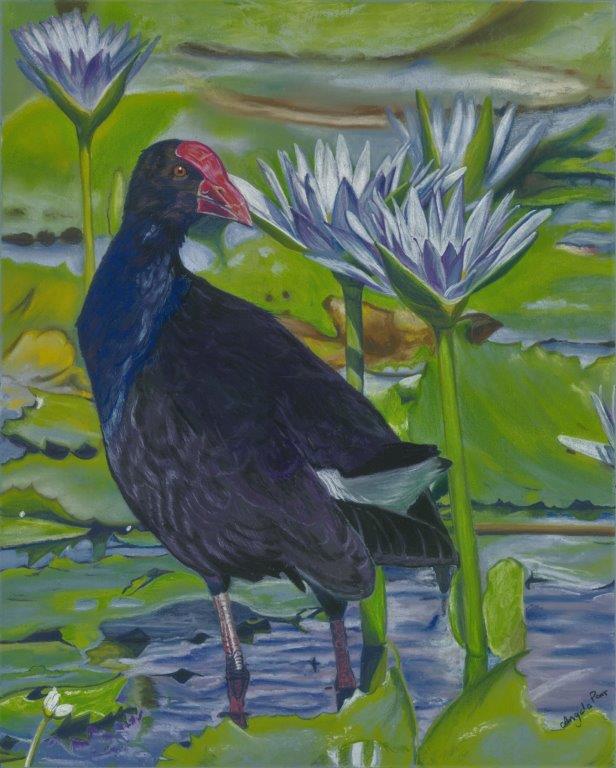
Pukeko
Pastel on Canson paper ($POA)
30 cm W x 36 cm H
Our dog was a very well behaved cattle dog who as a rule didn’t chase wildlife or birds, but there was something about the “pukeko” which drove her crazy. The Australasian swamphen (Porphyrio melanotus) is a species of swamphen occurring in eastern Indonesia, Papua New Guinea, Australia and New Zealand where it is known as the pukeko. They are a handsome bird of the wetlands, Conspicuous blue and black in colour with a gigantic red bill and forehead shield. They have large feet and white under tail feathers which they flick up and down when walking. They are very vocal, often making loud crowing calls and a range of other shorter squawks, including a single note squawk at night.Quick View