Birds
-
Crimson Quartet
Acrylic on Canvas (Sold)
Image size 100.2 cm h x 100.2 cm w
The Crimson Rosella (Platycercus elegans) is a parrot native to eastern and south eastern Australia common in coastal and mountain forests at all altitudes. It is a medium-sized Australian parrot at 36 cm (14 in) long, much of which is tail.
Adults and juveniles generally show strikingly different colouration in south-eastern populations, with predominantly greenish-olive body plumage on the juvenile, most persistent on the nape and breast. Juveniles are said to ‘ripen’ as they get older and turn from green to red. All races have blue cheeks and black-scalloped blue-margined wings and predominantly blue tail with predominantly red coloration. The most noticeable difference between sexes is that males are up to 15% larger, and have a relatively larger and wider beak.
Almost all Crimson Rosellas are sedentary, although occasional populations are considered nomadic; no rosellas are migratory. Outside of the breeding season, Crimson Rosellas tend to congregate in pairs or small groups and feeding parties. When they forage, they are conspicuous and chatter noisily. Rosellas are monogamous, and during the breeding season, adult birds will not congregate in groups and will only forage with their mate.Read more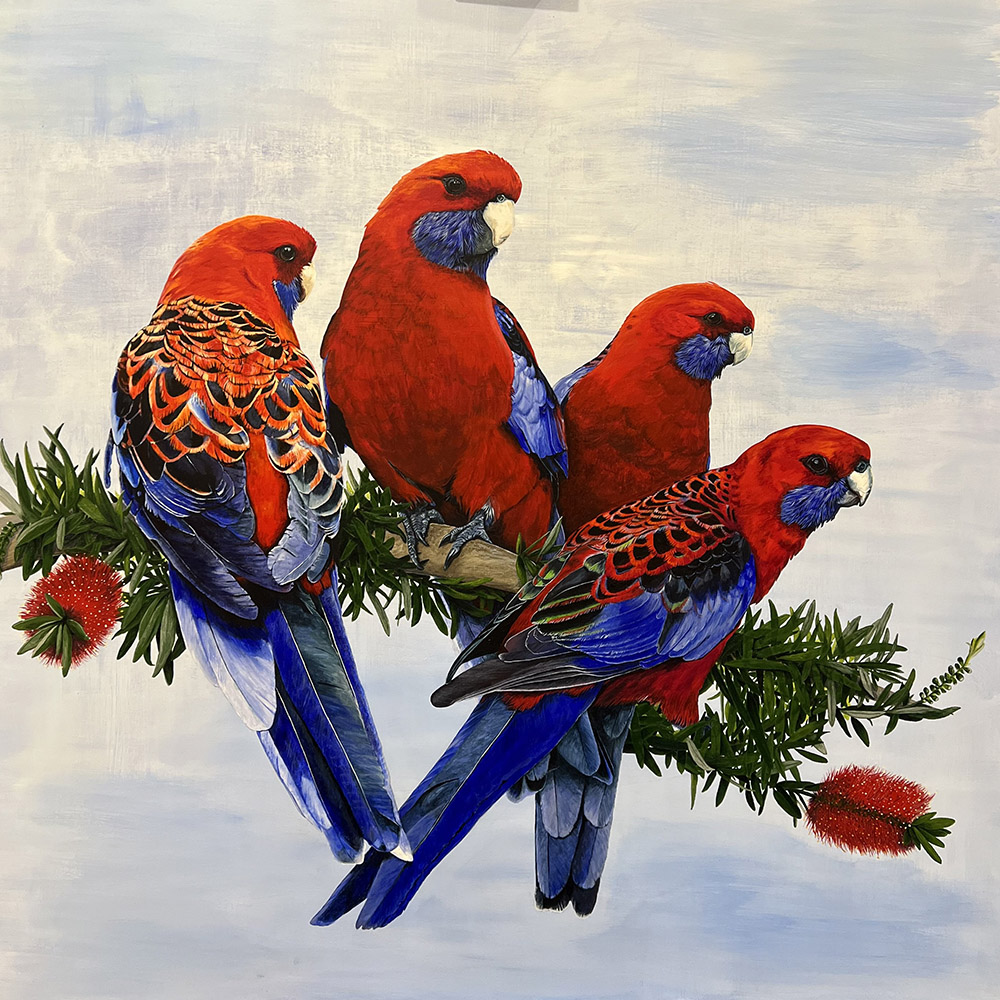
Crimson Quartet
Acrylic on Canvas (Sold)
Image size 100.2 cm h x 100.2 cm w
The Crimson Rosella (Platycercus elegans) is a parrot native to eastern and south eastern Australia common in coastal and mountain forests at all altitudes. It is a medium-sized Australian parrot at 36 cm (14 in) long, much of which is tail.
Adults and juveniles generally show strikingly different colouration in south-eastern populations, with predominantly greenish-olive body plumage on the juvenile, most persistent on the nape and breast. Juveniles are said to ‘ripen’ as they get older and turn from green to red. All races have blue cheeks and black-scalloped blue-margined wings and predominantly blue tail with predominantly red coloration. The most noticeable difference between sexes is that males are up to 15% larger, and have a relatively larger and wider beak.
Almost all Crimson Rosellas are sedentary, although occasional populations are considered nomadic; no rosellas are migratory. Outside of the breeding season, Crimson Rosellas tend to congregate in pairs or small groups and feeding parties. When they forage, they are conspicuous and chatter noisily. Rosellas are monogamous, and during the breeding season, adult birds will not congregate in groups and will only forage with their mate.Quick View -
Damn! Forgot My Spoon
Pastel on Pastelmat Card ($POA)
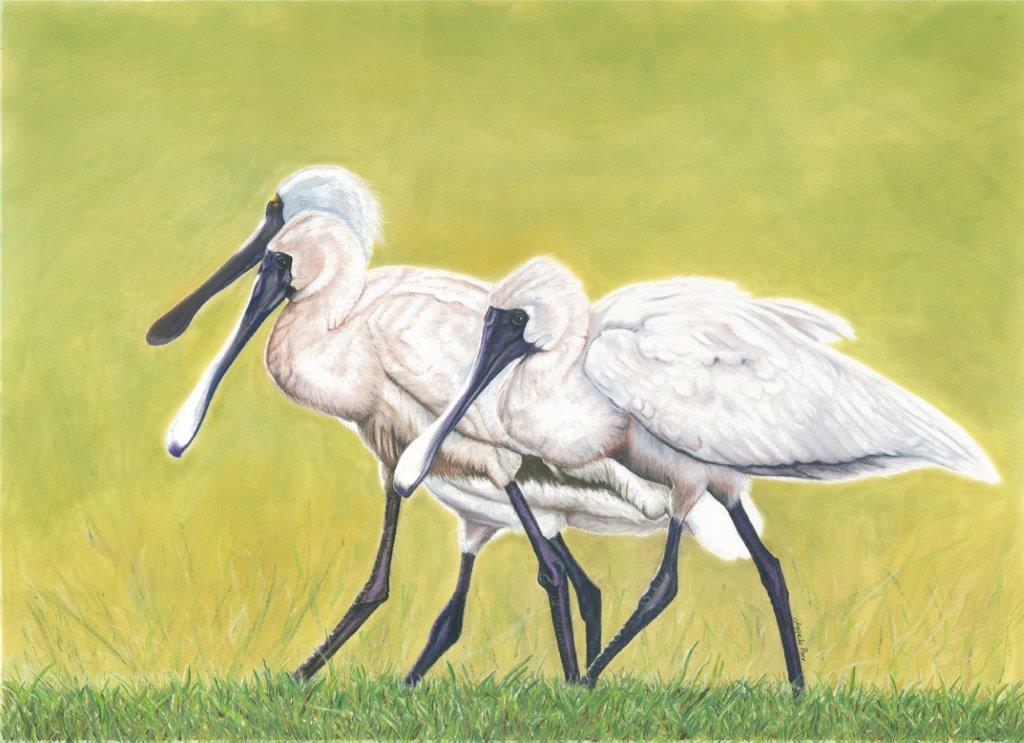
The royal spoonbill (Platalea regia) also known as the black-billed spoonbill, occurs in intertidal flats and shallows of fresh and saltwater wetlands in Australia, New Zealand, Indonesia, Papua New Guinea, and the Solomon Islands. It is a wading bird and has long legs for walking through water. Spoonbills are characterized by their spoon-shaped bills, which they use to sweep through the water to catch prey. It eats fish, shellfish, crabs and amphibians, catching its prey by making a side-to-side movement with its bill. Ibises, also have long legs and long necks, but on the other hand have long, curved beaks used for probing in the mud for food. They are however the closest relative spoonbills have. Both Ibis and Spoonbills are excellent indicators of wetland health.
Read more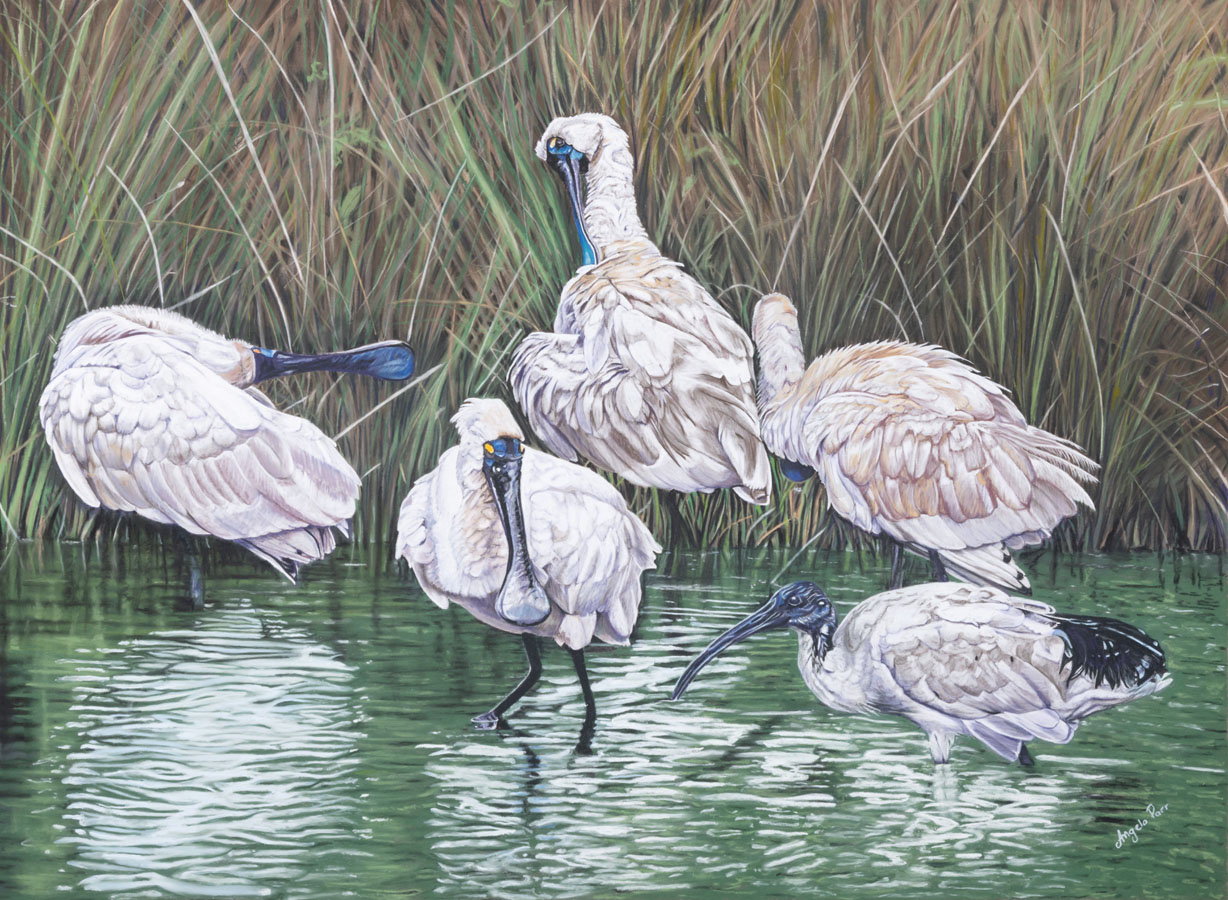
Damn! Forgot My Spoon
Pastel on Pastelmat Card ($POA)
The royal spoonbill (Platalea regia) also known as the black-billed spoonbill, occurs in intertidal flats and shallows of fresh and saltwater wetlands in Australia, New Zealand, Indonesia, Papua New Guinea, and the Solomon Islands. It is a wading bird and has long legs for walking through water. Spoonbills are characterized by their spoon-shaped bills, which they use to sweep through the water to catch prey. It eats fish, shellfish, crabs and amphibians, catching its prey by making a side-to-side movement with its bill. Ibises, also have long legs and long necks, but on the other hand have long, curved beaks used for probing in the mud for food. They are however the closest relative spoonbills have. Both Ibis and Spoonbills are excellent indicators of wetland health.
Quick View -
In the Forest Deep and Dark
Pastel on Pastelmat Board ($POA)
Image size 47cm h x 56 cm w
Framed 83 cm h x 65 cm w
The Azure Kingfisher is found across northern and eastern Australia, almost always above water. It patrols up and down waterways and rivers from perch to perch flying very fast, and only a few meters off the water, typically making a loud high pitched “seeeeeeeep” call. They are very defensive of their breeding territory and form monogamous pairs. Their nests are hidden away at the end of a burrow, dug out of soil in riverbanks. Both parents incubate and feed the chicks. This pastel artwork captures an Azure Kingfisher in a fragile eco-system, a deep and dark mangrove forest. My artwork has contrasted a monochrome background with the bright blues of the bird, thereby focusing on it and the purity of its environment, hoping to elicit in the viewer an urgent need to protect our critical coastal habitats for future generations.Read more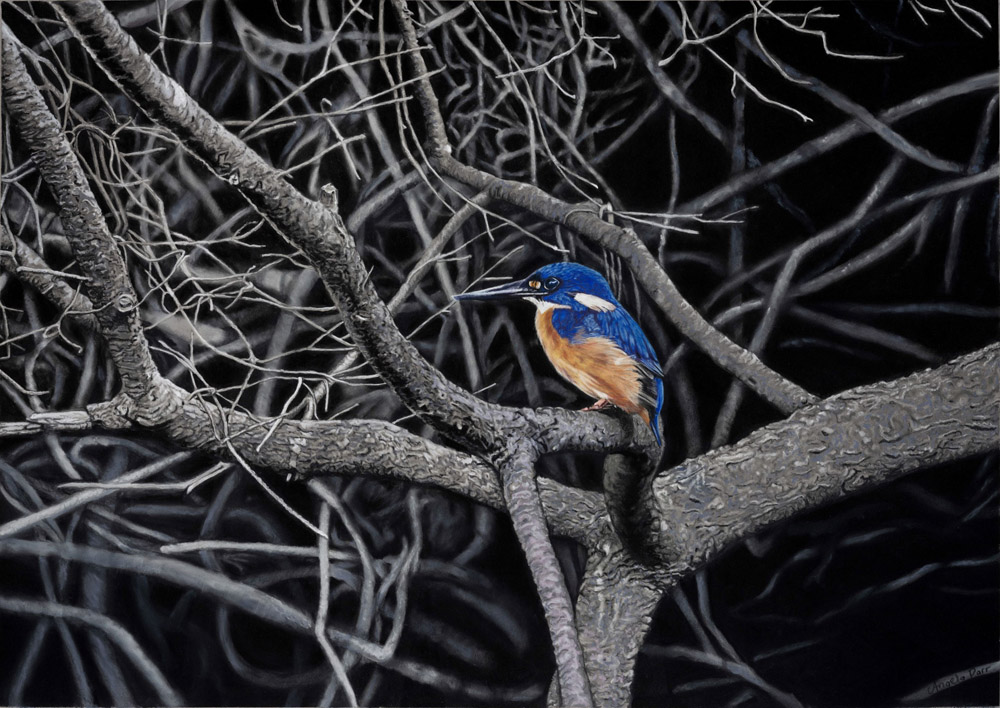
In the Forest Deep and Dark
Pastel on Pastelmat Board ($POA)
Image size 47cm h x 56 cm w
Framed 83 cm h x 65 cm w
The Azure Kingfisher is found across northern and eastern Australia, almost always above water. It patrols up and down waterways and rivers from perch to perch flying very fast, and only a few meters off the water, typically making a loud high pitched “seeeeeeeep” call. They are very defensive of their breeding territory and form monogamous pairs. Their nests are hidden away at the end of a burrow, dug out of soil in riverbanks. Both parents incubate and feed the chicks. This pastel artwork captures an Azure Kingfisher in a fragile eco-system, a deep and dark mangrove forest. My artwork has contrasted a monochrome background with the bright blues of the bird, thereby focusing on it and the purity of its environment, hoping to elicit in the viewer an urgent need to protect our critical coastal habitats for future generations.Quick View -
Me First! Me First!
Pastel on Pastelmat Board ($POA)
Image size 60 cm h x 60 cm w
Framed 78 cm h x 78 cm wThe Nankeen Kestrel (Falco cenchroides) is widespread in Australia, though it occurs only sporadically in Tasmania. Kestrels usually occur in open country, such as grasslands and farmland, and avoid dense forests unless they have been opened up by clearing. They hunt a variety of prey, including small mammals (especially mice), small birds, lizards and insects. Small items may be eaten while flying, but larger prey is taken back to a perch. The Nankeen Kestrel’s success as a bird of prey can be largely contributed to its tolerance for a wide variety of habitats and its ability to feed on a variety of foods and nest in a range of sites.
It nests in a wide variety of sites, including tree hollows, caves, ledges on the outside of buildings, and occasionally on the ground. The nest consists of anything from a simple scrape in the dirt of a ledge or tree hollow, to a nest of sticks or mud that has been abandoned by another species of bird. Pairs of Nankeen Kestrels usually stay together over successive breeding seasons and will often use the same nest site or territory year after year. Usually, only one brood of young is raised in a year. The female does the bulk of the incubation, while the male supplies the food.Read more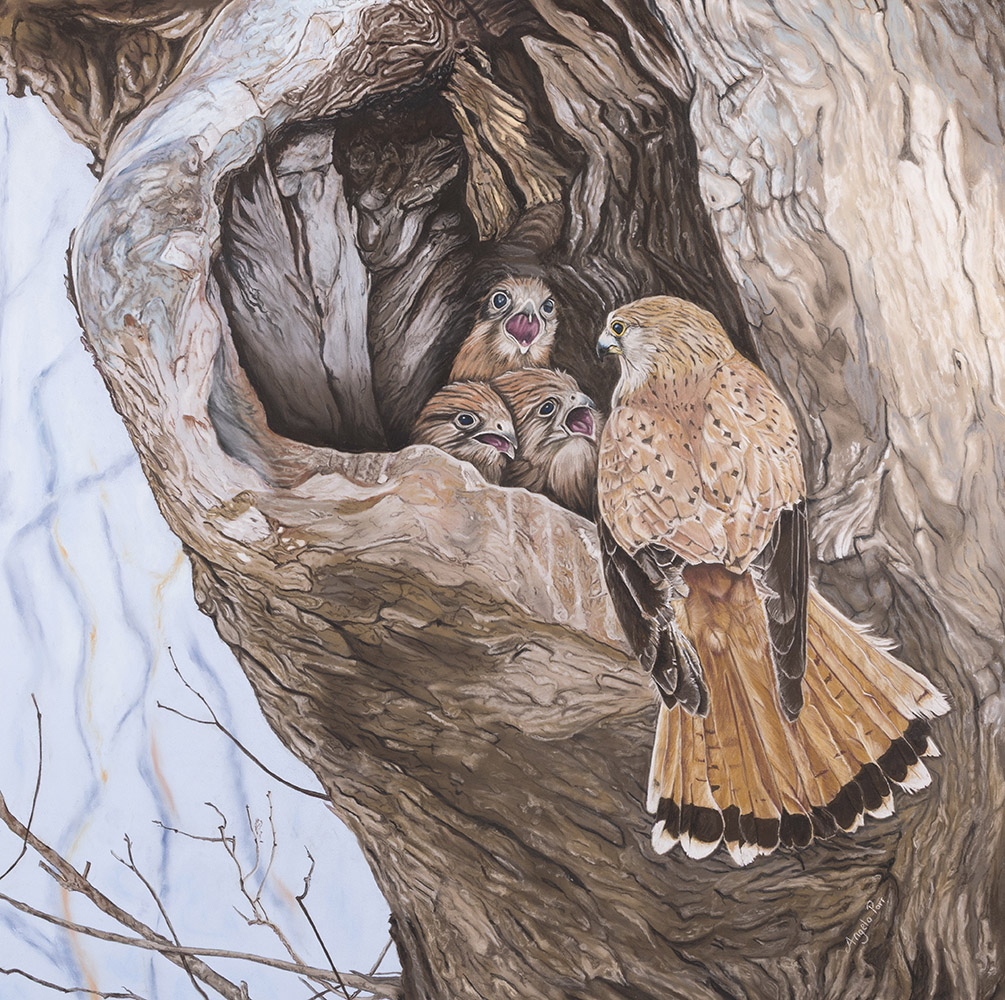
Me First! Me First!
Pastel on Pastelmat Board ($POA)
Image size 60 cm h x 60 cm w
Framed 78 cm h x 78 cm wThe Nankeen Kestrel (Falco cenchroides) is widespread in Australia, though it occurs only sporadically in Tasmania. Kestrels usually occur in open country, such as grasslands and farmland, and avoid dense forests unless they have been opened up by clearing. They hunt a variety of prey, including small mammals (especially mice), small birds, lizards and insects. Small items may be eaten while flying, but larger prey is taken back to a perch. The Nankeen Kestrel’s success as a bird of prey can be largely contributed to its tolerance for a wide variety of habitats and its ability to feed on a variety of foods and nest in a range of sites.
It nests in a wide variety of sites, including tree hollows, caves, ledges on the outside of buildings, and occasionally on the ground. The nest consists of anything from a simple scrape in the dirt of a ledge or tree hollow, to a nest of sticks or mud that has been abandoned by another species of bird. Pairs of Nankeen Kestrels usually stay together over successive breeding seasons and will often use the same nest site or territory year after year. Usually, only one brood of young is raised in a year. The female does the bulk of the incubation, while the male supplies the food.Quick View -
Reef Raider
Pastel on Pastelmat Board (Sold)
Image size 42 cm H x 60 cm W.
Framed 61 cm H x 78 cm WFlat Rock is exactly as it sounds, a large flat rocky outcrop between two beaches in the Ballina Shire. It is a haven for seabirds, both local and migratory, and they know they are safe there. This Pacific Reef Egret (also known as Eastern Reef Egret, and Pacific Reef Heron) was busy fishing in the early morning, wading through one of the many shallow pools.
Having lived in this area since 1982, I often walk these beaches enjoying the beautiful sights here. I just love the drama in this image and hope my artwork has conveyed this.Read more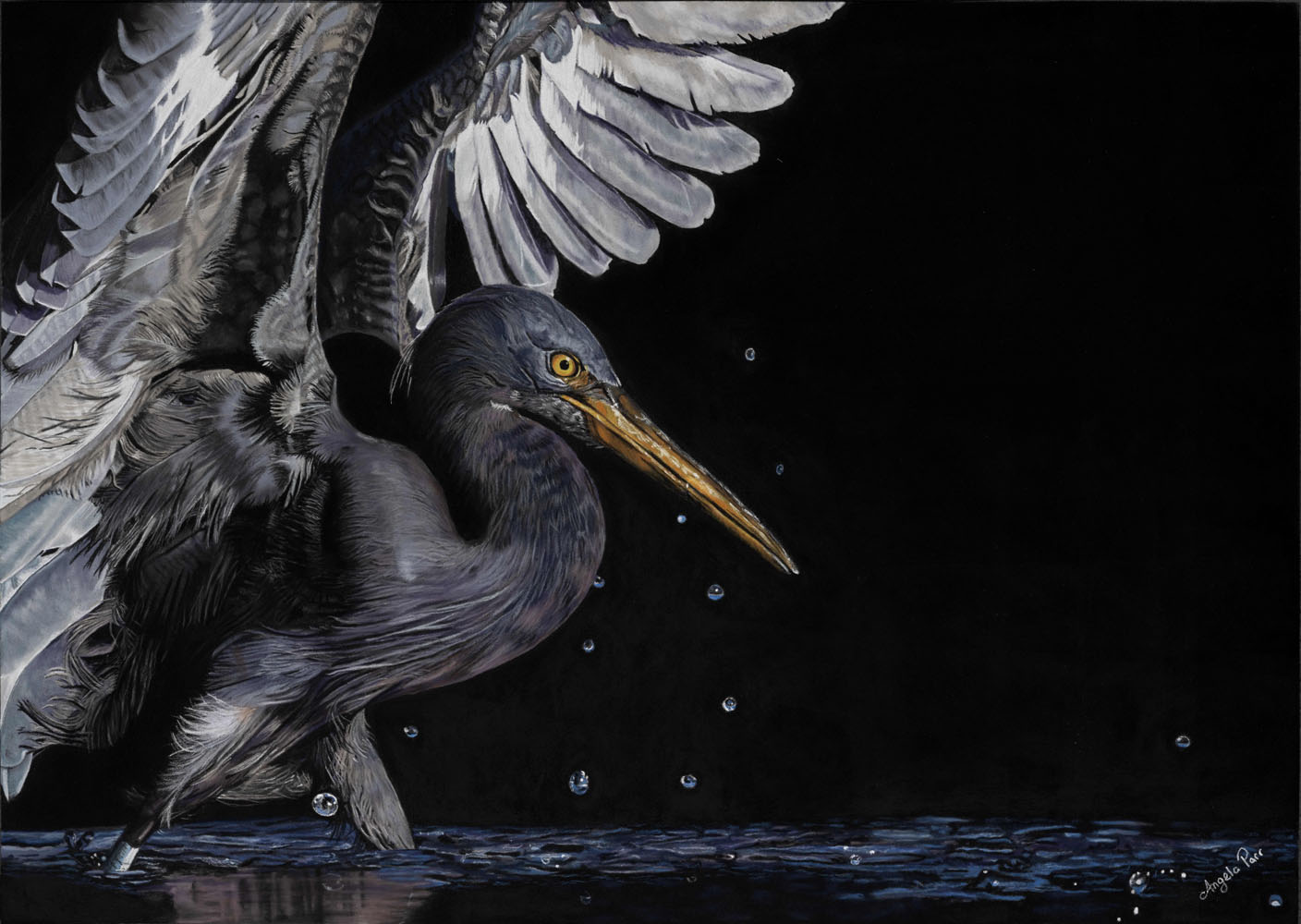
Reef Raider
Pastel on Pastelmat Board (Sold)
Image size 42 cm H x 60 cm W.
Framed 61 cm H x 78 cm WFlat Rock is exactly as it sounds, a large flat rocky outcrop between two beaches in the Ballina Shire. It is a haven for seabirds, both local and migratory, and they know they are safe there. This Pacific Reef Egret (also known as Eastern Reef Egret, and Pacific Reef Heron) was busy fishing in the early morning, wading through one of the many shallow pools.
Having lived in this area since 1982, I often walk these beaches enjoying the beautiful sights here. I just love the drama in this image and hope my artwork has conveyed this.Quick View -
Resplendent
Pastel on Pastelmat Board ($POA)
Image size 82 cm h x 76 cm w
Framed 100 cm h x 94 cm wThe Straw-Necked Ibis (Threskiornis spinicollis) has an unenviable reputation as a worthless scavenger, however nothing could be further from the truth. Aboriginal communities recognise all ibis species (the Glossy, the Australian White and the Straw-necked) as a health indicator for our vital wetland ecosystems. Ibis are extremely important for pest control, being natural regulators of insect and grub populations, and their nesting colony guano droppings enriches the soil, promoting plant growth and improved overall health of the wetland.
They are frequently seen standing on high branches of bare trees, silhouetted against the sky. Their plumage, of distinctive, highly iridescent glossy colours, becomes apparent in bright sunlight. Resplendent means attractive and impressive through being richly colourful, and it was this quality I paid homage to.Read more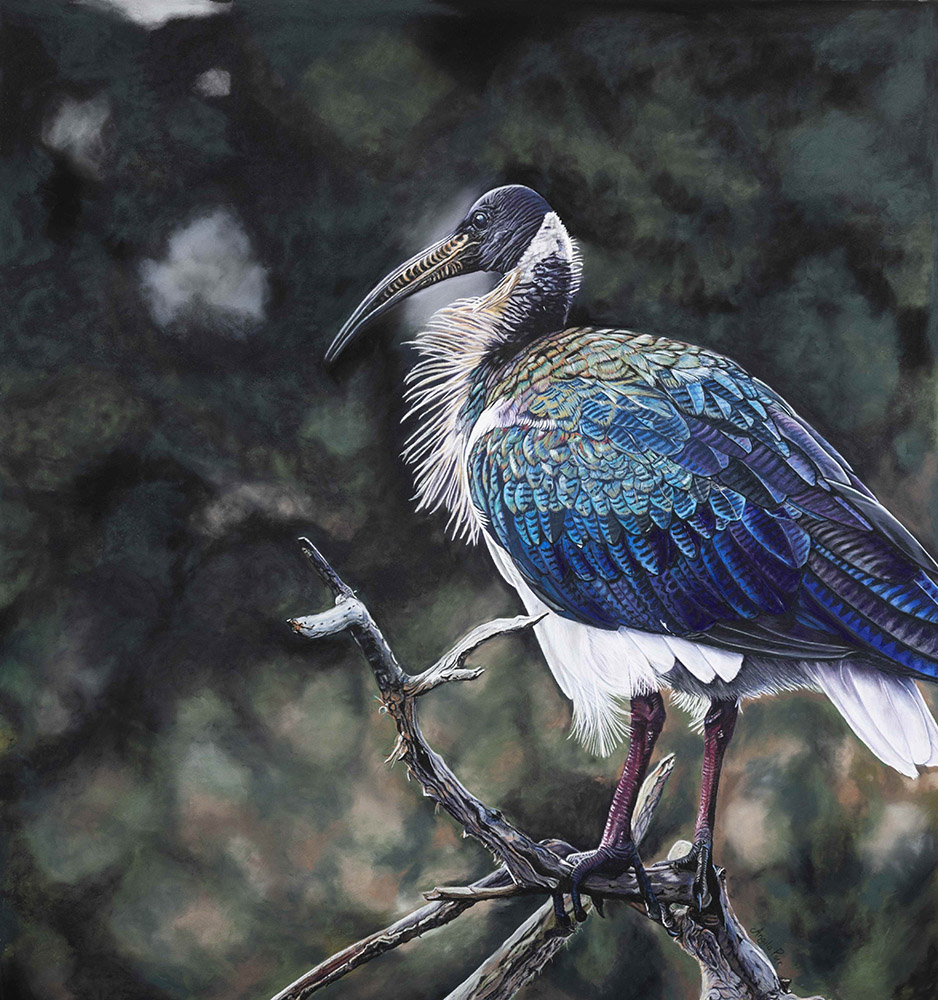
Resplendent
Pastel on Pastelmat Board ($POA)
Image size 82 cm h x 76 cm w
Framed 100 cm h x 94 cm wThe Straw-Necked Ibis (Threskiornis spinicollis) has an unenviable reputation as a worthless scavenger, however nothing could be further from the truth. Aboriginal communities recognise all ibis species (the Glossy, the Australian White and the Straw-necked) as a health indicator for our vital wetland ecosystems. Ibis are extremely important for pest control, being natural regulators of insect and grub populations, and their nesting colony guano droppings enriches the soil, promoting plant growth and improved overall health of the wetland.
They are frequently seen standing on high branches of bare trees, silhouetted against the sky. Their plumage, of distinctive, highly iridescent glossy colours, becomes apparent in bright sunlight. Resplendent means attractive and impressive through being richly colourful, and it was this quality I paid homage to.Quick View -
Scarlet Honeyeater
Pastel on Pastelmat Board ($POA)
Image size 46 cm H x 66 cm W
The tiny Scarlet Honeyeater’s range extends along the east coast of Australia. As with most Australian birds, the male is the showier of the two, with brilliant red coloration on the face and back. The female, in contrast, is pale brown-grey.
This is no doubt to protect her, and her offspring in the nest, by being less obvious for predators. My artwork is aimed to highlight her petite beauty, as she props within a flourish of red grevillea, in the Northern Rivers area of NSW, awaiting a male to enthusiastically call out to her.Read more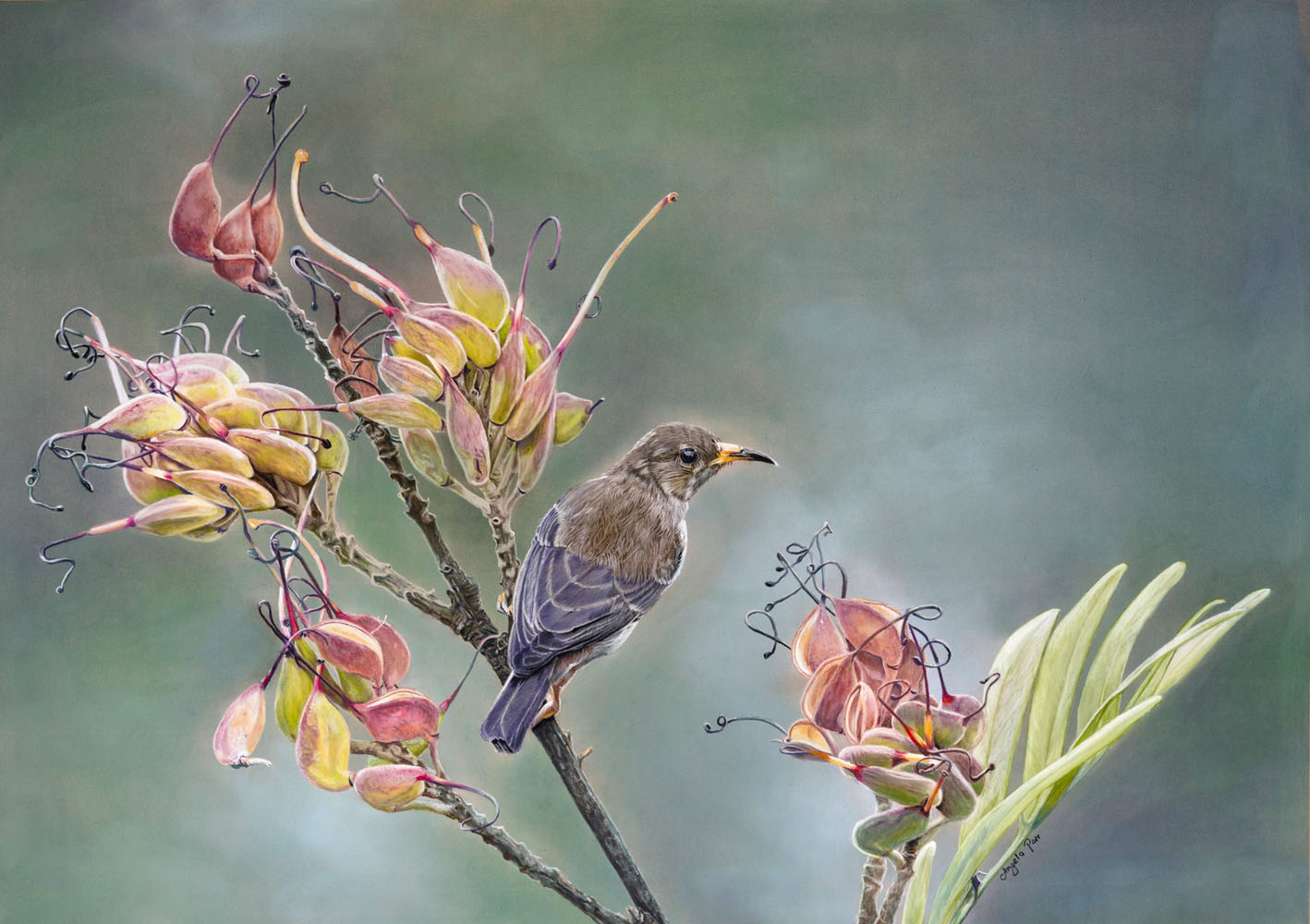
Scarlet Honeyeater
Pastel on Pastelmat Board ($POA)
Image size 46 cm H x 66 cm W
The tiny Scarlet Honeyeater’s range extends along the east coast of Australia. As with most Australian birds, the male is the showier of the two, with brilliant red coloration on the face and back. The female, in contrast, is pale brown-grey.
This is no doubt to protect her, and her offspring in the nest, by being less obvious for predators. My artwork is aimed to highlight her petite beauty, as she props within a flourish of red grevillea, in the Northern Rivers area of NSW, awaiting a male to enthusiastically call out to her.Quick View -
She Contemplates
Pastel on Pastelmat Board ($POA)
Image size 45cm h x 58 cm w
Framed 63 cm h x 76 cm w
Kookaburras are the unique and much-loved sound of the Australian bush. Despite being “boofy- headed”, they are still considered very handsome birds with an intelligent eye. They have a strong beak and a compact body covered in a beautiful array of whites, browns, and blacks. Who wouldn’t love them? This female was captured in the failing light just outside Lismore, northern NSW, presumably contemplating her next meal. Her peaceful demeanour lent itself to a serene portrait using dramatic lighting for highlighting purposes.Read more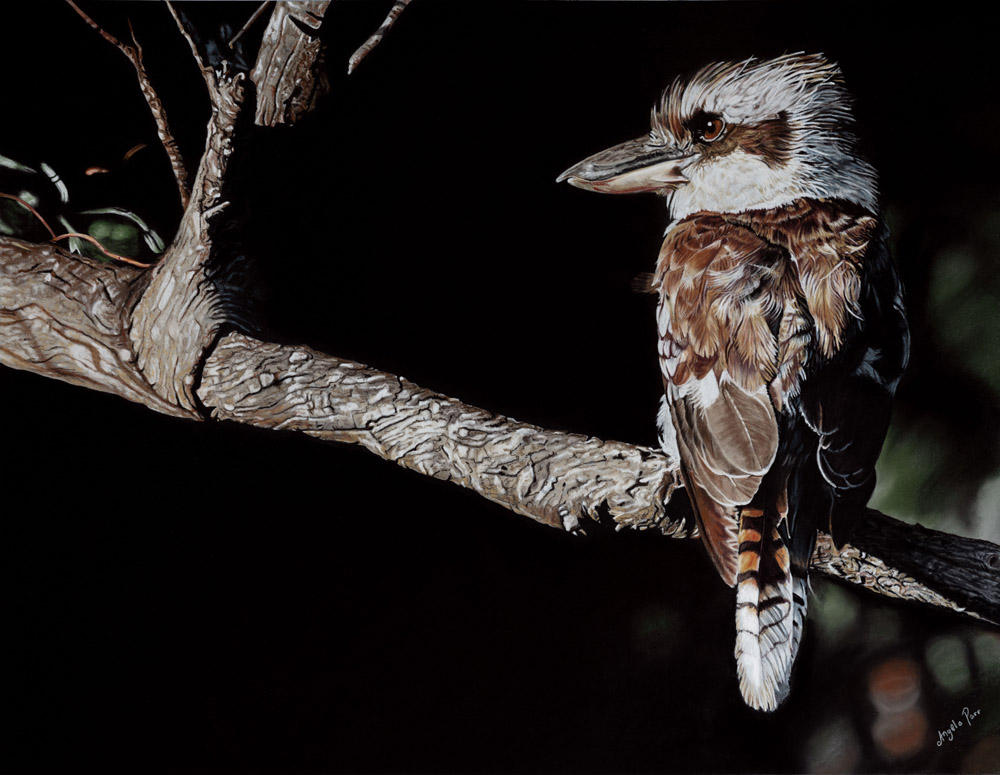
She Contemplates
Pastel on Pastelmat Board ($POA)
Image size 45cm h x 58 cm w
Framed 63 cm h x 76 cm w
Kookaburras are the unique and much-loved sound of the Australian bush. Despite being “boofy- headed”, they are still considered very handsome birds with an intelligent eye. They have a strong beak and a compact body covered in a beautiful array of whites, browns, and blacks. Who wouldn’t love them? This female was captured in the failing light just outside Lismore, northern NSW, presumably contemplating her next meal. Her peaceful demeanour lent itself to a serene portrait using dramatic lighting for highlighting purposes.Quick View -
Sitting On the Fence
Pastel on Pastelmat Board ($POA)
Image size 43 cm h x 31 cm w
Framed 66 cm h x 52 cm wThe Superb Fairywren (Malurus cyaneus ) is common and familiar across south-eastern Australia, their range extending from the south-east of South Australia (including Kangaroo Island and Adelaide) and the tip of the Eyre Peninsula, through all of Victoria, Tasmania, coastal and sub-coastal New South Wales, and Queensland, through the Brisbane area and extending inland – north to the Dawson River and west to Blackall. These birds inhabit almost any area that has at least a little dense undergrowth for shelter, including grasslands with scattered shrubs, moderately thick forest, woodland, heaths, and domestic gardens. They are active and restless feeders, active during the day and feeding mainly on open ground near the shelter, but also through the lower foliage and they accompany their foraging with song. They move with a series of jaunty hops and bounces. The Superb Fairywren was named ‘Australian Bird of the Year’ for 2021
Read more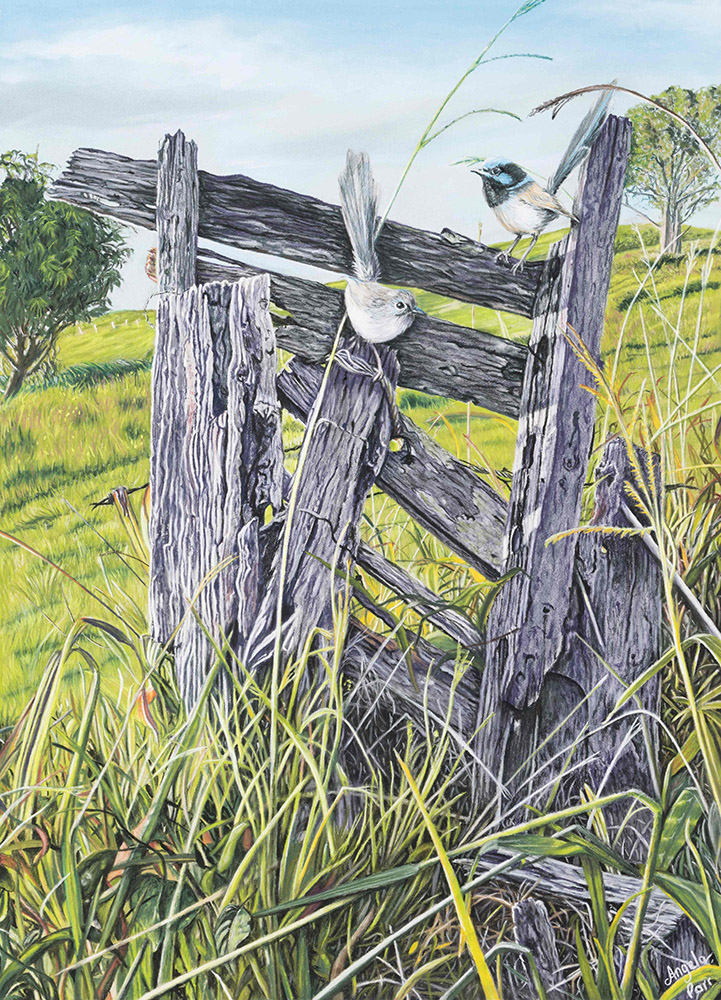
Sitting On the Fence
Pastel on Pastelmat Board ($POA)
Image size 43 cm h x 31 cm w
Framed 66 cm h x 52 cm wThe Superb Fairywren (Malurus cyaneus ) is common and familiar across south-eastern Australia, their range extending from the south-east of South Australia (including Kangaroo Island and Adelaide) and the tip of the Eyre Peninsula, through all of Victoria, Tasmania, coastal and sub-coastal New South Wales, and Queensland, through the Brisbane area and extending inland – north to the Dawson River and west to Blackall. These birds inhabit almost any area that has at least a little dense undergrowth for shelter, including grasslands with scattered shrubs, moderately thick forest, woodland, heaths, and domestic gardens. They are active and restless feeders, active during the day and feeding mainly on open ground near the shelter, but also through the lower foliage and they accompany their foraging with song. They move with a series of jaunty hops and bounces. The Superb Fairywren was named ‘Australian Bird of the Year’ for 2021
Quick View -
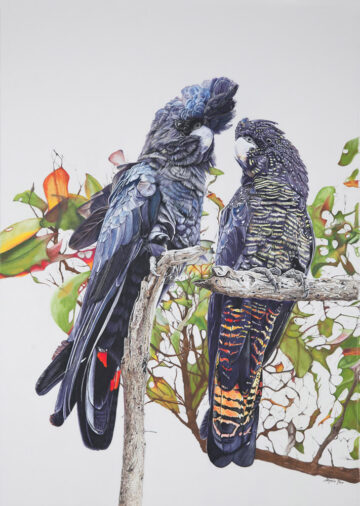
The Reds
Pastel on Pastelmat Board (Sold)
Image size 80 cm h x 60 cm w
Framed 100 cm h x 78 cm w
I recently spent time in Western Australia where these stunning Forest Red Tails reside. Sadly they are critically endangered due to losses of native habitat, car strikes, nesting competition, animal attacks, and poaching.
They mate for life, sometimes over 50 years, but as they breed slowly, just one young every second year, increasing the species’ numbers has proven difficult.
Their distinctive screech gave them their Noongar name, the Karrak, and is also old bush-lore indicating rain is coming. To see them fly overhead is an absolute privilege, and I hope to have paid homage to their beauty in my artwork.Read more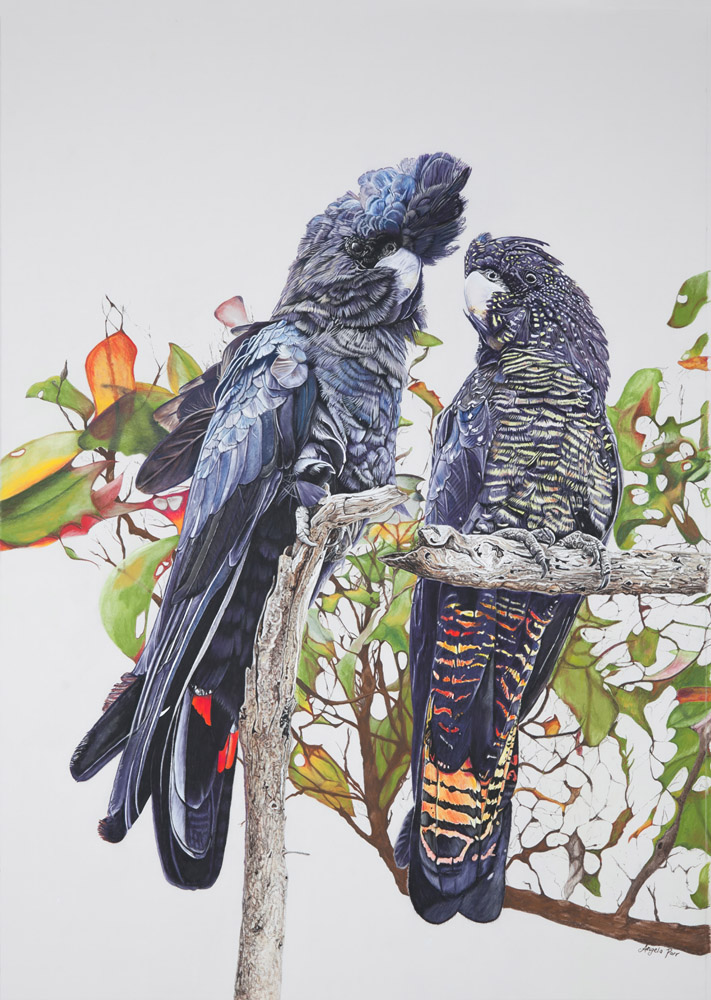
The Reds
Pastel on Pastelmat Board (Sold)
Image size 80 cm h x 60 cm w
Framed 100 cm h x 78 cm w
I recently spent time in Western Australia where these stunning Forest Red Tails reside. Sadly they are critically endangered due to losses of native habitat, car strikes, nesting competition, animal attacks, and poaching.
They mate for life, sometimes over 50 years, but as they breed slowly, just one young every second year, increasing the species’ numbers has proven difficult.
Their distinctive screech gave them their Noongar name, the Karrak, and is also old bush-lore indicating rain is coming. To see them fly overhead is an absolute privilege, and I hope to have paid homage to their beauty in my artwork.Quick View -
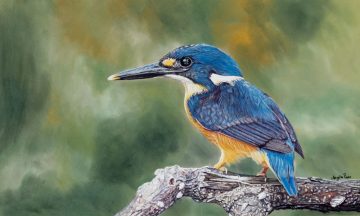
My Favourite Colour is Blue
Pastels (Sold)
30cm H x 45cm W
The Azure kingfisher is a tiny, colourful and highly elusive aquatic kingfisher, usually found above or around the edges of most waterways that have low, overhanging branches.
It patrols up and down waterways and rivers from perch to perch flying very fast, and only a few meters off the water, typically making a loud high pitched “seeeeeeeep” call.
It has a long black beak and a whitish rear eye spot. This bird gets its name from its beautiful colouring, being dark glossy blue, its underside an orange-rufous; its legs and feet red. Males and females have very similar appearance and juveniles are less vibrant in colour.
These birds are generally sedentary, although they can perform some seasonal migration.
You might see this shy bird skimming along the surface of creeks and billabongs as it hunts for fish before ducking back into the vegetation.Read more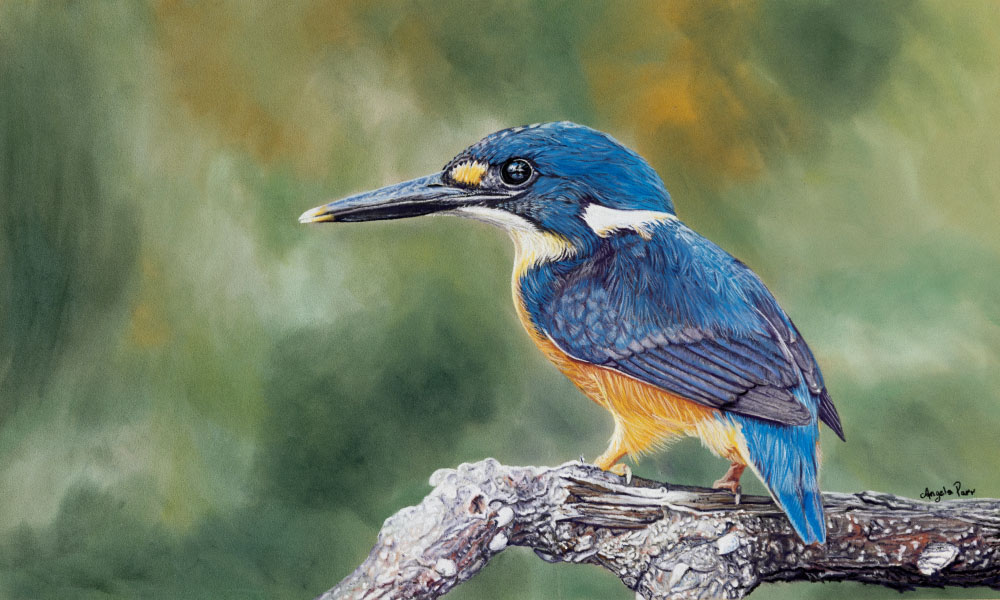
My Favourite Colour is Blue
Pastels (Sold)
30cm H x 45cm W
The Azure kingfisher is a tiny, colourful and highly elusive aquatic kingfisher, usually found above or around the edges of most waterways that have low, overhanging branches.
It patrols up and down waterways and rivers from perch to perch flying very fast, and only a few meters off the water, typically making a loud high pitched “seeeeeeeep” call.
It has a long black beak and a whitish rear eye spot. This bird gets its name from its beautiful colouring, being dark glossy blue, its underside an orange-rufous; its legs and feet red. Males and females have very similar appearance and juveniles are less vibrant in colour.
These birds are generally sedentary, although they can perform some seasonal migration.
You might see this shy bird skimming along the surface of creeks and billabongs as it hunts for fish before ducking back into the vegetation.Quick View -
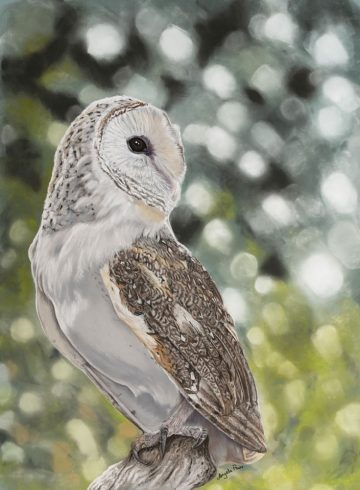
Socrates
Pastels ($POA)
60 cm H x 48 cm W
Barn owls live alone or in pairs and are excellent hunters, catching their prey in complete darkness, using super-sensitive hearing, and silent flight.
Being nocturnal, they roost quietly by day in unseen places like tree hollows, thickly foliaged trees, caves and rock crevices, buildings and even wells. As Australia is one of the world’s worst offenders when it comes to land clearing, with a projected 3 million hectares of untouched forest to be lost by 2030, one of the biggest threats to Australian owls is loss of habitat. Our owls rely on hollow-bearing trees, often hundreds of years old, for breeding.
As owls are natural predators of rodents, Rat Poison is fast becoming the biggest killers of owls, due to secondary killings. Owls also fall victim to vehicle strikes as they disperse in search of food when local prey populations begin to thin out, or drought conditions affect inland Australia.Read more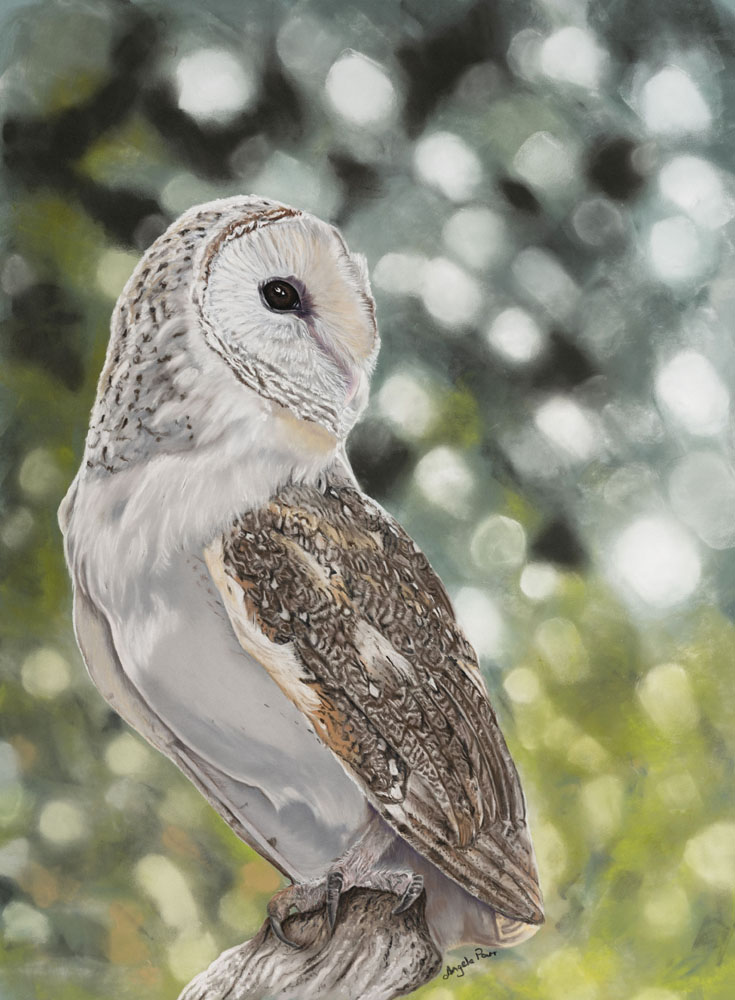
Socrates
Pastels ($POA)
60 cm H x 48 cm W
Barn owls live alone or in pairs and are excellent hunters, catching their prey in complete darkness, using super-sensitive hearing, and silent flight.
Being nocturnal, they roost quietly by day in unseen places like tree hollows, thickly foliaged trees, caves and rock crevices, buildings and even wells. As Australia is one of the world’s worst offenders when it comes to land clearing, with a projected 3 million hectares of untouched forest to be lost by 2030, one of the biggest threats to Australian owls is loss of habitat. Our owls rely on hollow-bearing trees, often hundreds of years old, for breeding.
As owls are natural predators of rodents, Rat Poison is fast becoming the biggest killers of owls, due to secondary killings. Owls also fall victim to vehicle strikes as they disperse in search of food when local prey populations begin to thin out, or drought conditions affect inland Australia.Quick View -
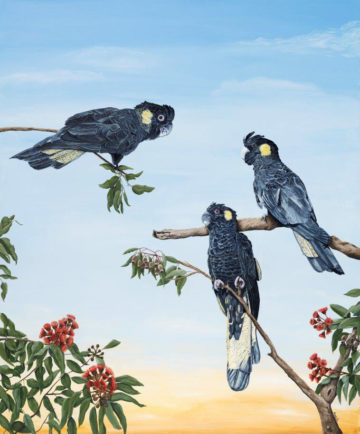
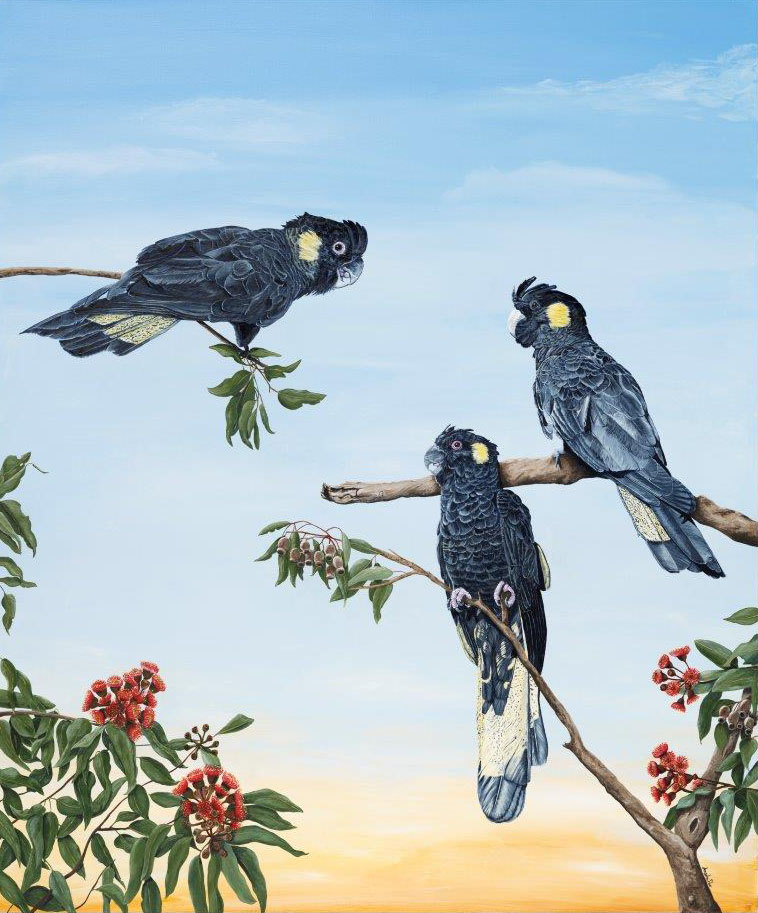
Back Off! She’s Mine!
Acrylic on Canvas (Sold)
150 cm W x 180 cm H
Black cockatoos are my absolute favourite birds, and these three “yellow-tails” were a commission for a local family who had a large wall which needed a stunningly large artwork to feature on it.
They also have a beautiful flowering Corymbia Calophylla tree in their yard, which they requested to be incorporated into the composition. As it turns out they have two sons and a daughter, and by mere coincidence, I painted two male cockatoos (they have the pink rimmed eyes) and one female (grey rimmed eyes). My clients now feel the cockatoos represent their own three “golden” children. One could say it was a very successful commission for all involved. Limited Edition Prints are available, and as always a percentage of sales goes to the Byron Bay Wildlife Hospital.Read more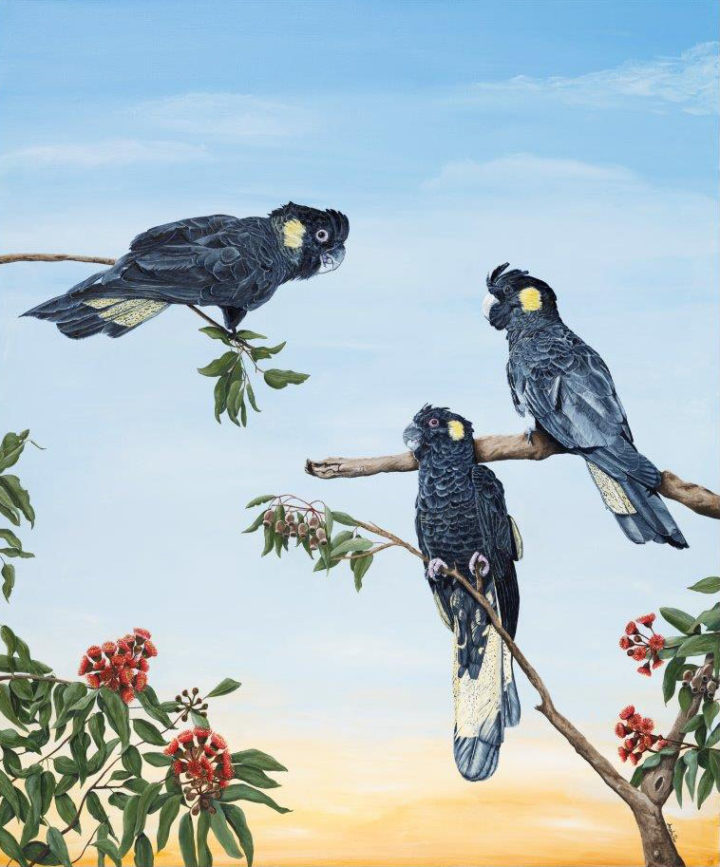
Back Off! She’s Mine!
Acrylic on Canvas (Sold)
150 cm W x 180 cm H
Black cockatoos are my absolute favourite birds, and these three “yellow-tails” were a commission for a local family who had a large wall which needed a stunningly large artwork to feature on it.
They also have a beautiful flowering Corymbia Calophylla tree in their yard, which they requested to be incorporated into the composition. As it turns out they have two sons and a daughter, and by mere coincidence, I painted two male cockatoos (they have the pink rimmed eyes) and one female (grey rimmed eyes). My clients now feel the cockatoos represent their own three “golden” children. One could say it was a very successful commission for all involved. Limited Edition Prints are available, and as always a percentage of sales goes to the Byron Bay Wildlife Hospital.Quick View -
Girl Gang
Pastel on Pastelmat (Sold)
89 cm W x 63 cm H
Galahs (Eolophus roseicapilla) are one of the most abundant and familiar of the Australian parrots, occurring over most of the country, including some offshore islands. Galahs have a bouncing acrobatic flight, but spend much of the day sheltering from heat in the foliage of trees and shrubs. Huge noisy flocks of birds congregate and roost together at night. They are affectionate and friendly birds, with pairs mating for life. Female Galahs have red or pink eyes (the males have brown or black), so these are girls obviously hanging together for a good giggle.
Read more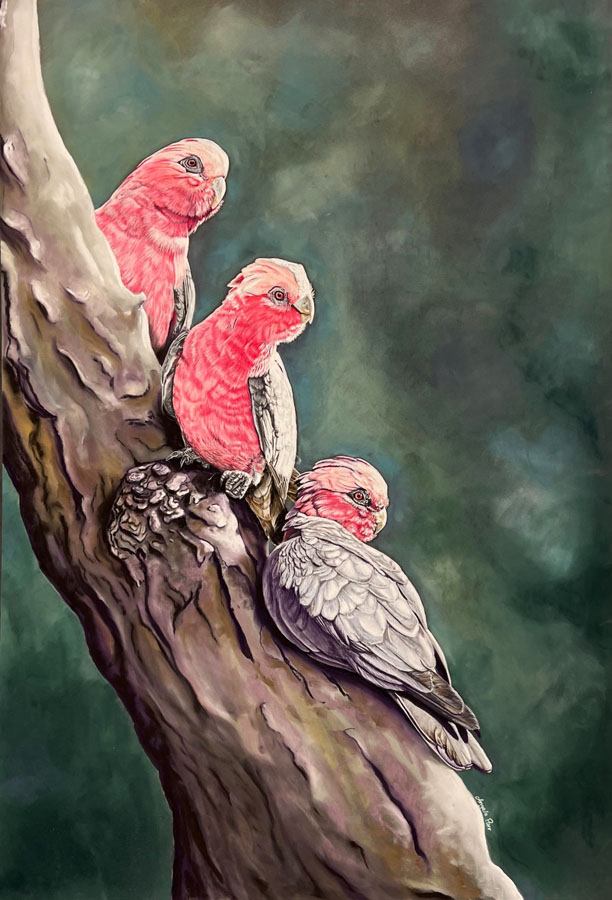
Girl Gang
Pastel on Pastelmat (Sold)
89 cm W x 63 cm H
Galahs (Eolophus roseicapilla) are one of the most abundant and familiar of the Australian parrots, occurring over most of the country, including some offshore islands. Galahs have a bouncing acrobatic flight, but spend much of the day sheltering from heat in the foliage of trees and shrubs. Huge noisy flocks of birds congregate and roost together at night. They are affectionate and friendly birds, with pairs mating for life. Female Galahs have red or pink eyes (the males have brown or black), so these are girls obviously hanging together for a good giggle.
Quick View -
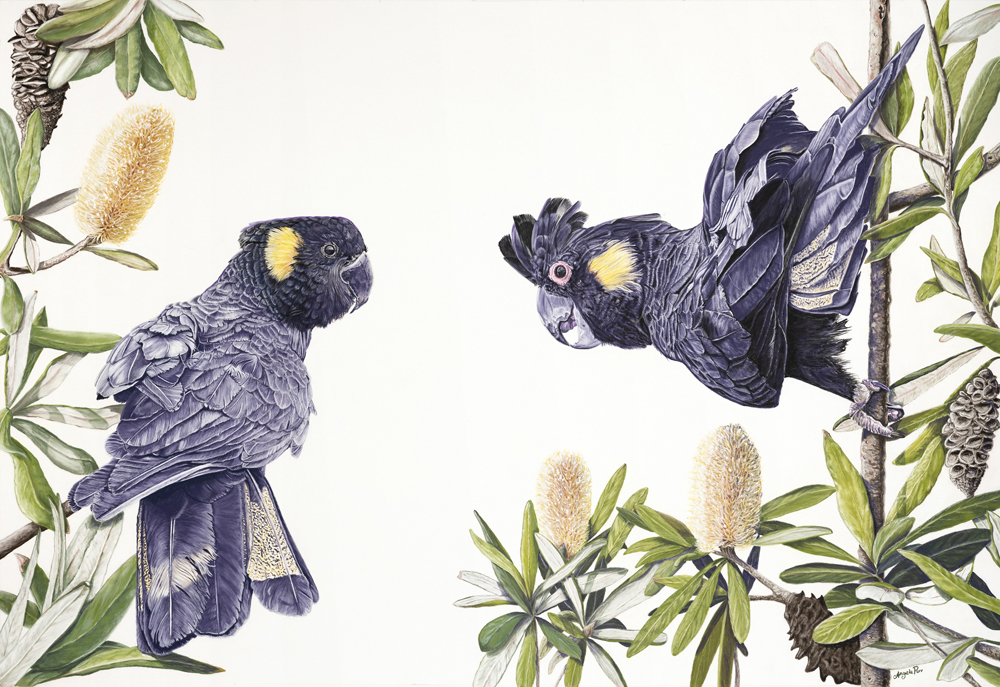
You’re Such a Show Off
Pastel on Pastelmat Board (Sold)
94 cm W x 64 cm H
Black cockatoos are the biggest parrots in Australia, and these Yellow-Tails have been painted life size to illustrate just how large they really are. The male (pink eye rim) is a big show off, usually dancing around during breeding season to impress his mate, bopping his head like a rock star, and fluffing up his crest. But they are also very intelligent and loving, often bringing their mate gifts of food, singing to her and preening her feathers to show his affection. The female is less than impressed, often giving him a sharp peck to bring him into line. Hence my title. They mate for life, which can be over 50 years, but sadly they breed slowly, just two eggs, of which only one survives. The chick will stay with its parents for six months before becoming independent. The adult pair will remain together for life, caring tenderly for one another, even after reproductive age has ceased. Their distinctive screech is old bush lore indicating rain is coming, and I always love seeing their huge flocks fly over our property, screaming raucously. They are one of my favourite birds.Read more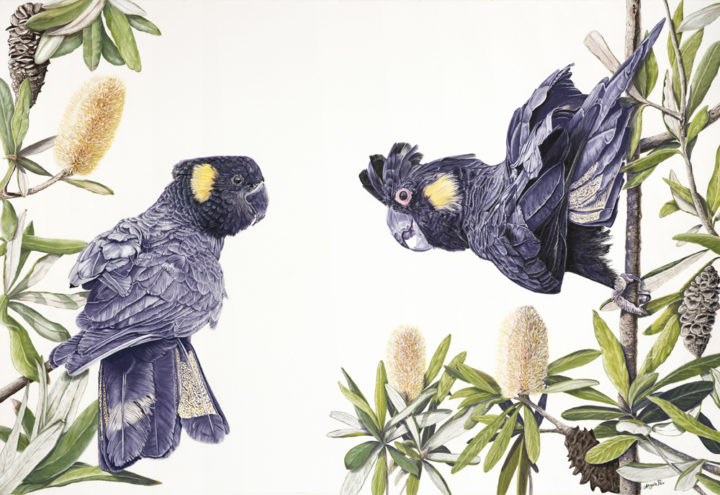
You’re Such a Show Off
Pastel on Pastelmat Board (Sold)
94 cm W x 64 cm H
Black cockatoos are the biggest parrots in Australia, and these Yellow-Tails have been painted life size to illustrate just how large they really are. The male (pink eye rim) is a big show off, usually dancing around during breeding season to impress his mate, bopping his head like a rock star, and fluffing up his crest. But they are also very intelligent and loving, often bringing their mate gifts of food, singing to her and preening her feathers to show his affection. The female is less than impressed, often giving him a sharp peck to bring him into line. Hence my title. They mate for life, which can be over 50 years, but sadly they breed slowly, just two eggs, of which only one survives. The chick will stay with its parents for six months before becoming independent. The adult pair will remain together for life, caring tenderly for one another, even after reproductive age has ceased. Their distinctive screech is old bush lore indicating rain is coming, and I always love seeing their huge flocks fly over our property, screaming raucously. They are one of my favourite birds.Quick View -
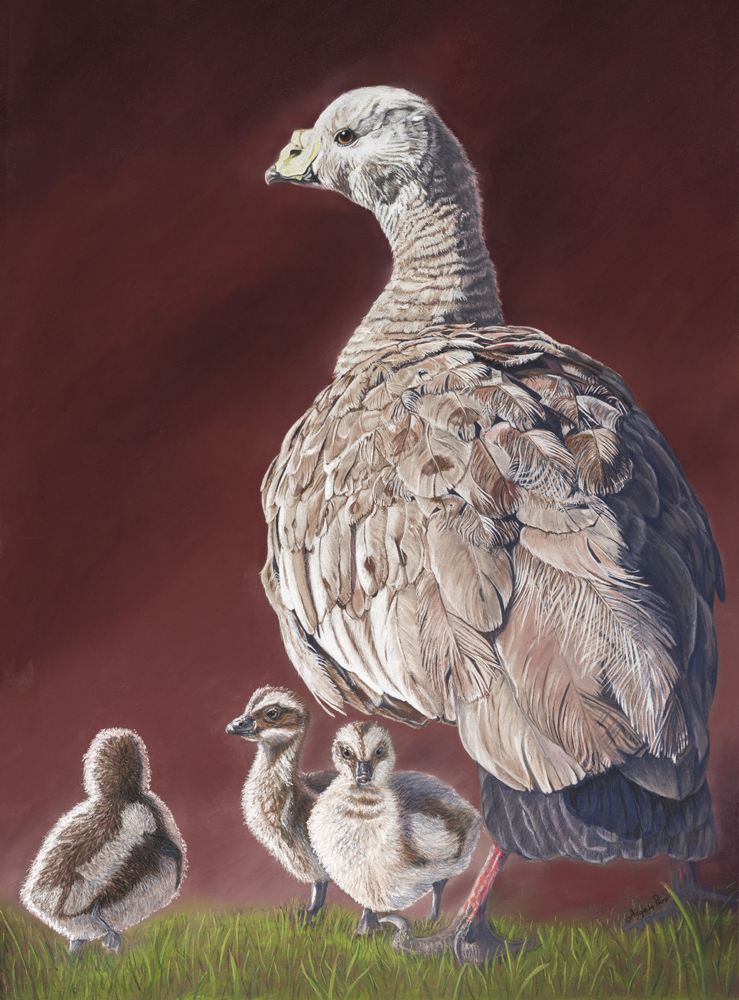
Protecting Her Young
Pastel on Pastelmat (Sold)
51 cm W x 71 cm H
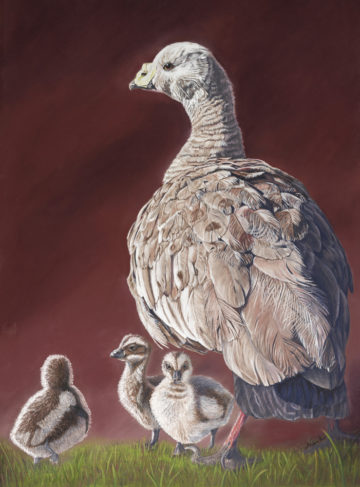
An early morning drive on Kangaroo Island revealed Cape Barron Geese (Cereopsis novaehollandiae) grazing in the grassy clearing. A month later half of the island was burning, and I was concerned for this little flock. Cape Barron Geese were almost hunted to extinction in the 1900’s but numbers eventually restored to 20,000 on Australia’s southern islands. They are monogamous, bonding for life, and aggressively defend their clutches of 4-5 eggs. They are one of the world’s rarest geese. In my artwork I highlight their beautiful plumage, the adult’s defensive position over the vulnerable chicks, and hint at the imminent danger of fire.Read more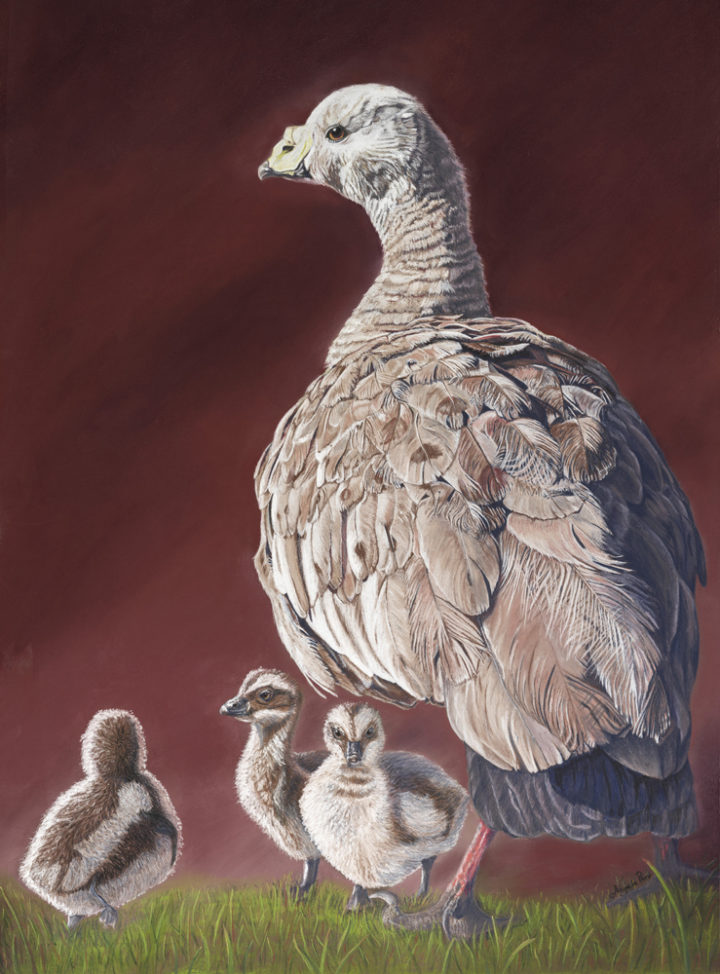
Protecting Her Young
Pastel on Pastelmat (Sold)
51 cm W x 71 cm H
An early morning drive on Kangaroo Island revealed Cape Barron Geese (Cereopsis novaehollandiae) grazing in the grassy clearing. A month later half of the island was burning, and I was concerned for this little flock. Cape Barron Geese were almost hunted to extinction in the 1900’s but numbers eventually restored to 20,000 on Australia’s southern islands. They are monogamous, bonding for life, and aggressively defend their clutches of 4-5 eggs. They are one of the world’s rarest geese. In my artwork I highlight their beautiful plumage, the adult’s defensive position over the vulnerable chicks, and hint at the imminent danger of fire.Quick View -
A Keen Eye
Pastel on Pastelmat (Sold)
51 cm W x 67 cm H
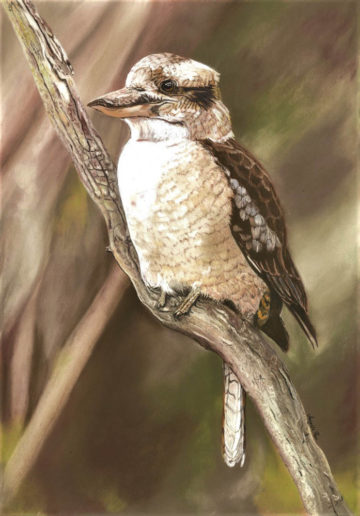
The Laughing Kookaburra (Dacelo novaeguineae) is arguably the best-known and most loved bird of Australia with its highly distinctive raucous “laugh”. The loud ‘koo-koo-koo-koo-koo-kaa-kaa-kaa’ is however not really the kookaburra laughing but actually a territorial call to warn other birds to stay away. Laughing Kookaburras feed mostly on insects, worms and crustaceans, although small snakes, mammals, frogs and birds may also be eaten. Prey is espied and then seized by pouncing from a suitable perch, as shown in my artwork. Small prey is eaten whole, but larger prey is killed by bashing it against the ground or tree branch.Read more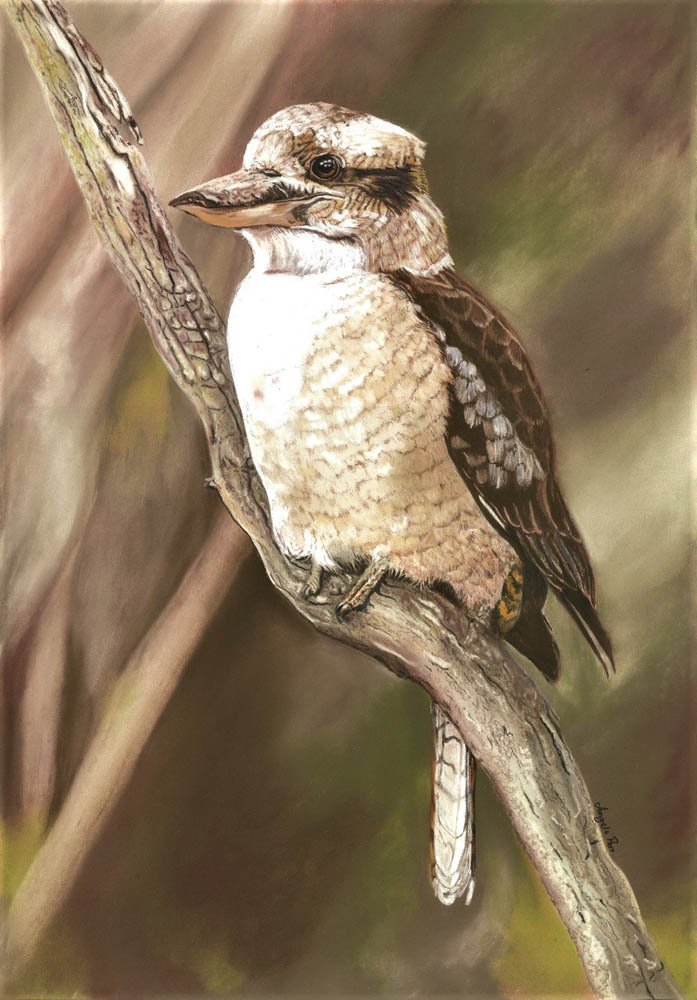
A Keen Eye
Pastel on Pastelmat (Sold)
51 cm W x 67 cm H
The Laughing Kookaburra (Dacelo novaeguineae) is arguably the best-known and most loved bird of Australia with its highly distinctive raucous “laugh”. The loud ‘koo-koo-koo-koo-koo-kaa-kaa-kaa’ is however not really the kookaburra laughing but actually a territorial call to warn other birds to stay away. Laughing Kookaburras feed mostly on insects, worms and crustaceans, although small snakes, mammals, frogs and birds may also be eaten. Prey is espied and then seized by pouncing from a suitable perch, as shown in my artwork. Small prey is eaten whole, but larger prey is killed by bashing it against the ground or tree branch.Quick View -
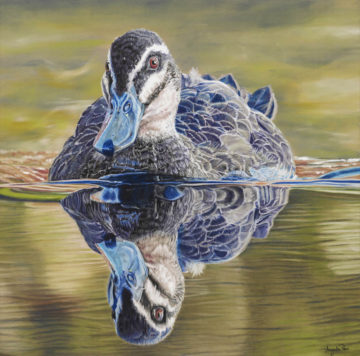
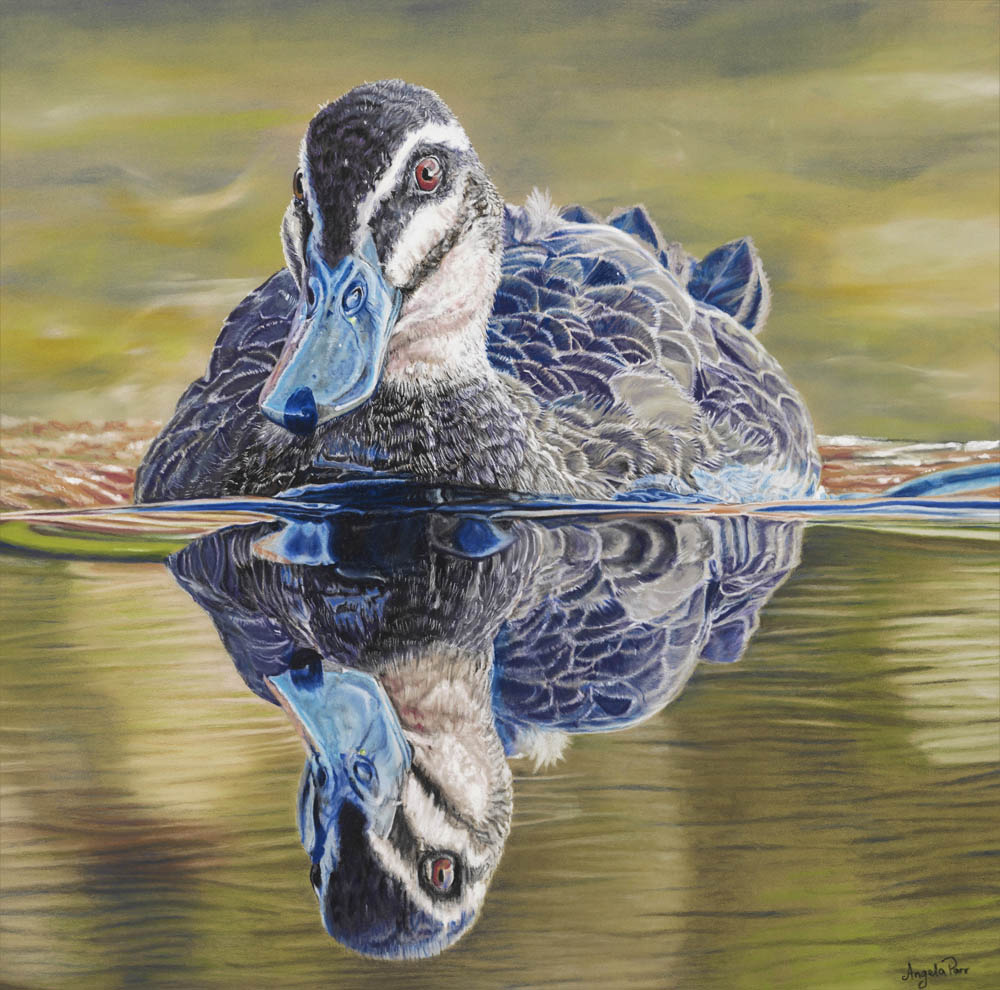
The Bow Wave
Pastel on Pastelmat (Sold)
45 cm W x 45 cm H
Sunset on Lake Ainsworth at Lennox Head, and this Pacific Black Duck (Anas superciliosa) was hunting a final meal for the day. Their diet is mainly vegetarian, supplemented by small molluscs, crustaceans, and insects, not bread, which well-meaning but misinformed people often feed them. Due to their “commonness” ducks are often overlooked as subjects to paint, although they have obvious beauty. They are at risk from habitat loss and despite the strong evidence of the extreme suffering involved, four Australian states still allow recreational duck hunting. My artwork aims to draw attention to these ducks, becoming a conversation starter for their protection.Read more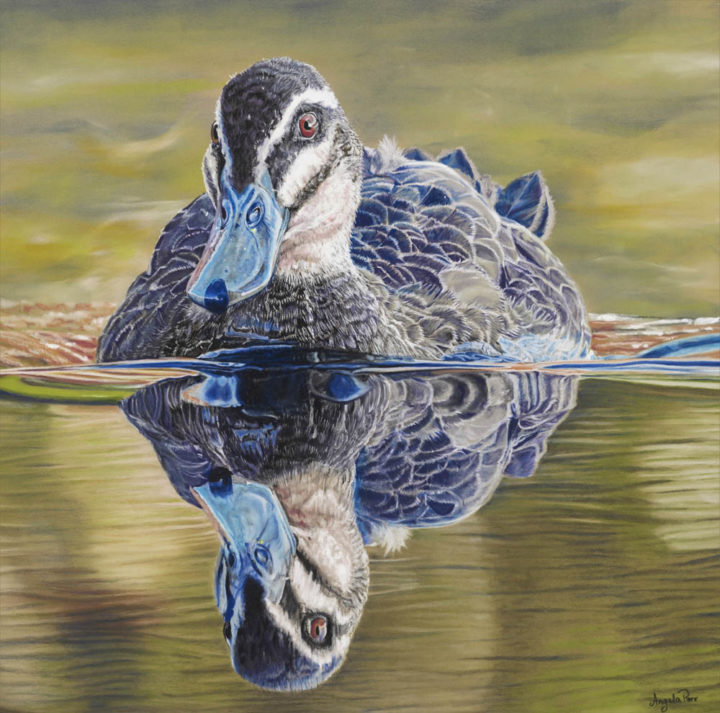
The Bow Wave
Pastel on Pastelmat (Sold)
45 cm W x 45 cm H
Sunset on Lake Ainsworth at Lennox Head, and this Pacific Black Duck (Anas superciliosa) was hunting a final meal for the day. Their diet is mainly vegetarian, supplemented by small molluscs, crustaceans, and insects, not bread, which well-meaning but misinformed people often feed them. Due to their “commonness” ducks are often overlooked as subjects to paint, although they have obvious beauty. They are at risk from habitat loss and despite the strong evidence of the extreme suffering involved, four Australian states still allow recreational duck hunting. My artwork aims to draw attention to these ducks, becoming a conversation starter for their protection.Quick View -
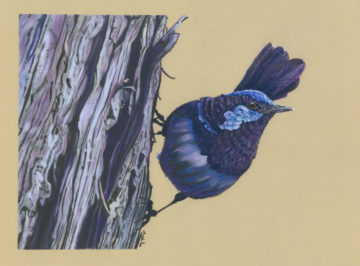
A Split Second
Pastel on Pastelmat Board (Sold)
48 cm W x 38 cm H
Adult male Superb Fairy-wrens (Malurus cyaneus) are among the most brightly coloured of the species, especially during the breeding season. These ‘coloured’ males are often accompanied by a band of brown ‘jenny wrens’, assumed to be a harem of females, but often include immature males which have not yet attained their breeding plumage. Seen in most habitat types where suitable dense cover and low shrubs occur, including urban parks and gardens, they can be seen in small social groups. These groups normally consist of one male and several females and young birds. They feed on insects and other small arthropods, which are caught mostly on the ground, but may also be taken from low bushes. This artwork depicts a male in the waning evening light about to launch on unsuspecting prey.Read more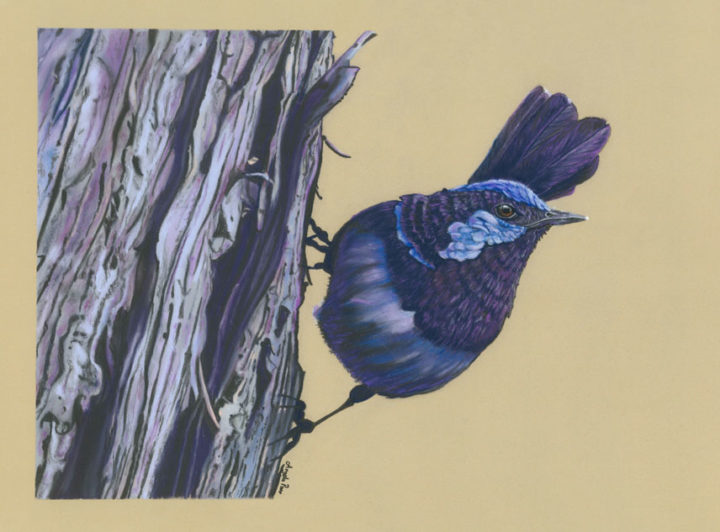
A Split Second
Pastel on Pastelmat Board (Sold)
48 cm W x 38 cm H
Adult male Superb Fairy-wrens (Malurus cyaneus) are among the most brightly coloured of the species, especially during the breeding season. These ‘coloured’ males are often accompanied by a band of brown ‘jenny wrens’, assumed to be a harem of females, but often include immature males which have not yet attained their breeding plumage. Seen in most habitat types where suitable dense cover and low shrubs occur, including urban parks and gardens, they can be seen in small social groups. These groups normally consist of one male and several females and young birds. They feed on insects and other small arthropods, which are caught mostly on the ground, but may also be taken from low bushes. This artwork depicts a male in the waning evening light about to launch on unsuspecting prey.Quick View -
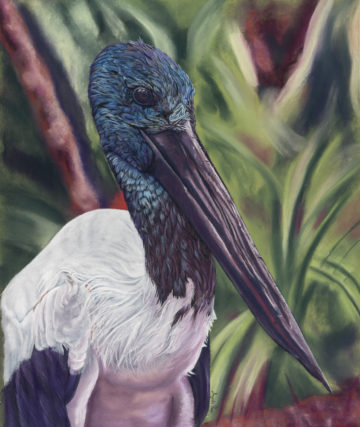
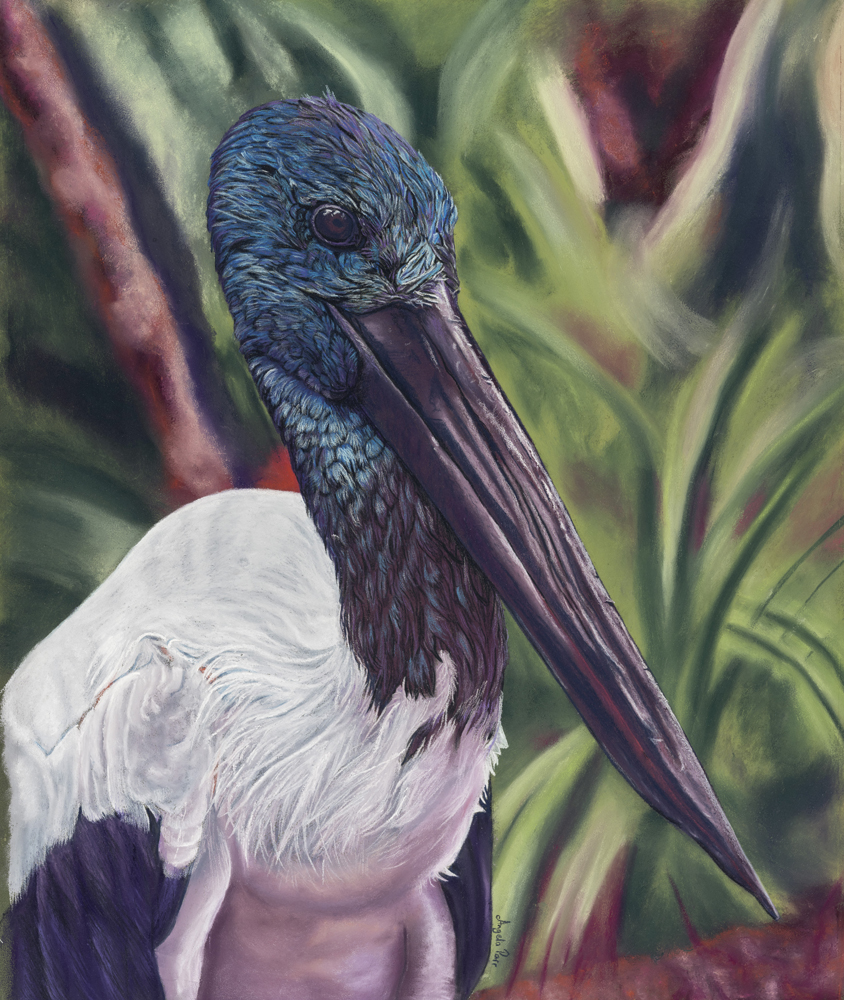
Jabiru Dreaming
Pastel on Mi Tientes Tex ($POA)
41 cm W x 51 cm H
The Black-necked Stork (formerly referred to as the Jabiru) (Ephippiorhynchus asiaticusis) is Australia’s only native stork, with numbers at approximately 10,000 birds. They are threatened by habitat destruction, the draining of shallow wetlands, disturbance at nests, overfishing, pollution, collision with electricity wires and hunting. Several breeding pairs have recently been spotted as far south as the northern river areas of NSW, the Bundjalung area where I live. My father-in-law loves these birds and asked me to paint him one. Their black-neck name is misleading, as although their bodies are black and white, their necks shine a radiant glossy dark green and purple in the sunlight. They have a massive black bill and striking long coral-red legs. The males have black eyes whilst the female’s eye is yellow. This fellow is obviously a male and was hunting in the shallow waters of Chickiba Lake in Ballina, NSW.Read more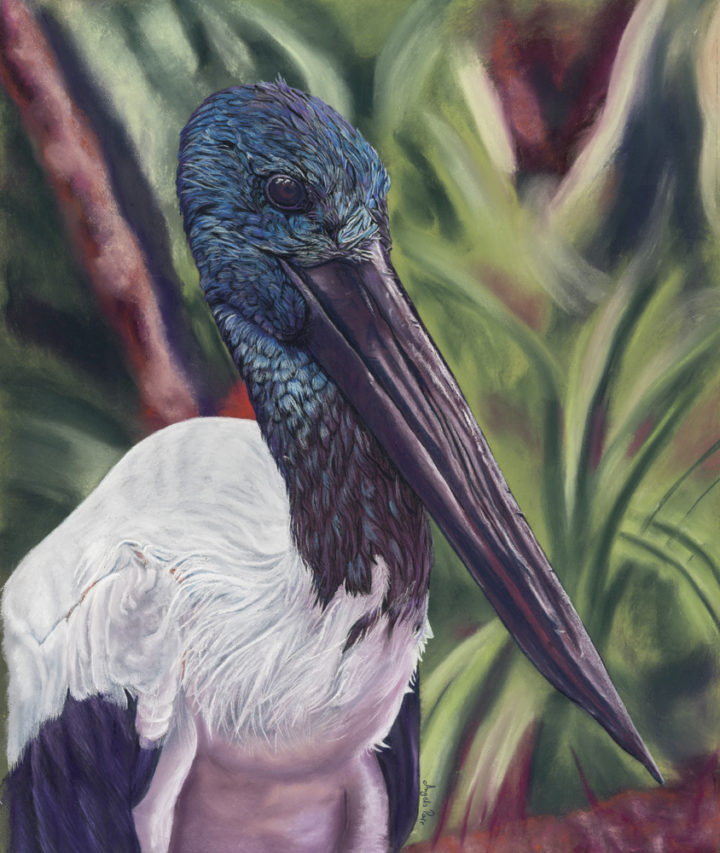
Jabiru Dreaming
Pastel on Mi Tientes Tex ($POA)
41 cm W x 51 cm H
The Black-necked Stork (formerly referred to as the Jabiru) (Ephippiorhynchus asiaticusis) is Australia’s only native stork, with numbers at approximately 10,000 birds. They are threatened by habitat destruction, the draining of shallow wetlands, disturbance at nests, overfishing, pollution, collision with electricity wires and hunting. Several breeding pairs have recently been spotted as far south as the northern river areas of NSW, the Bundjalung area where I live. My father-in-law loves these birds and asked me to paint him one. Their black-neck name is misleading, as although their bodies are black and white, their necks shine a radiant glossy dark green and purple in the sunlight. They have a massive black bill and striking long coral-red legs. The males have black eyes whilst the female’s eye is yellow. This fellow is obviously a male and was hunting in the shallow waters of Chickiba Lake in Ballina, NSW.Quick View -
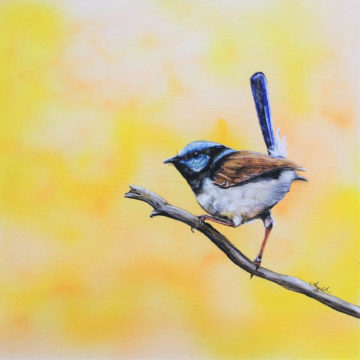
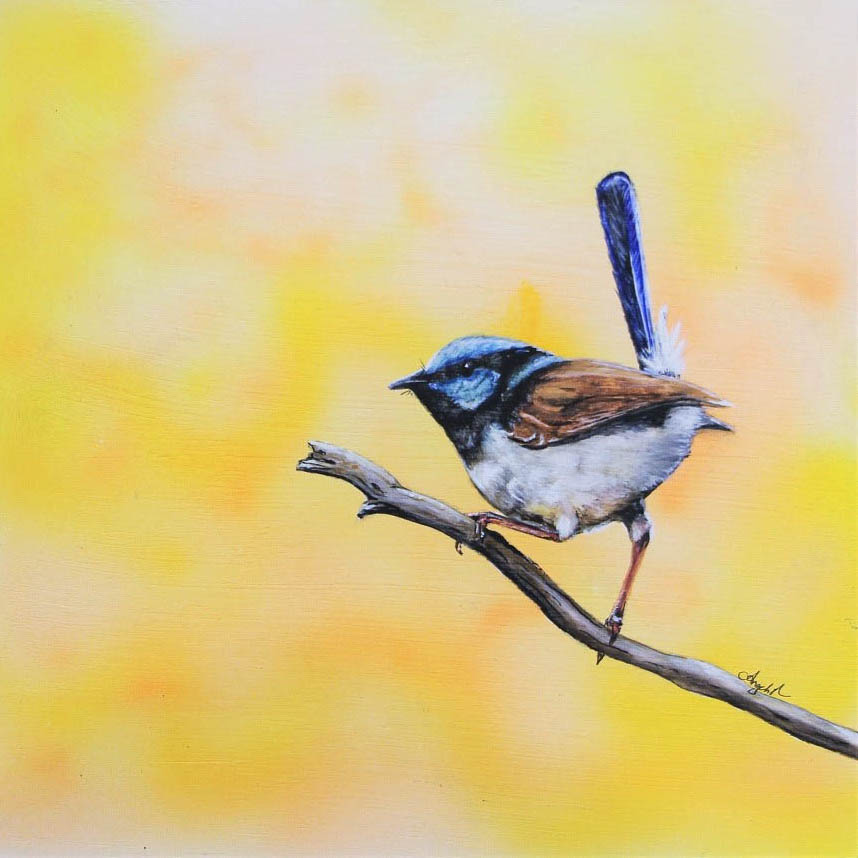
Little Boy Blue
Watercolour on board (Sold)
35 cm W x 30 cm H
Another Superb Fairy-Wren (Malurus cyaneus) this time outside of breeding season. It’s their sky blue-coloured caps, which become iridescent during breeding season. Much loved among Australians, the fairy-wren can be found all across south-east Australia and enjoys a shrubby understorey where they move about in small groups. New research has revealed that male fairy-wrens sing to their eggs and their chicks come out recognising their parent’s unique song. This small study made good use of a vibrant yellow background to really highlight the wren’s colouration.Read more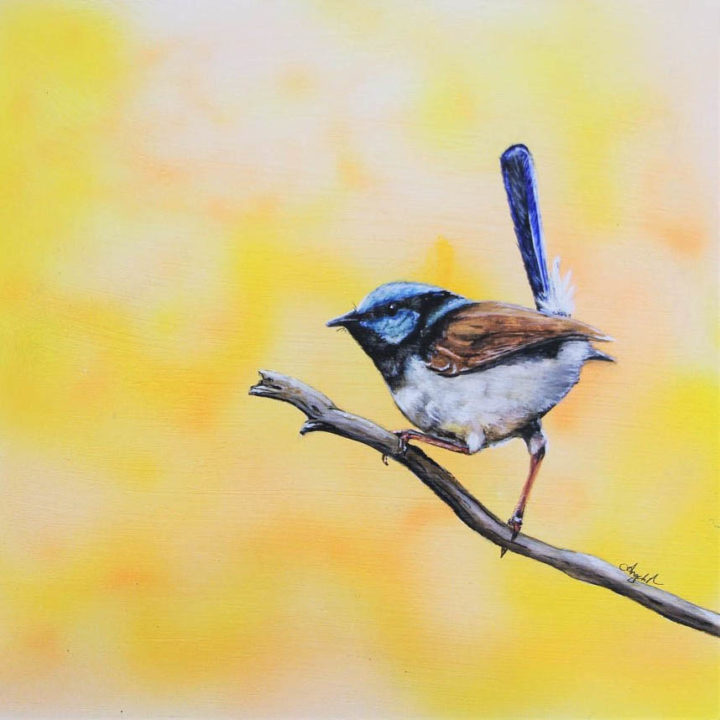
Little Boy Blue
Watercolour on board (Sold)
35 cm W x 30 cm H
Another Superb Fairy-Wren (Malurus cyaneus) this time outside of breeding season. It’s their sky blue-coloured caps, which become iridescent during breeding season. Much loved among Australians, the fairy-wren can be found all across south-east Australia and enjoys a shrubby understorey where they move about in small groups. New research has revealed that male fairy-wrens sing to their eggs and their chicks come out recognising their parent’s unique song. This small study made good use of a vibrant yellow background to really highlight the wren’s colouration.Quick View -
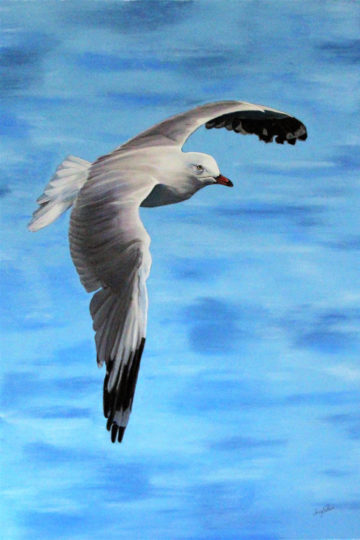
Jonathan Soaring
Pastel on Mi Tientes Tex ($POA)
68 cm W x 88 cm H
I was obsessed with the book Jonathan Livingston Seagull during my youth and even named our son Fletcher after one of the characters in Richard Bach’s fable novella. The common Silver Gull (Chroicocephalus novaehollandiae) is easily the most recognisable of all seagulls, although sadly it is also widely castigated as a voracious and persistent scavenger. The saying “Like a seagull on a hot chip” speaks of this characteristic. Their kleptoparasitic behaviour, and explosion in numbers since the 1950’s is due to the large quantities of food waste that Australians now produce. Their “natural diet” includes worms, fish, insects, and crustaceans. They are a clean and attractive bird and to see them soaring on the coastal breezes, like this one is doing, reminds us of how stunning they really are.Read more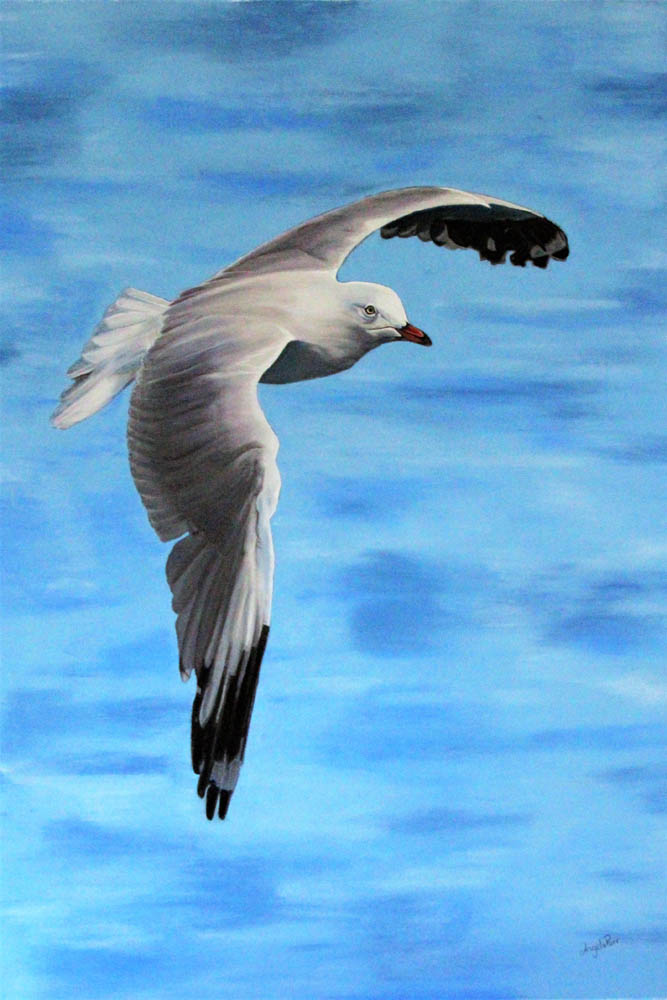
Jonathan Soaring
Pastel on Mi Tientes Tex ($POA)
68 cm W x 88 cm H
I was obsessed with the book Jonathan Livingston Seagull during my youth and even named our son Fletcher after one of the characters in Richard Bach’s fable novella. The common Silver Gull (Chroicocephalus novaehollandiae) is easily the most recognisable of all seagulls, although sadly it is also widely castigated as a voracious and persistent scavenger. The saying “Like a seagull on a hot chip” speaks of this characteristic. Their kleptoparasitic behaviour, and explosion in numbers since the 1950’s is due to the large quantities of food waste that Australians now produce. Their “natural diet” includes worms, fish, insects, and crustaceans. They are a clean and attractive bird and to see them soaring on the coastal breezes, like this one is doing, reminds us of how stunning they really are.Quick View -
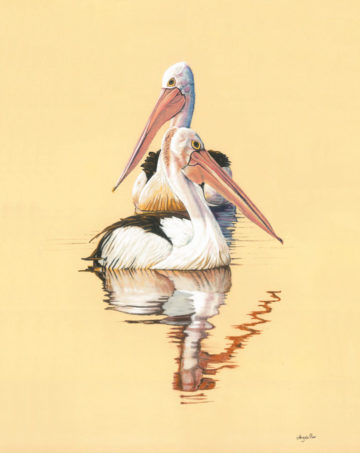
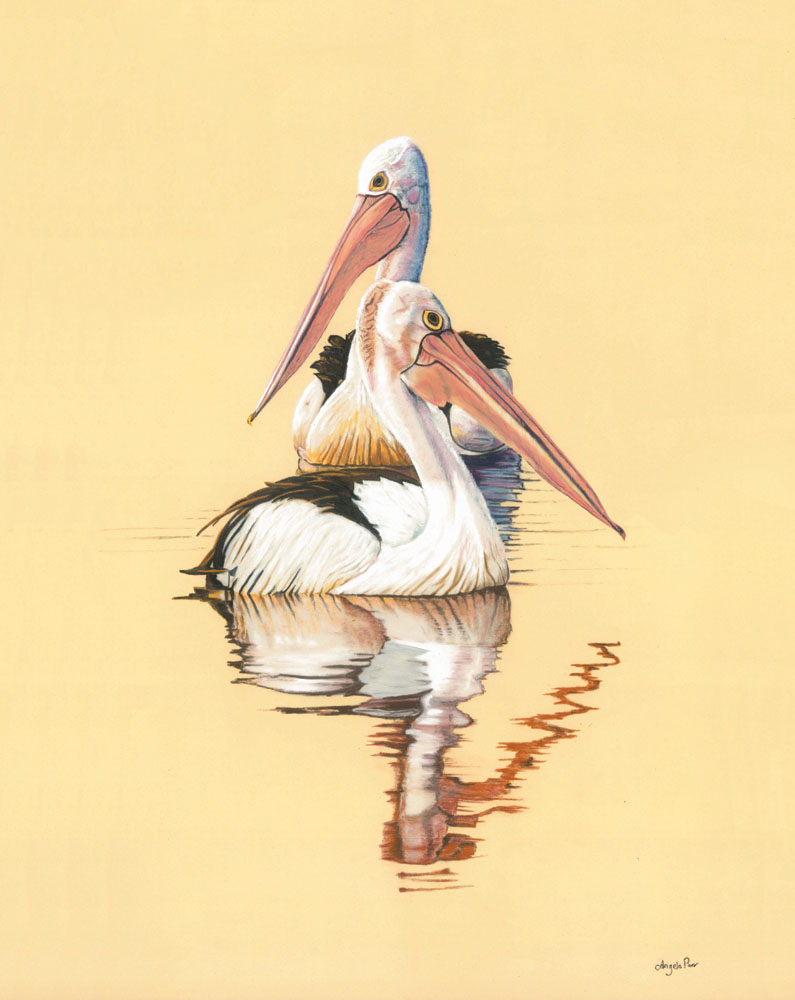
Ponderings
Pastel on Pastelmat (Sold)
63 cm W x 83 cm H
My hometown has an abundance of Australian pelicans (Pelecanus conspicillatus), and in fact the Australia Seabird Rescue was founded and based here through the conservation work of a wonderful man Lance Ferris, whom locals affectionately knew as “The Pelican Man”. Lance’s work started in 1992 after he noticed many pelicans injured by fishing line and hooks. Pelicans were rescued, rehabilitated, and released. His work soon extended from pelicans to other coastal birds as well as marine turtles. As I was involved in Bird Rehabilitation myself at the time, I often crossed paths with Lance. He was passionate about educating the community, especially school children and fisher-folk, to preserve and protect the coastal environment and all marine wildlife. Australian Seabird Rescue (one of my chosen charities) now works around Australia to protect and rescue seabirds and shorebirds. Seeing pelicans serenely gliding along our waterways, still gives me great delight.Read more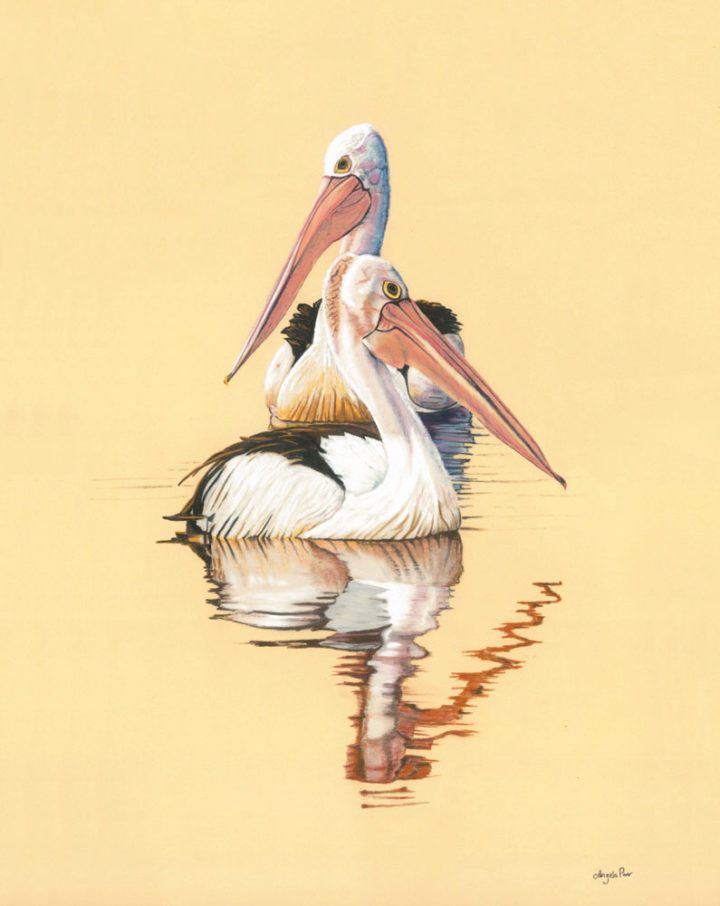
Ponderings
Pastel on Pastelmat (Sold)
63 cm W x 83 cm H
My hometown has an abundance of Australian pelicans (Pelecanus conspicillatus), and in fact the Australia Seabird Rescue was founded and based here through the conservation work of a wonderful man Lance Ferris, whom locals affectionately knew as “The Pelican Man”. Lance’s work started in 1992 after he noticed many pelicans injured by fishing line and hooks. Pelicans were rescued, rehabilitated, and released. His work soon extended from pelicans to other coastal birds as well as marine turtles. As I was involved in Bird Rehabilitation myself at the time, I often crossed paths with Lance. He was passionate about educating the community, especially school children and fisher-folk, to preserve and protect the coastal environment and all marine wildlife. Australian Seabird Rescue (one of my chosen charities) now works around Australia to protect and rescue seabirds and shorebirds. Seeing pelicans serenely gliding along our waterways, still gives me great delight.Quick View -
Rainbows Take Flight
Pastel on Pastelmat board ($POA)
94 cm W x 54 cm H
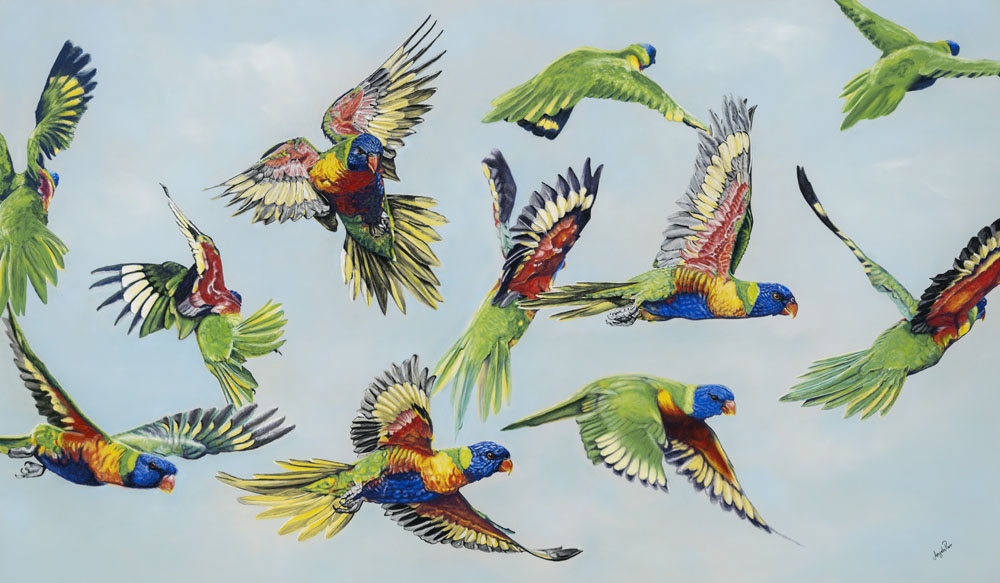
Loud, belligerent colonies of rainbow lorikeets (Trichoglossus moluccanus) are the soundtrack of urban Australia. They are often seen in fast-moving screeching flocks or gathering in huge, noisy numbers inhabiting large blossoming trees in local parks or backyards. The noise can be deafening. In many places, including campsites and suburban gardens, wild lorikeets are so used to humans that they can be hand-fed, although many people, ignorant of their dietary requirements, feed them bread or bread coated with honey. This is an inadequate source of the nutrients, vitamins and minerals that the rainbow lorikeet requires and can lead to health and feather formation issues in young lorikeets. Sadly, this is just another example of how human interaction can negatively affect our precious wildlife. I have created this artwork from a compilation of images, intending to show the rainbow lorikeets’ unmistakable patchwork of colours in a variety of flight positions and focus.Read more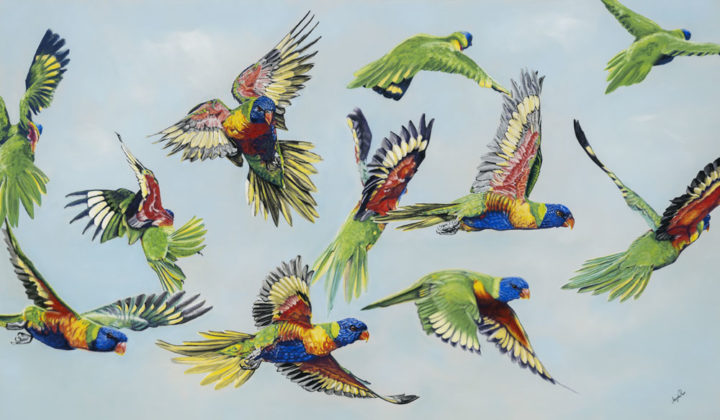
Rainbows Take Flight
Pastel on Pastelmat board ($POA)
94 cm W x 54 cm H
Loud, belligerent colonies of rainbow lorikeets (Trichoglossus moluccanus) are the soundtrack of urban Australia. They are often seen in fast-moving screeching flocks or gathering in huge, noisy numbers inhabiting large blossoming trees in local parks or backyards. The noise can be deafening. In many places, including campsites and suburban gardens, wild lorikeets are so used to humans that they can be hand-fed, although many people, ignorant of their dietary requirements, feed them bread or bread coated with honey. This is an inadequate source of the nutrients, vitamins and minerals that the rainbow lorikeet requires and can lead to health and feather formation issues in young lorikeets. Sadly, this is just another example of how human interaction can negatively affect our precious wildlife. I have created this artwork from a compilation of images, intending to show the rainbow lorikeets’ unmistakable patchwork of colours in a variety of flight positions and focus.Quick View -
Is This My Best Side?
Pastel on Pastelmat board ($POA)
55 cm W x 46 cm H
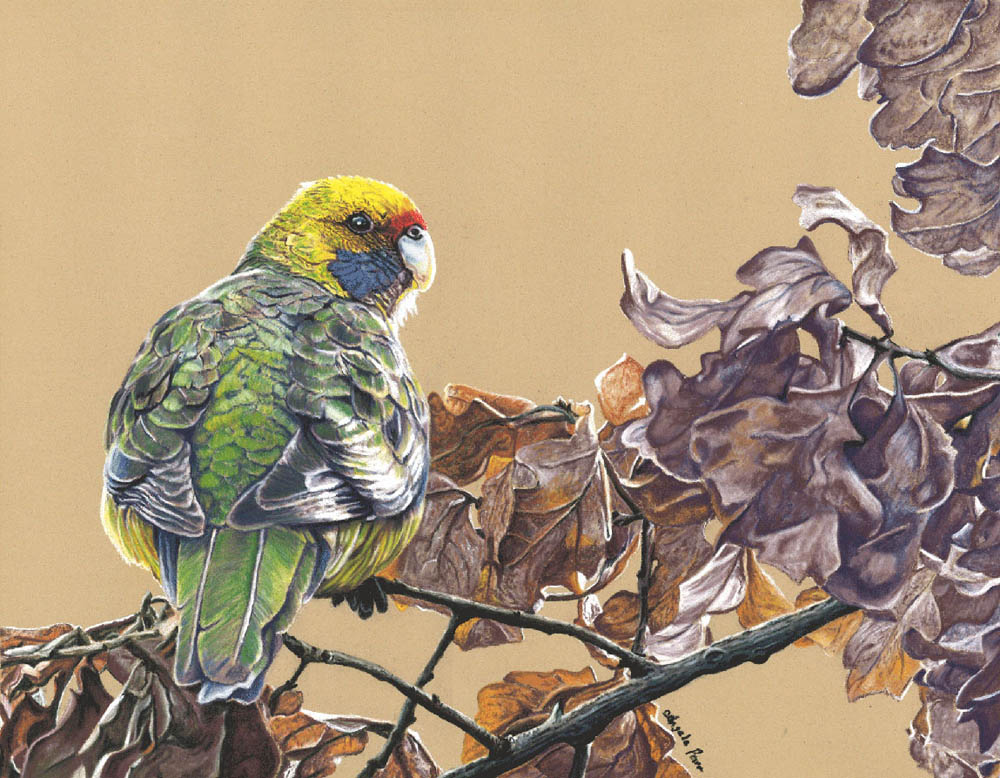
The green rosella or Tasmanian rosella (Platycercus caledonicus) is a species of parrot native to Tasmania and Bass Strait islands. Found in a wide range of habitats with some form of tree cover, the green rosella is predominantly herbivorous, consuming seeds, berries, nuts and fruit, as well as flowers, but may also eat insect larvae and insects such as psyllids. Their nesting site is usually a hollow over 1 m deep in a tree trunk anywhere up to 30 m above the ground. Chimneys, holes in walls and even the vertical pipes of tennis court fences have been used. Green rosellas nested in a wall cavity at Port Arthur convict prison site in 1958 and 2009, which is where this bird was spotted.Read more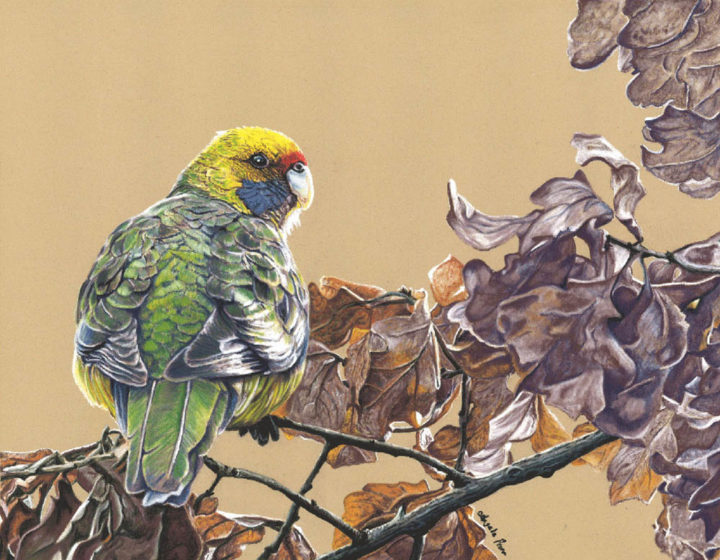
Is This My Best Side?
Pastel on Pastelmat board ($POA)
55 cm W x 46 cm H
The green rosella or Tasmanian rosella (Platycercus caledonicus) is a species of parrot native to Tasmania and Bass Strait islands. Found in a wide range of habitats with some form of tree cover, the green rosella is predominantly herbivorous, consuming seeds, berries, nuts and fruit, as well as flowers, but may also eat insect larvae and insects such as psyllids. Their nesting site is usually a hollow over 1 m deep in a tree trunk anywhere up to 30 m above the ground. Chimneys, holes in walls and even the vertical pipes of tennis court fences have been used. Green rosellas nested in a wall cavity at Port Arthur convict prison site in 1958 and 2009, which is where this bird was spotted.Quick View -
Wrinkles
Pastel on Canson paper (Sold)
47 cm W x 66 cm H
“Wrinkles” lives in the Daintree in far north Queensland, along with other Southern Cassowaries, (Casuarius casuarius). They are an icon of tourism in this area, but sadly are now endangered due to habitat loss, and threats from motor vehicles, dog packs, feral pigs and disease. Cassowaries are integral for the health of our Tropical rainforests due to seed dispersal of between 70 to 100 plant species. It is vital that this bird’s unique future is secured. Cassowaries have striking colours and “helmets” known as casques and I hoped to give homage to this in my pastel rendition.Read more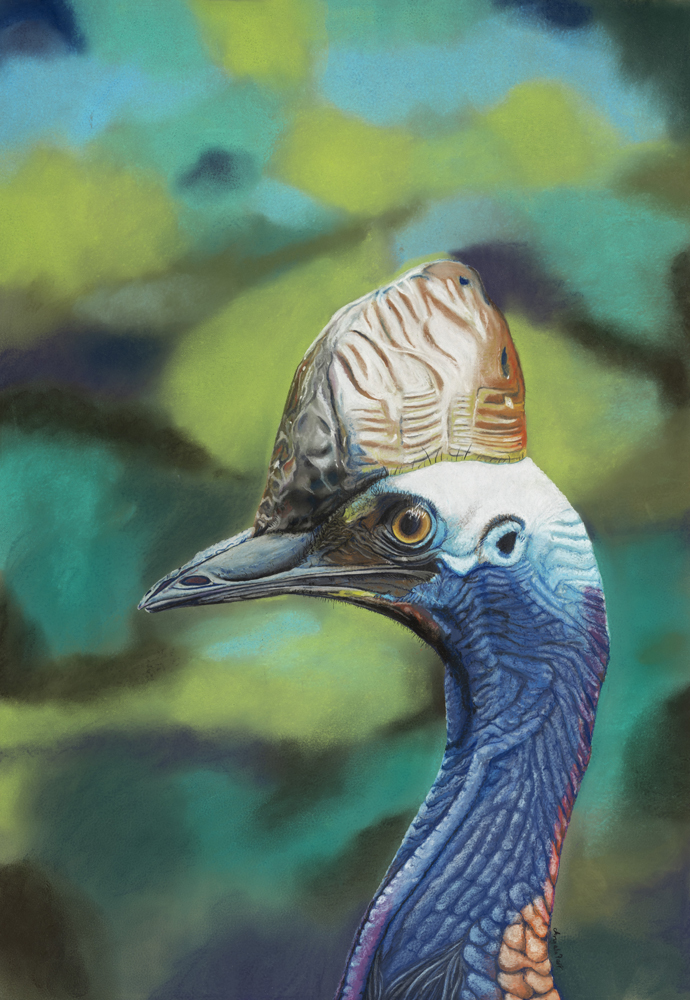
Wrinkles
Pastel on Canson paper (Sold)
47 cm W x 66 cm H
“Wrinkles” lives in the Daintree in far north Queensland, along with other Southern Cassowaries, (Casuarius casuarius). They are an icon of tourism in this area, but sadly are now endangered due to habitat loss, and threats from motor vehicles, dog packs, feral pigs and disease. Cassowaries are integral for the health of our Tropical rainforests due to seed dispersal of between 70 to 100 plant species. It is vital that this bird’s unique future is secured. Cassowaries have striking colours and “helmets” known as casques and I hoped to give homage to this in my pastel rendition.Quick View -
A Brush with Death
Acrylic on canvas (Sold)
122 cm W x 122 cm H
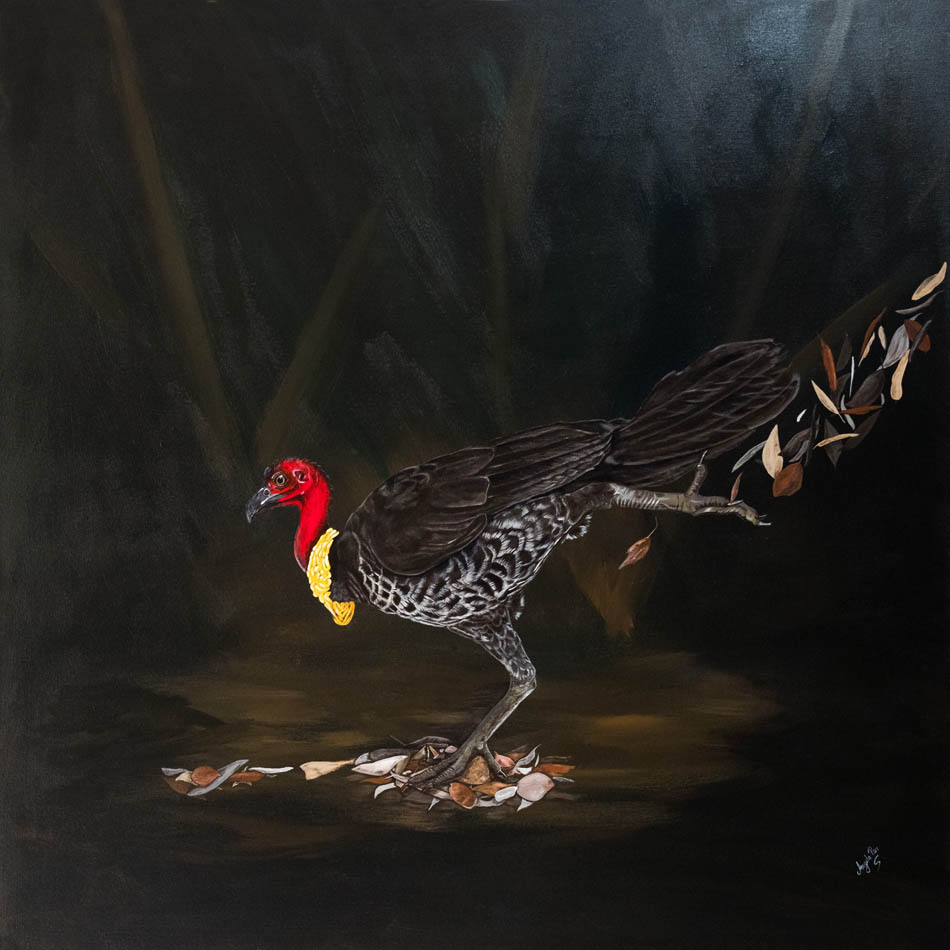
Never has a bird so divided the opinions of visitors coming to my gallery as this Brush Turkey. The Australian Brush Turkey (Alectura lathami), also known as the bush or scrub turkey, has a bad reputation. They are blamed for damaging gardens (making an awful mess as it digs up leaf litter, twigs and dirt to build its egg mound) and darting across roads. Found in eastern Australia from Far North Queensland to the Illawarra in New South Wales, they’ve managed to adapt to life in cities and have also been introduced to Kangaroo Island in South Australia. Brush turkey nests or ‘mounds’ are the size of a car and are made up of soil and plant material. Built by the males to attract a mate, they’re essentially large compost heaps, that take the hard-working male about a month to create.
These mounds generate a huge amount of heat and that’s what incubates the eggs — which is lucky because once the eggs are laid the mother is off, and the father only sticks around to defend the mound. When the chicks have left the nest, the leftover mound is a perfect bit of compost for humans to spread out over the garden.Read more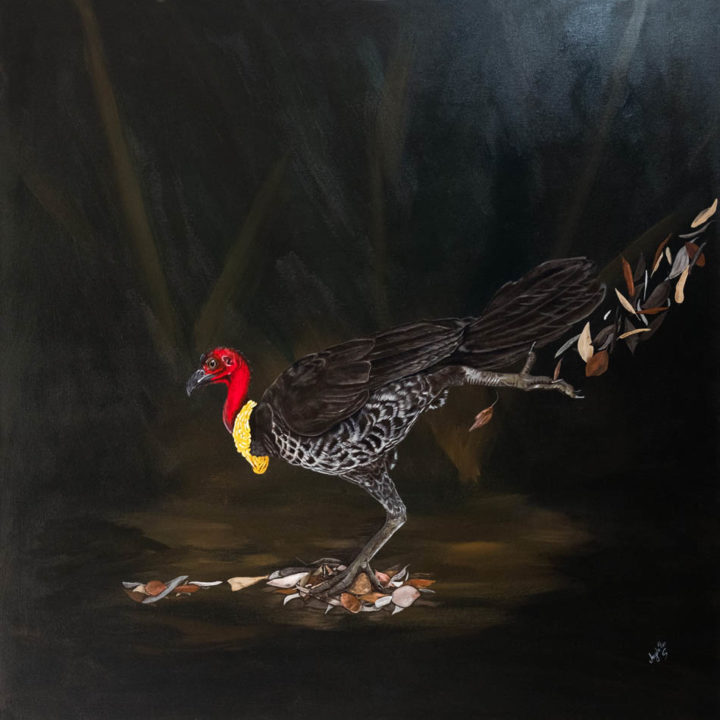
A Brush with Death
Acrylic on canvas (Sold)
122 cm W x 122 cm H
Never has a bird so divided the opinions of visitors coming to my gallery as this Brush Turkey. The Australian Brush Turkey (Alectura lathami), also known as the bush or scrub turkey, has a bad reputation. They are blamed for damaging gardens (making an awful mess as it digs up leaf litter, twigs and dirt to build its egg mound) and darting across roads. Found in eastern Australia from Far North Queensland to the Illawarra in New South Wales, they’ve managed to adapt to life in cities and have also been introduced to Kangaroo Island in South Australia. Brush turkey nests or ‘mounds’ are the size of a car and are made up of soil and plant material. Built by the males to attract a mate, they’re essentially large compost heaps, that take the hard-working male about a month to create.
These mounds generate a huge amount of heat and that’s what incubates the eggs — which is lucky because once the eggs are laid the mother is off, and the father only sticks around to defend the mound. When the chicks have left the nest, the leftover mound is a perfect bit of compost for humans to spread out over the garden.Quick View -
A Nest of Spoons
Pastel on Mi Tientes Tex. Unframed ($POA)
87 cm W x 67 cm H
A juvenile Royal Spoonbill (Platalea regia) arrived on our property, lost and starving. We fed little “Teaspoon” the Christmas Prawn scraps before finding a suitable wetland nearby for relocation.
“Teaspoon’s” visit made me curious about Spoonbills. They are found throughout eastern and northern Australia, residing in wetlands, mudflats and grasslands. Their black spatulate bill contains papillae (vibration detectors) which help them “feel” for prey in murky water, day or night.
In breeding season the birds are very white, with a distinctive ‘nuchal’ crest on the head/neck. A yellow patch is above the eye, absent in juveniles, who are often ‘dirty’ in appearance.Read more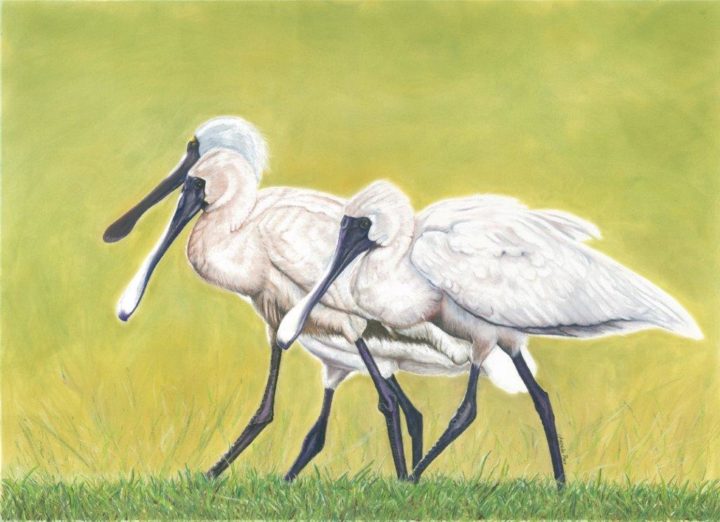
A Nest of Spoons
Pastel on Mi Tientes Tex. Unframed ($POA)
87 cm W x 67 cm H
A juvenile Royal Spoonbill (Platalea regia) arrived on our property, lost and starving. We fed little “Teaspoon” the Christmas Prawn scraps before finding a suitable wetland nearby for relocation.
“Teaspoon’s” visit made me curious about Spoonbills. They are found throughout eastern and northern Australia, residing in wetlands, mudflats and grasslands. Their black spatulate bill contains papillae (vibration detectors) which help them “feel” for prey in murky water, day or night.
In breeding season the birds are very white, with a distinctive ‘nuchal’ crest on the head/neck. A yellow patch is above the eye, absent in juveniles, who are often ‘dirty’ in appearance.Quick View -
The Observer
Pastel on Pastelmat (Sold)
46 cm W x 66 cm H
The Eastern Osprey (Pandion cristatus) is a familiar sight on the Ballina/Byron coastline, so I was surprised to learn its status is “vulnerable” in NSW. Osprey often return to the same nest, so habitat destruction and disturbance often disrupts nesting. Discarded fishing tackle, contaminated fish, polluted waterways and electrocution from nesting on powerline poles also pose serious threats. Fortunately, our council has erected several Osprey Breeding Platforms and I am accustomed to see them circling the skies, hear them whistle to each other, and in breeding season, see little fluff balls peek over the nest’s edge. They are a majestic bird.Read more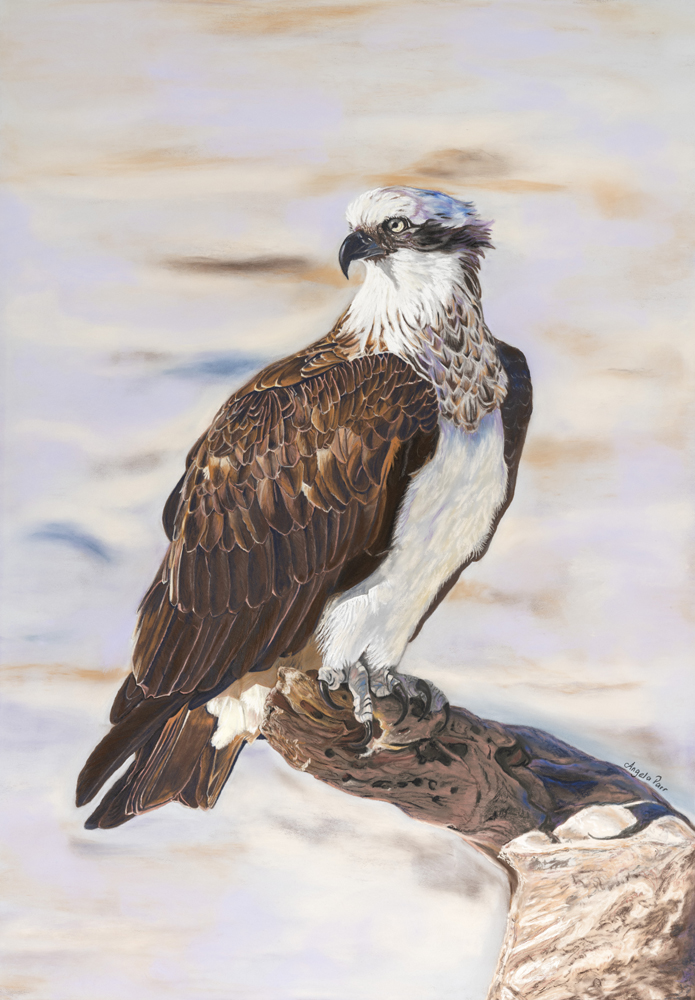
The Observer
Pastel on Pastelmat (Sold)
46 cm W x 66 cm H
The Eastern Osprey (Pandion cristatus) is a familiar sight on the Ballina/Byron coastline, so I was surprised to learn its status is “vulnerable” in NSW. Osprey often return to the same nest, so habitat destruction and disturbance often disrupts nesting. Discarded fishing tackle, contaminated fish, polluted waterways and electrocution from nesting on powerline poles also pose serious threats. Fortunately, our council has erected several Osprey Breeding Platforms and I am accustomed to see them circling the skies, hear them whistle to each other, and in breeding season, see little fluff balls peek over the nest’s edge. They are a majestic bird.Quick View -
Peregrine Falcon
Watercolour on Arches paper ($POA)
49 cm W x 68 cm H
The peregrine falcon (Falco peregrinus) is the world’s most widespread raptor found nearly everywhere on Earth, except extreme polar regions, very high mountains, and most tropical rainforests. The peregrine is renowned for its speed, reaching over 320 km/h during its characteristic hunting stoop (high-speed dive), making it the fastest bird in the world, and the fastest member of the animal kingdom. Although its diet consists almost exclusively of medium-sized birds, the peregrine will sometimes hunt small mammals, small reptiles, or even insects. Reaching sexual maturity at one year, it mates for life and nests in a scrape, normally on cliff edges or, in recent times, on tall human-made structures. Since 1991, a pair of Peregrine Falcons has been observed in a nest on the rooftop of 367 Collins Street. As home to the only known peregrine falcon nesting site within Melbourne’s CBD, the building plays a surprisingly important role to the ongoing breeding success of these rare and fiercely territorial birds. The magnificent specimen in my artwork was recovering from injury in a raptor sanctuary before being released back into the wild.Read more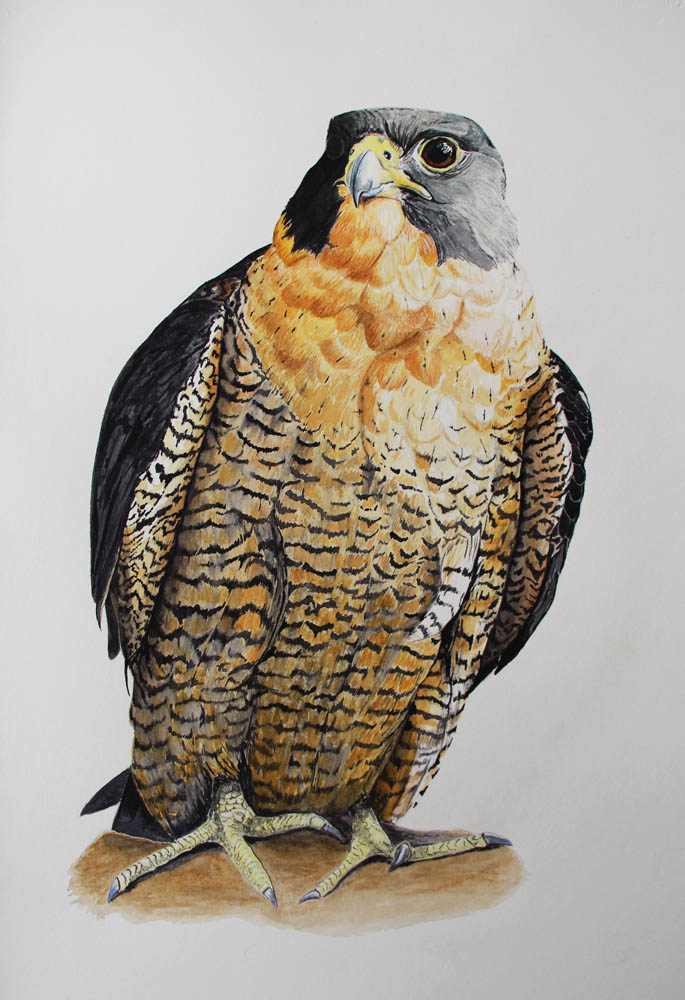
Peregrine Falcon
Watercolour on Arches paper ($POA)
49 cm W x 68 cm H
The peregrine falcon (Falco peregrinus) is the world’s most widespread raptor found nearly everywhere on Earth, except extreme polar regions, very high mountains, and most tropical rainforests. The peregrine is renowned for its speed, reaching over 320 km/h during its characteristic hunting stoop (high-speed dive), making it the fastest bird in the world, and the fastest member of the animal kingdom. Although its diet consists almost exclusively of medium-sized birds, the peregrine will sometimes hunt small mammals, small reptiles, or even insects. Reaching sexual maturity at one year, it mates for life and nests in a scrape, normally on cliff edges or, in recent times, on tall human-made structures. Since 1991, a pair of Peregrine Falcons has been observed in a nest on the rooftop of 367 Collins Street. As home to the only known peregrine falcon nesting site within Melbourne’s CBD, the building plays a surprisingly important role to the ongoing breeding success of these rare and fiercely territorial birds. The magnificent specimen in my artwork was recovering from injury in a raptor sanctuary before being released back into the wild.Quick View -
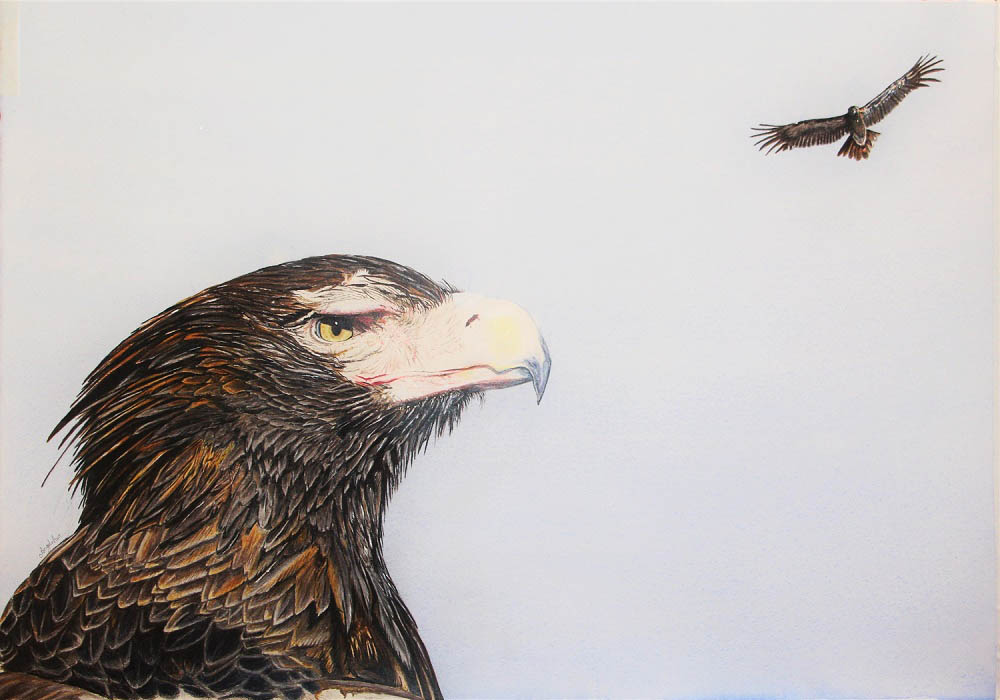
Aquila Audax
Watercolour and coloured pencil on Arches paper ($POA)
76 cm W x 60 cm H
The wedge-tailed eagle (Aquila audax) is the largest bird of prey in Australia, with an impressive wing span of up to 2.84 m and a body length up to 1.06 m. Females weigh between 3-6kg , whilst males are slightly lighter at 2-4kg. Wedge-tailed eagles are highly aerial, soaring for hours on end without wingbeat and seemingly without effort, regularly reaching 1,800 m. Most prey is captured on the ground in gliding attacks. Choice of prey include the introduced rabbit and brown hare, (their diet of choice) foxes and feral cats, native wallabies, small kangaroos, possums, wombats, koalas, and bandicoots. In some areas, birds and reptiles may also be taken. “Wedgies” have also been known to team up to hunt large red kangaroos, to cause goats to fall off steep hillsides and injure themselves, or to drive flocks of sheep or kangaroos to isolate a weaker animal.Read more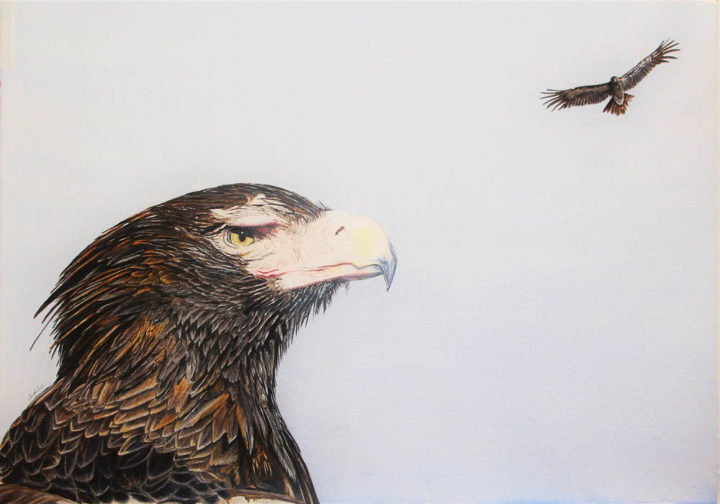
Aquila Audax
Watercolour and coloured pencil on Arches paper ($POA)
76 cm W x 60 cm H
The wedge-tailed eagle (Aquila audax) is the largest bird of prey in Australia, with an impressive wing span of up to 2.84 m and a body length up to 1.06 m. Females weigh between 3-6kg , whilst males are slightly lighter at 2-4kg. Wedge-tailed eagles are highly aerial, soaring for hours on end without wingbeat and seemingly without effort, regularly reaching 1,800 m. Most prey is captured on the ground in gliding attacks. Choice of prey include the introduced rabbit and brown hare, (their diet of choice) foxes and feral cats, native wallabies, small kangaroos, possums, wombats, koalas, and bandicoots. In some areas, birds and reptiles may also be taken. “Wedgies” have also been known to team up to hunt large red kangaroos, to cause goats to fall off steep hillsides and injure themselves, or to drive flocks of sheep or kangaroos to isolate a weaker animal.Quick View -
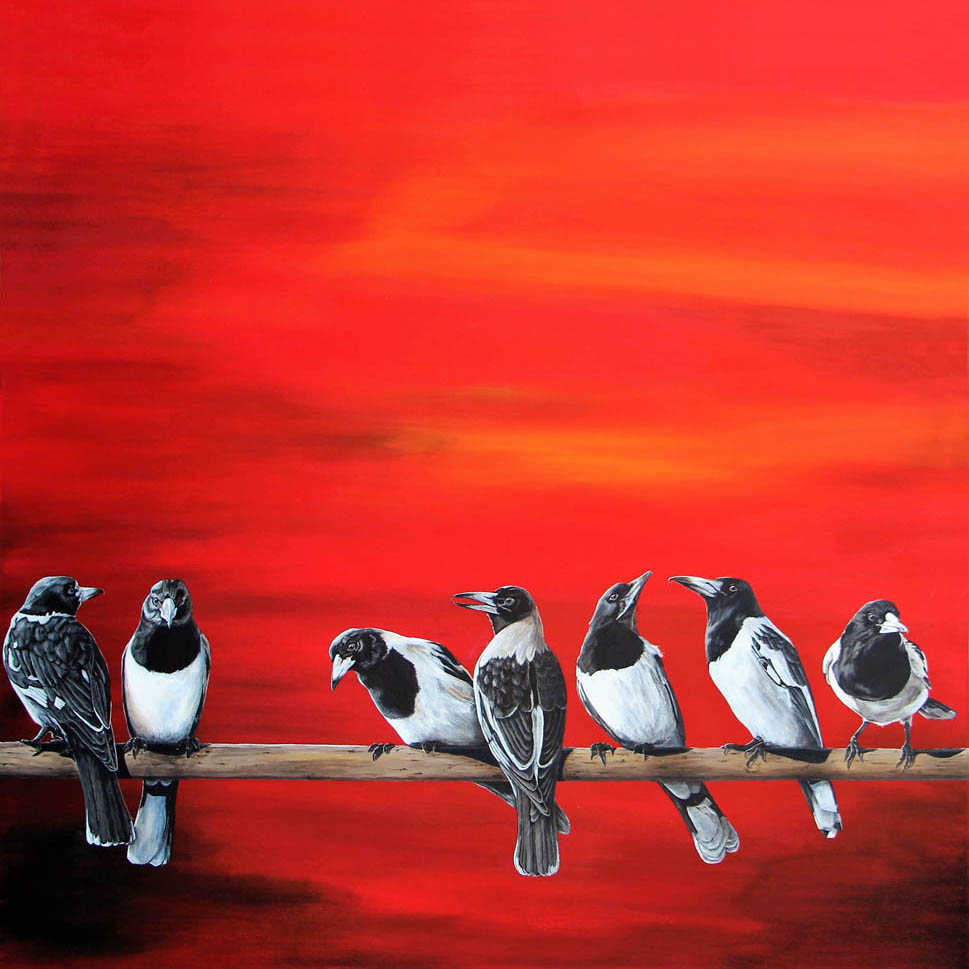
Butchers
Acrylic on canvas (Sold)
122 cm W x 122 cm H
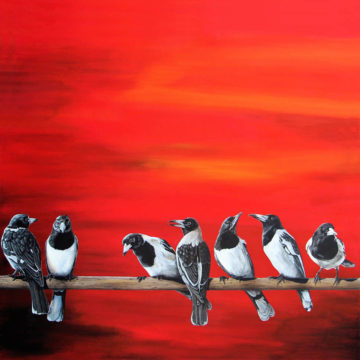
The striking red background in this “Avian Criminal” piece hints strongly at the blood thirsty nature of the pied butcherbird (Cracticus nigrogularis) due to its habit of sometimes storing food items by impaling them on a stick or on barbed wire or shoving them in a nook or crevice. In ironic contrast the pied butcherbird has been considered the most accomplished songbird in Australia, its song described as a “magic flute”. Song melodies vary across the continent and no single song is sung by the whole population. There is no clear demarcation between simple calls and elaborate songs: duets, and even larger choirs, are common. The species improvises extensively in creating new and complex melodies. One of its calls has been likened to the opening bars of Beethoven’s Fifth Symphony. Singing often takes place at dawn, rarely late in the day, but sometimes on moonlit nights.Read more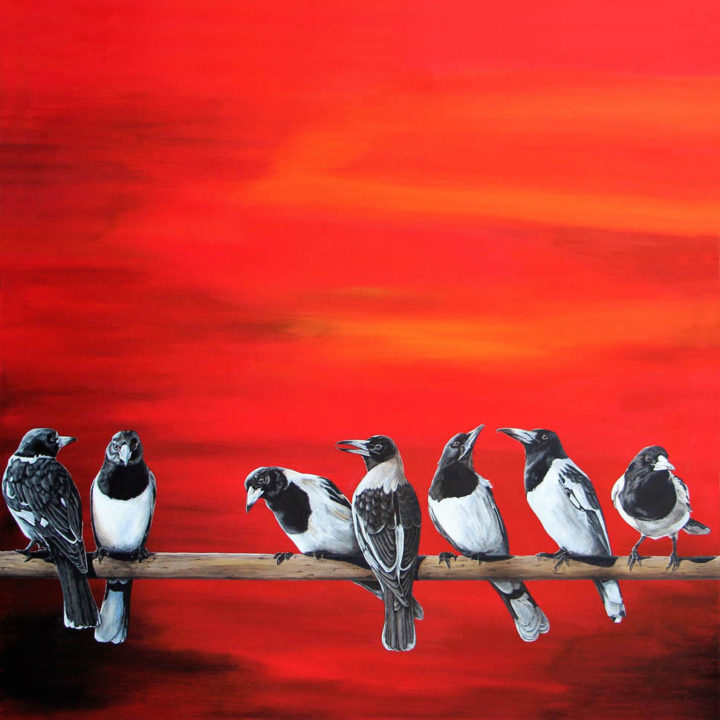
Butchers
Acrylic on canvas (Sold)
122 cm W x 122 cm H
The striking red background in this “Avian Criminal” piece hints strongly at the blood thirsty nature of the pied butcherbird (Cracticus nigrogularis) due to its habit of sometimes storing food items by impaling them on a stick or on barbed wire or shoving them in a nook or crevice. In ironic contrast the pied butcherbird has been considered the most accomplished songbird in Australia, its song described as a “magic flute”. Song melodies vary across the continent and no single song is sung by the whole population. There is no clear demarcation between simple calls and elaborate songs: duets, and even larger choirs, are common. The species improvises extensively in creating new and complex melodies. One of its calls has been likened to the opening bars of Beethoven’s Fifth Symphony. Singing often takes place at dawn, rarely late in the day, but sometimes on moonlit nights.Quick View -
Pukeko
Pastel on Canson paper ($POA)
30 cm W x 36 cm H
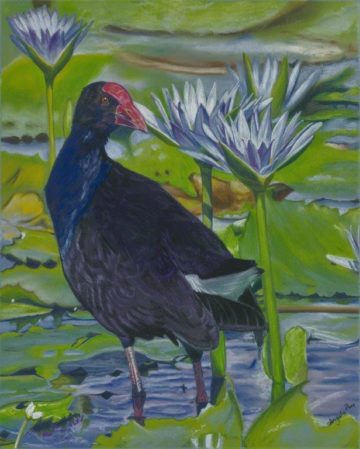
Our dog was a very well behaved cattle dog who as a rule didn’t chase wildlife or birds, but there was something about the “pukeko” which drove her crazy. The Australasian swamphen (Porphyrio melanotus) is a species of swamphen occurring in eastern Indonesia, Papua New Guinea, Australia and New Zealand where it is known as the pukeko. They are a handsome bird of the wetlands, Conspicuous blue and black in colour with a gigantic red bill and forehead shield. They have large feet and white under tail feathers which they flick up and down when walking. They are very vocal, often making loud crowing calls and a range of other shorter squawks, including a single note squawk at night.Read more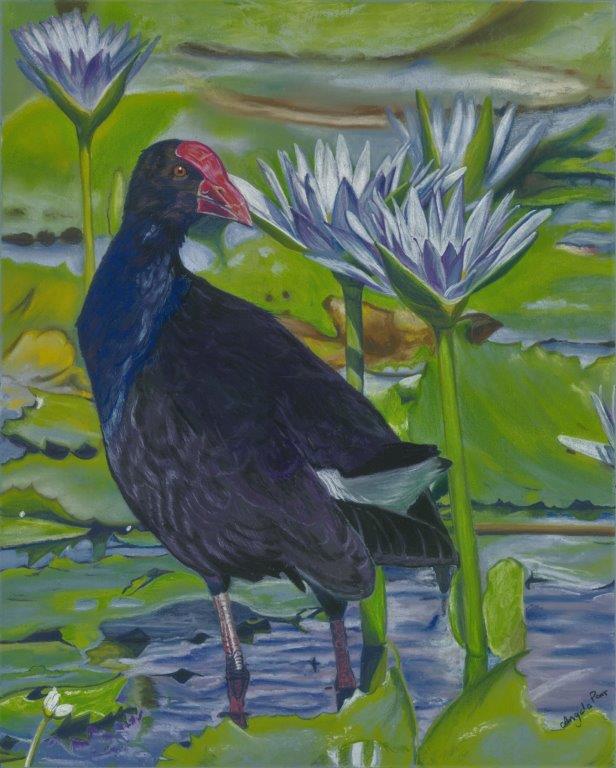
Pukeko
Pastel on Canson paper ($POA)
30 cm W x 36 cm H
Our dog was a very well behaved cattle dog who as a rule didn’t chase wildlife or birds, but there was something about the “pukeko” which drove her crazy. The Australasian swamphen (Porphyrio melanotus) is a species of swamphen occurring in eastern Indonesia, Papua New Guinea, Australia and New Zealand where it is known as the pukeko. They are a handsome bird of the wetlands, Conspicuous blue and black in colour with a gigantic red bill and forehead shield. They have large feet and white under tail feathers which they flick up and down when walking. They are very vocal, often making loud crowing calls and a range of other shorter squawks, including a single note squawk at night.Quick View